Five Fires, Six Triangles, Five Elements—and the Ancient Question of What Makes a Space Sacred
The Sacred Fire Code · Part 4 of 15
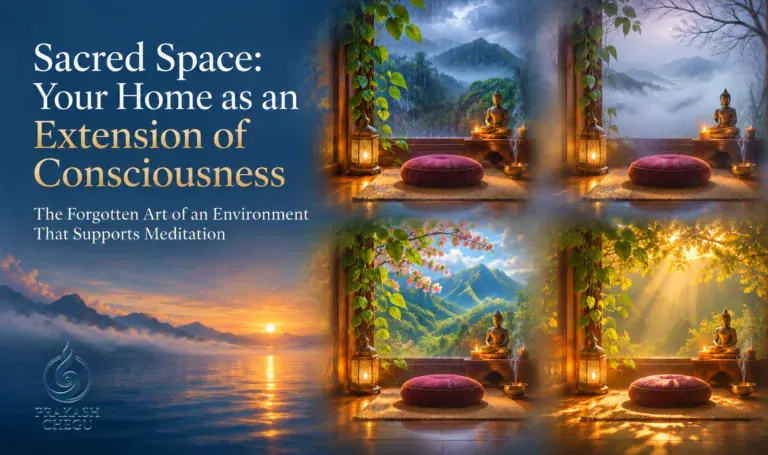
What makes a space sacred?
Is it the architecture?
The materials?
The presence of a deity?
The rituals performed there?
Or something less visible—the quality of awareness we bring into that space?
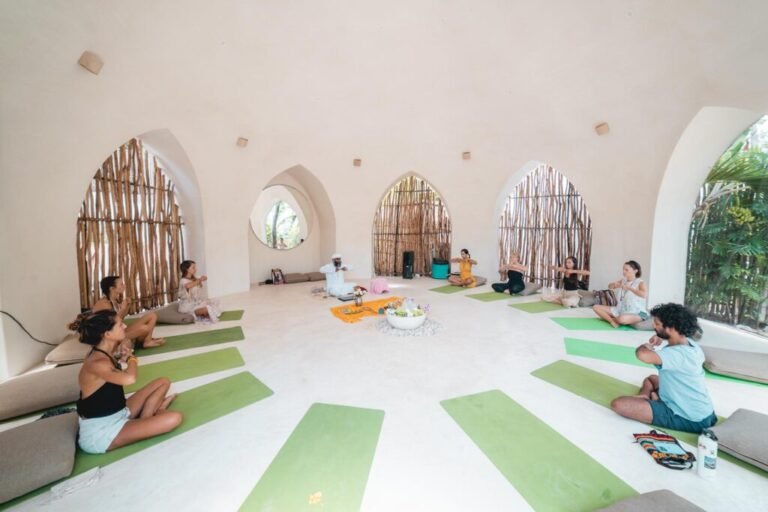
Over the years, I have practiced and taught yoga in many different environments.
Beautiful studios.
Ancient spiritual places.
Modern wellness centers.
Quiet homes.
And places that had nothing particularly impressive about their physical appearance.
One observation has stayed with me.
An elaborate space does not automatically create a profound experience.
And a simple room does not prevent one.
Sometimes a room is beautifully decorated, filled with meaningful symbols, and carefully designed to inspire spirituality. Yet the experience remains superficial.
At other times, the simplest setting becomes deeply conducive to meditation.
This raises an important question.
If consciousness is ultimately cultivated within us, why have spiritual traditions invested so much attention in the preparation of external spaces?
The answer may be found in the relationship between our inner state and the environment in which we practice.
One contemporary teaching that explores this relationship is a home-based Panchagni arrangement described by Sadhguru.
It involves earthy materials, sacred geometry, water, and five lamps.
The arrangement is fascinating.
But to understand its value responsibly, we should first distinguish the practice itself from the larger traditions that share the name Panchagni.
1. What Does Panchagni Mean?
The word Pañcāgni combines pañca, meaning five, and agni, meaning fire.
Five fires.
But the term does not always refer to the same practice.
In classical Hindu sources, we encounter several contexts.
Panchagni Vidya appears in the Chandogya Upanishad and describes a profound cosmological teaching involving five sacrificial fires, the movement of existence, and the conditions of birth and rebirth.
Panchagni Tapas is associated with ascetic disciplines in which a practitioner undertakes austerity in relation to surrounding fires and the heat of the sun.
The household arrangement described by Sadhguru is another application of the language of five fires.
It is a contemporary spiritual instruction involving an elemental and geometric configuration within the home.
These should not be confused.
A household lamp arrangement does not become the same practice as an Upanishadic cosmological contemplation merely because both use the word Panchagni.
Likewise, an accessible domestic ritual should not be confused with physically demanding ascetic austerities.
Understanding these distinctions helps preserve the integrity of each tradition.
2. The Six Triangles: A Geometry of Inner and Outer Space
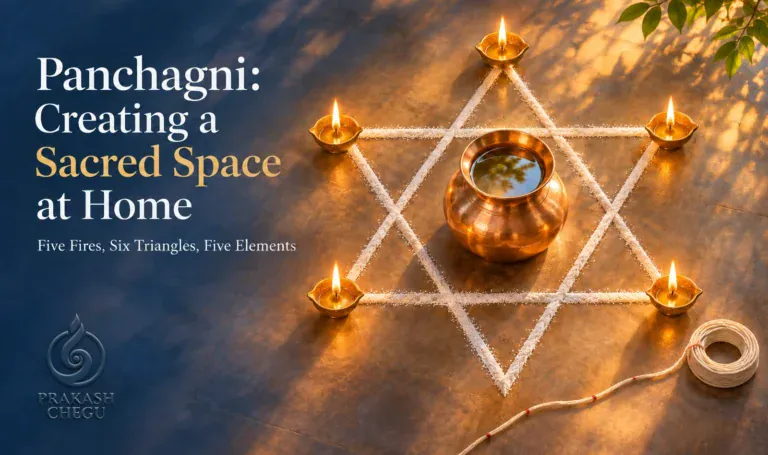
The arrangement described by Sadhguru begins with six triangles.
Four appear in the outer configuration.
Two point upward.
Two point downward.
At the center, another pair of intersecting triangles creates a six-pointed star associated in this teaching with Anahata.
The suggested area may be approximately six feet by six feet or ten feet by ten feet, depending on the room.
The geometry is not described as requiring extraordinary artistic skill.
It is a simple configuration that can be created with natural materials.
Why triangles?
Throughout Indian artistic and Tantric traditions, geometric forms have carried symbolic significance.
The triangle appears in different yantric arrangements and may take on differing meanings according to the tradition.
Upward and downward triangles are sometimes associated with complementary principles, including masculine and feminine, Shiva and Shakti, or other metaphysical relationships.
But the meaning is never established by shape alone.
The textual and ritual context matters.
In the present Panchagni teaching, the six triangles are specifically said to represent six chakras.
This is an important distinction because many readers will immediately think of a seven-chakra diagram.
3. Why Six Chakras Rather Than Seven?
Popular yoga culture frequently presents the chakra system as seven energy centers arranged along the spine and head.
That model is familiar, but it is not the only chakra framework found in Indian traditions.
Different Tantric and yogic texts describe different numbers, names, relationships, and practices.
The six-chakra model has particular importance in several traditions.
The six commonly named centers are:
Muladhara.
Svadhishthana.
Manipura.
Anahata.
Vishuddha.
Ajna.
Sahasrara is then commonly discussed as the crown center or supreme locus beyond the sixfold sequence.
Within Sadhguru’s explanation, the six triangles represent the six chakras because the seventh is not approached as something that can be manipulated in the same way.
This is his interpretation of the practice.
It should not be elevated into a universal rule governing every historical Tantric system.
Nevertheless, the philosophical implication is worth exploring.
There is a difference between deliberately working with the conditions of our experience and trying to manufacture the ultimate nature of consciousness.
We can organize our actions.
We can refine attention.
We can cultivate discipline.
We can work with breath and posture.
But can the deepest reality of consciousness be produced through technique?
Or is technique ultimately a preparation for something that cannot be manufactured?
The question goes far beyond the drawing of triangles.
It touches the very purpose of yoga.
4. Why Use Rice, Grains or Earth?
The instruction specifies natural, earthy materials.
Rice flour.
Whole rice.
Pulses.
Fine red earth.
The triangles may be outlined or filled.
What matters in the teaching is the participation of the earth element.
The symbolism is quite direct.
Earth represents structure, stability, support, and material form.
When we draw sacred geometry using earthy materials, we are intentionally incorporating the physical substance of the world into the ritual.
This is not unique to Panchagni.
Across India, floor designs, mandalas, rangoli, and kolam traditions use different materials and carry a variety of religious, social, aesthetic, and regional meanings.
Some are associated with auspiciousness.
Some with household rhythms.
Some with festivals.
Some with devotional or ritual practice.
The use of grain can also evoke nourishment and abundance.
But we should avoid claiming that every such floor design has the same ancient purpose or energetic effect.
Traditions are diverse.
Their details matter.
For the Panchagni arrangement, natural materials serve a symbolic and ritual function.
If an actual lamp is present, however, dry flour and grains must not be placed where sparks, hot surfaces, or flames could ignite them.
An arrangement can retain its symbolic meaning while being adapted to basic fire safety.
5. The Central Vessel: Water and Copper
At the center of the arrangement, Sadhguru describes a metal plate, preferably copper, containing water.
A lamp is placed in association with this central water vessel.
The image is striking.
Fire and water—two seemingly opposing forces—are deliberately brought into the same ritual arrangement.
From a symbolic perspective, this combination invites reflection.
Fire illuminates and transforms.
Water flows, receives, and sustains.
The human body itself depends upon systems that balance energy production, fluid regulation, temperature, and other biological conditions.
But a ritual arrangement does not reproduce these physiological mechanisms.
We should not confuse symbolism with a literal biological model.
Why Copper?
Copper has a longstanding place in Indian domestic and ritual traditions.
It is used for vessels, implements, and sacred objects.
From a materials perspective, copper conducts heat and electricity efficiently.
It also has antimicrobial properties under particular experimental conditions.
But these facts do not establish that simply placing water in a copper vessel produces an Akashic field or purifies the subtle atmosphere of a room.
Furthermore, copper’s high thermal conductivity is a practical consideration.
A copper plate near a flame can become hot.
Its significance must therefore be considered both symbolically and materially.
The outer arrangement may express profound intentions, but the physical behavior of its components remains governed by ordinary natural laws.
6. The Five Lamps and the Five Elements
The teaching specifies five lamps in association with the configuration.
It also refers to the five elements:
Earth.
Water.
Fire.
Air.
Akasha.
In the arrangement, the earthy materials and water vessel are explicit physical components.
The lamps provide fire.
Air participates in the combustion process.
Akasha appears as a traditional subtle principle associated with the space in which the arrangement exists.
It is important to understand that this is a symbolic elemental configuration.
The five Mahabhutas are not five separate substances that can all be physically measured within the arrangement.
The ritual draws on their philosophical associations.
And the teacher proposes that maintaining this configuration influences the subtle atmosphere of the space.
The original instruction suggests keeping the five flames burning for six to eight hours.
It is said that the area gradually acquires a particular aura and becomes more conducive to meditation.
These are spiritual claims from the teaching.
They have not been established through controlled scientific studies demonstrating the formation of a measurable Akashic field.
Nor is there credible evidence that such an arrangement medically heals sick people, elderly people, or children.
This distinction matters, particularly because the original teaching mentions vulnerable household members.
In a modern home, maintaining five open flames for many hours could create substantial fire and indoor-air-quality risks.
For that reason, I would not recommend prolonged indoor burning as a default household practice.
7. A Safer Way to Explore the Symbolism
If you wish to explore this geometry contemplatively, there is a practical approach that preserves much of the symbolic structure without requiring prolonged combustion.
Choose a clean and spacious area.
Use a fire-resistant or noncombustible base where appropriate.
Create the four outer triangles using a suitable nonflammable visual representation.
In the center, draw two intersecting triangles.
Place a stable vessel containing water in the central area.
Represent the five fires with battery-powered lamps or other flameless lights.
Then sit quietly and contemplate the symbolic relationship among the five elements.
This is an adapted practice, not a reproduction of Sadhguru’s specified fire ritual.
That distinction should be openly acknowledged.
It does not claim to generate the same subtle energetic result.
Its purpose is to create a meaningful setting for meditation while avoiding unnecessary risk.
If a practitioner chooses to use a real diya as part of a separate brief observance, it should be attended continuously, kept clear of combustible objects, and extinguished before leaving the space.
We should never assume that spiritual sincerity makes a physical flame harmless.
8. External Geometry and Internal Experience
There is a beautiful principle hidden within this discussion.
A sacred arrangement creates order.
The objects are intentionally placed.
The geometry has a recognizable structure.
The space is prepared.
The practitioner approaches it with attention.
But the next question is more important.
What happens within the practitioner?
Does the mind become more attentive?
Does the person become more receptive?
Is there a greater willingness to remain still?
Does the ritual lead to greater clarity in ordinary life?
Or does it merely produce fascination with an attractive arrangement?
This is where external sacred geometry meets inner discipline.
In yoga, technique is meaningful when it supports transformation.
A beautiful arrangement may help create an atmosphere.
But an atmosphere is not the same as realization.
The real work begins when we become available to ourselves.
I have often found that the quality of attention brought into a space matters more than its extravagance.
A room becomes associated with meditation when we repeatedly enter it with meditative intention.
The mind begins to recognize the transition.
The body becomes familiar with the sequence.
Distractions can gradually become easier to notice.
This is a practical reason to maintain a dedicated meditation space, even when one does not accept the subtle-energy explanations attached to a particular ritual.
9. Why External Ritual Is Not a Contradiction of Inner Yoga
One of the most interesting parts of Sadhguru’s explanation is his response to the apparent contradiction.
If yoga is about inner transformation, why perform an external ritual?
His answer is that a person established deeply enough within themselves may not require such arrangements.
The external support becomes useful when inner stability has not yet become sufficiently established.
I find this distinction valuable.
A beginner learning music may need a metronome.
An experienced musician may eventually internalize the rhythm.
A student of meditation may benefit from a consistent environment, a structured practice, and a visible symbol.
As awareness matures, some of those supports may become less necessary.
The important thing is not to confuse the support with the destination.
We do not become enlightened because the room contains particular objects.
Nor is there any spiritual superiority in rejecting every external practice.
The wiser question is whether the method genuinely supports our development.
If it does, use it with discrimination.
If it becomes an attachment, examine that attachment.
If it creates fear, dependency, or an exaggerated sense of spiritual accomplishment, reconsider its role.
Ritual should serve awareness.
Awareness should not become enslaved to ritual.
10. A Seven-Day Sacred-Space Experiment
Rather than claiming extraordinary results, I suggest treating the home meditation arrangement as an experiment in attention.
For seven days, choose the same location and practice at approximately the same time.
Keep the arrangement simple and safe.
On the first day, observe the immediate experience of entering the space.
Is the mind restless?
Is the body uncomfortable?
How much attention is drawn toward the appearance of the arrangement?
On the second day, notice the relationship between preparation and practice.
Does cleaning and organizing the space change your willingness to sit?
On the third day, observe your breathing and posture.
Does the environment make it easier to remain with your experience?
On the fourth day, pay attention to sound.
Notice the difference between a quiet environment and an inwardly quiet state.
On the fifth day, explore your relationship with distraction.
When the mind wanders, can you return without frustration?
On the sixth day, remain attentive to your emotional experience.
Do not attempt to force peacefulness.
Allow whatever is present to be recognized.
On the seventh day, reflect on the entire experiment.
Has anything changed?
Perhaps you sit with greater ease.
Perhaps you have established a useful daily rhythm.
Perhaps you have noticed how strongly the environment affects your motivation.
Or perhaps the arrangement has made little difference.
All of these observations are useful.
A genuine experiment does not begin by demanding a particular conclusion.
It begins with curiosity.
11. When the Space Becomes Sacred
What I appreciate most about the Panchagni teaching is not the promise of an invisible aura.
It is the larger invitation to become conscious of our relationship with the spaces we inhabit.
We spend enormous amounts of time designing our homes around comfort, storage, entertainment, and appearance.
These are legitimate concerns.
But how often do we design a place specifically to encourage awareness?
A place where we are not required to produce something.
Where we do not have to entertain ourselves.
Where silence is not considered wasted time.
Where the body can become still and attention can turn inward.
Perhaps one small corner of the home deserves that purpose.
It need not be elaborate.
It need not be expensive.
It need not resemble a temple.
It needs to be sincere.
A sacred space is not necessarily a place where something supernatural occurs.
It can also be a place where we repeatedly choose to meet life with a greater degree of consciousness.
And perhaps that is the beginning of its transformation.
12. The Real Panchagni Is Not Merely Outside Us
The deeper teaching returns us to the relationship between outer and inner fire.
The arrangement uses geometry, material, water, and light.
But the ultimate invitation is inward.
Can the practitioner become more attentive?
More stable?
More compassionate?
Less dominated by compulsive reactions?
More available to the deeper possibilities of being human?
If the external arrangement helps, it has served a meaningful purpose.
But if we become so absorbed in maintaining the arrangement that we forget why we created it, the ritual has lost its direction.
The same is true of yoga postures.
Mantras.
Pranayama.
Meditation techniques.
And spiritual study itself.
The method is not the destination.
It is a means of preparation, refinement, and inquiry.
The purpose of creating sacred space is not to escape ordinary life. It is to cultivate the awareness with which we return to ordinary life.
The real result is not measured by the number of lamps.
Or the perfection of the triangles.
Or how impressive the room appears.
It is measured, if it can be measured at all, by the quality of our participation in life.
How we speak.
How we listen.
How we respond to difficulty.
How we care for others.
How honestly we examine ourselves.
And whether we are gradually becoming less fragmented within our own existence.
That is the sacred space I would like every home to nurture.
Not merely a beautiful corner.
But a place where greater consciousness becomes possible.
Continue Exploring The Sacred Fire Code
Previously: Akasha — The Fifth Element and the Forgotten Dimension of Perception.
Next: Six Chakras, Seven Centers — Why the Crown Cannot Be Manipulated.
Related articles: Bhuta Shuddhi — The Ancient Art of Purifying the Five Elements; Sacred Space — How Your Home Becomes an Extension of Your Consciousness; Panchagni Vidya — The Five Fires of the Upanishads.
Sources and Further Reading
-
Inner Engineering, Perform This Process for Health and Wellbeing, published December 24, 2023. https://innerengineering.sadhguru.org/online/blog/perform-this-process-for-health-and-wellbeing
-
Chandogya Upanishad, chapter 5, sections 3–10 — Panchagni Vidya and the five-fire teaching. https://upanishads.org.in/u/chhandogya
-
Bhagavad Gita 6.11–12 — The preparation of a meditation seat and setting. https://heritage.iitk.ac.in/SBG/6.11
-
Traditional Tantric and Hatha Yoga literature concerning chakras and sacred geometry, to be explored in the following article.
-
National Fire Protection Association — Household candle and open-flame safety. https://www.nfpa.org/education-and-research/home-fire-safety/candles
The symbolic arrangement described here is adapted from a contemporary teaching. The suggested flameless version is a safety-conscious contemplative adaptation, not a claim to reproduce its traditional energetic results.
Series Navigation
Previous: Part 3 · Akasha: The Fifth Element and the Forgotten Dimension of Perception
View the Complete Sacred Fire Code series
Next: Part 5 · Six Chakras, Seven Centers: Why the Crown Cannot Be Manipulated
Frequently Asked Questions
What actually makes a meditation space sacred?
Less the visible setup than the quality of awareness you bring into it. I have taught in beautiful studios and in very plain rooms, and the appearance of the space never reliably predicted the depth of what unfolded. A sacred space is one that consistently supports attention and stillness, and that quality comes from how you enter it and return to it, more than from what fills it.
Do I need an elaborate altar or special objects?
No. Objects and symbolism can support attention, but they do not create depth on their own, and chasing the perfect setup can quietly become another distraction. A clean, simple space you actually use every day will serve you far better than an elaborate one you admire occasionally. Start simple; let consistency do the work.
How do I begin setting one up?
Choose a spot you can return to daily, clear it of clutter and competing uses, and keep it simple, perhaps a mat, a clean surface and a single lamp. Then let the space be defined by the practice you bring to it rather than the things you place in it. Over time the room takes on a quality not because of its contents but because of what you repeatedly do there.