
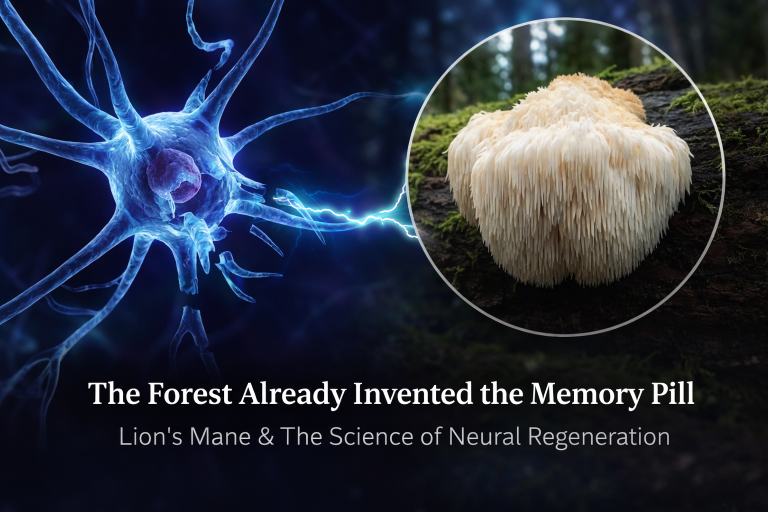
For decades, we were told a story about the brain.
“You’re born with a fixed number of neurons.”
“Kill them with alcohol, stress, or age, and they’re gone forever.”
“The brain doesn’t regenerate.”
It was presented as biological law. Final. Irreversible.
But the story was incomplete.
Today, neuroscience confirms something both humbling and revolutionary:
Your brain is not static.
It is adaptive.
It is plastic.
And under the right conditions — it regenerates.
The Truth About Neuroplasticity & Neurogenesis
The adult brain possesses neuroplasticity — the ability to rewire connections based on experience.
Even more profound, it possesses neurogenesis — the ability to generate new neurons, particularly in areas like the hippocampus (the center of memory and learning).
But here’s the critical nuance:
Neurogenesis does not happen automatically at meaningful levels.
It requires a signal.
That signal is called NGF — Nerve Growth Factor.
NGF is a protein that tells your neurons:
-
Grow.
-
Repair.
-
Strengthen.
-
Myelinate.
-
Connect.
It is, essentially, fertilizer for your nervous system.
There’s just one problem.
NGF is a large protein molecule.
And your brain is protected by one of the most selective security systems in biology:
The Blood–Brain Barrier (BBB).
You can’t simply “take NGF.”
It’s too big to cross.
So how do we stimulate it?
Enter the Fungi Kingdom: Lion’s Mane (Hericium erinaceus)
Long before neuroscience laboratories existed, Buddhist monks consumed a white cascading mushroom to “enhance meditation” and clarity.
That mushroom is Lion’s Mane (Hericium erinaceus).
Unlike most plants or fungi, Lion’s Mane contains two classes of bioactive compounds unique in nature:
-
Hericenones
-
Erinacines
These molecules are small.
Low molecular weight.
Lipophilic enough to cross the blood–brain barrier.
They don’t act like caffeine.
They don’t overstimulate.
They don’t hijack neurotransmitters like amphetamines.
Instead, they do something far more intelligent.
They signal your own brain to increase endogenous NGF production.
Not artificial stimulation.
Biological encouragement.
They don’t “replace” NGF.
They help you produce your own.
What the Research Says
A 2024 review in the International Journal of Molecular Sciences examining the neurotrophic properties of Hericium erinaceus consolidates growing evidence that Lion’s Mane:
🧠 1. Supports Myelin Repair
Myelin is the insulating sheath around neurons.
It determines processing speed.
Think of it like upgrading from dial-up to fiber optic.
Studies suggest Lion’s Mane compounds may assist in myelin regeneration — crucial for cognitive sharpness and neurological resilience.
🧠 2. Improves Mild Cognitive Impairment
A human clinical trial (PubMed ID: PMC6521003) found that older adults with mild cognitive impairment who consumed Lion’s Mane daily showed significant cognitive improvement over 16 weeks.
And notably — regression occurred when supplementation stopped.
This suggests active neurotrophic support was occurring.
🧠 3. Reduces Anxiety & Depression
Chronic stress inflames the hippocampus.
Lion’s Mane appears to reduce neuroinflammation and support hippocampal regeneration, correlating with improvements in mood and anxiety markers.
This is not symptom suppression.
This is root repair.
It’s Not a Hallucinogen
Lion’s Mane doesn’t take you “somewhere else.”
It brings you back.
Back to:
-
Mental clarity
-
Verbal fluency
-
Focus without jitter
-
The cognitive agility you had in your 20s
It feeds your hardware instead of overstimulating your software.
In a world of digital burnout, dopamine addiction, and cognitive fragmentation, Lion’s Mane is less a luxury — and more protective gear.
Why It Matters Now
We live in:
-
Chronic cortisol exposure
-
Blue light disruption
-
Information overload
-
Sleep debt
-
Emotional stress
-
Environmental toxins
All of these reduce NGF levels.
All of these thin myelin.
All of these accelerate cognitive aging.
You can meditate.
You can optimize sleep.
You can exercise.
But giving your brain the biochemical raw materials for regeneration changes the trajectory.
Important: Not All Supplements Are Equal
Here’s where most people get it wrong.
Cheap Lion’s Mane products are often:
-
Mycelium grown on rice
-
Mostly starch filler
-
Low in active compounds
What to look for:
✔ Fruiting Body Extract (the mature mushroom)
✔ Or a Mycelium/Fermented Body blend
✔ Standardized for Erinacines
✔ Dual-extracted (water + alcohol)
Effective Dosage:
1,000 mg – 2,000 mg daily
Morning is ideal (can be added to coffee)
Consistency matters more than intensity.
This is neural agriculture, not a stimulant hit.
The Bigger Picture
The forest did not design Lion’s Mane as a “biohack.”
It evolved as part of a vast intelligence system — and we are only beginning to understand it.
Neuroplasticity is not mystical.
It is biological grace.
Your brain is not a fixed machine.
It is a living ecosystem.
And sometimes the catalyst for repair doesn’t come from a pharmaceutical lab.
It comes from a white cascading fungus growing quietly on a tree trunk.
Final Thought
While the pharmacy searches for the magic pill for memory,
the forest already invented it millennia ago.
Not to overstimulate you.
Not to numb you.
But to help your mind remember how to grow again.
Sources:
International Journal of Molecular Sciences (2024). Neurotrophic properties of Hericium erinaceus.
Clinical study: PubMed ID PMC6521003.