
Most people either blindly fear Holashtak… or casually ignore it.
Both approaches miss the real point.
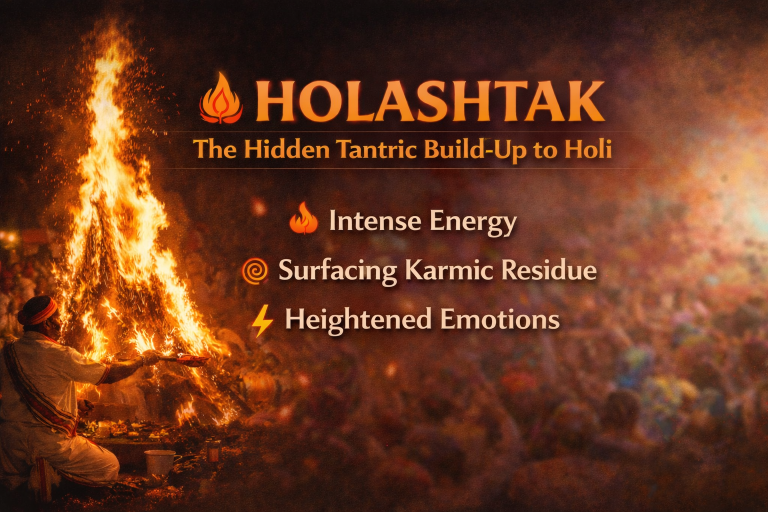
Holashtak is traditionally observed in the 8 days leading up to Holika Dahan, the sacred fire ritual that precedes Holi. Classical muhurta shastra often advises caution during this window for major life events like marriage, griha pravesh, or launching new ventures.
But here’s the deeper truth most surface-level posts never explain:
Holashtak is not inherently unlucky.
It is intense.
And intensity, without awareness, feels like misfortune.
🔥 What Is Actually Happening During Holashtak?
From a traditional lens, Holashtak marks a rise in agni tattva — the fire element — both seasonally and energetically.
Spring in the Vedic calendar is not soft and pastel.
It is catalytic.
It is disruptive.
It shakes stagnation.
From a tantric and psychological perspective, this 8-day window often corresponds to:
-
Heightened emotional reactivity
-
Surfacing karmic patterns
-
Increased internal heat (tapas)
-
Restlessness in relationships
-
Urges to confront, confess, act, or explode
In high-agni windows, whatever you feed gains momentum.
Sattva grows.
Rajas accelerates.
Tamas intensifies.
This is why awareness matters more than fear.
🕯 Why Muhurta Shastra Advises Caution
Classical timing sciences are not superstition — they are pattern recognition.
During volatile energetic phases, stability-based rituals (marriage, housewarming, foundation-laying ceremonies) are traditionally postponed. Not because “something bad will happen,” but because:
-
Emotional steadiness may be compromised
-
Decisions may be reactive rather than rooted
-
The collective field carries agitation
It is about energetic suitability — not doom.
The same reason you wouldn’t plant delicate seeds in a storm.
🌀 The Tantric View Most People Miss
In Tantra, volatile periods are not avoided — they are harnessed.
High-agni windows are powerful for:
-
Tapas (disciplined practice)
-
Karmic purification
-
Breaking addictions
-
Confronting suppressed emotions
-
Fasting or dietary discipline
-
Focused mantra japa
Fire reveals.
Fire purifies.
Fire destabilizes what is weak.
If your inner structure is grounded, Holashtak becomes an accelerator.
If your inner structure is chaotic, Holashtak exposes that chaos.
This is not “bad luck.”
It is magnification.
⚖️ What to Avoid During Holashtak
Not out of fear — but out of wisdom.
-
Impulsive financial decisions
-
Emotional ultimatums
-
Ego-based confrontations
-
Starting commitments out of agitation
-
Overindulging in excess (food, alcohol, drama)
High fire plus high ego equals combustion.
🌿 What Is Perfectly Safe (and Powerful)
For grounded individuals:
✨ Maintain emotional discipline
✨ Continue mantra or prayer
✨ Journal instead of reacting
✨ Practice breath regulation
✨ Simplify diet
✨ Sleep properly
✨ Avoid unnecessary arguments
This period rewards steadiness.
It punishes impulsivity.
🔥 Holashtak as Preparation for Holika Dahan
Holika Dahan is not just a mythological ritual.
It symbolizes the burning of egoic residue, illusion, and destructive tendencies before the colors of Holi erupt.
Holashtak is the psychological build-up.
The rising heat before the release.
The inner friction before the external celebration.
Without the fire, the colors have no meaning.
🧠 Psychological Lens: Why Emotions Intensify
As seasons shift, so does the nervous system.
Longer daylight.
Warmer air.
Changing digestive fire.
Hormonal fluctuations.
When physiology changes, emotional patterns surface.
Tantric sciences encoded this observation spiritually.
Modern psychology explains it biologically.
Different language.
Same phenomenon.
🛡 A Simple Grounding Routine for Holashtak
If you feel heightened during this window:
-
Wake before sunrise.
-
11 minutes of slow nasal breathing (equal inhale-exhale).
-
Chant a stabilizing mantra (even 108 repetitions).
-
Reduce stimulants.
-
Avoid reactive conversations after sunset.
-
Offer a small diya or candle with intention:
“May this fire purify without disturbing my stability.”
Consistency is protection.
Clarity is protection.
Self-awareness is protection.
🚫 The Problem With Fear-Based Narratives
When people call Holashtak “inauspicious,” they create unnecessary anxiety.
Fear itself destabilizes the mind more than the timing ever could.
If you are spiritually grounded, emotionally regulated, and not engaging in reckless behavior, there is no cosmic curse targeting you.
Energy amplifies what already exists.
That’s all.
🔥 Final Truth
Holashtak is not a punishment.
It is a pressure chamber.
If you use it consciously, it becomes a refinement process.
If you resist it, it feels chaotic.
The fire is coming either way.
The question is — are you prepared for it?
📌 Save this for Holashtak reference
🔁 Share with someone who fears this period unnecessarily
💬 Comment “HOLASHTAK” if you want a protection and grounding routine next
Stay steady.
Stay clear.
Stay aware.