
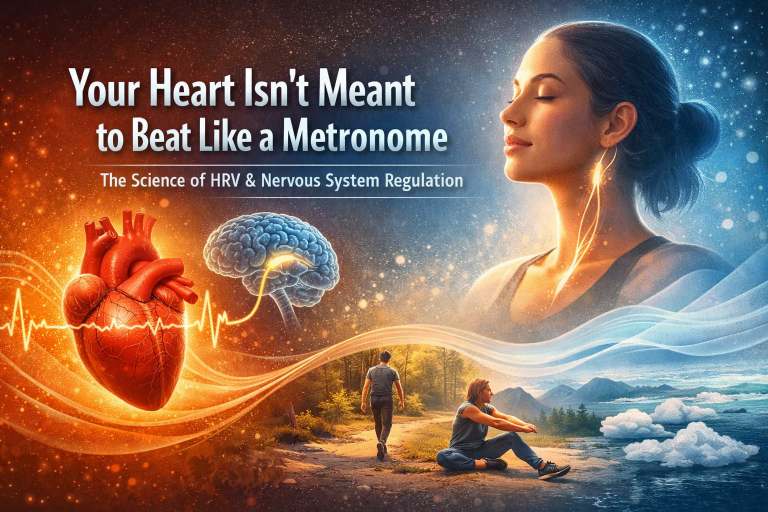
Understanding HRV, the Vagus Nerve & the Physiology of Calm
Your heart is not a machine designed for perfect, robotic timing.
If it were, every beat would land with identical precision — tick, tick, tick — like a metronome.
But a healthy heart doesn’t behave that way.
Between one beat and the next, there are tiny fluctuations. Micro-variations. Subtle pauses. Slight accelerations. These spaces are not errors.
They are intelligence.
They are called Heart Rate Variability (HRV) — and they are one of the most accurate windows into the state of your nervous system.
What HRV Actually Means
Heart Rate Variability does not measure how fast your heart beats.
It measures the variation in time between beats.
For example:
-
Beat 1 → Beat 2: 0.82 seconds
-
Beat 2 → Beat 3: 0.95 seconds
-
Beat 3 → Beat 4: 0.88 seconds
That variability — those changing intervals — reflect how dynamically your nervous system is responding to life.
High HRV = adaptability.
Low HRV = rigidity.
Fluid variability means your system can accelerate when needed and soften when safe.
Flat patterns mean you are stuck.
The Vagus Nerve: The Hidden Conductor
Behind HRV sits the vagus nerve — the primary pathway of the parasympathetic nervous system.


The vagus nerve:
-
Connects brain to heart
-
Regulates breath
-
Influences digestion
-
Modulates inflammation
-
Governs social engagement and emotional tone
When your vagus nerve is active and responsive:
-
Your heart rate rises and falls smoothly
-
Your breath deepens naturally
-
You recover faster from stress
-
You feel emotionally steady
When it is offline or underactive:
-
You stay in overdrive
-
Recovery slows
-
Sleep fragments
-
Emotional reactivity increases
Regulation isn’t a mindset.
It’s a neural state.
When HRV Is Flat or Chaotic
A system stuck in chronic stress often shows:
-
Low HRV (minimal variation)
-
Or erratic, chaotic patterns
This reflects sympathetic dominance — fight-or-flight without completion.
The body becomes vigilant.
Breath becomes shallow.
Heart rhythm stiffens.
Even if your thoughts appear calm, physiology tells the truth.
You cannot think your way into regulation.
You must train it into the body.
Calm Is Not Passive — It Is Trained
Many people confuse calm with weakness.
But true calm is adaptability under pressure.
It is the ability to:
-
Mobilize when necessary
-
Deactivate when safe
-
Transition smoothly between states
That flexibility is built through rhythm.
The Physiology of Regulation
The nervous system speaks in patterns.
So we regulate it with patterns.
1. Slow Breathing
Breathing at approximately 5–6 breaths per minute increases vagal tone and HRV.
Try:
-
4–5 seconds inhale
-
5–6 seconds exhale
-
No strain
Longer exhales stimulate parasympathetic activation.
Breath is the steering wheel of the nervous system.
2. Rhythmic Movement
The brain and heart synchronize through rhythm.
Walking.
Crawling.
Rocking.
Cross-body patterns.
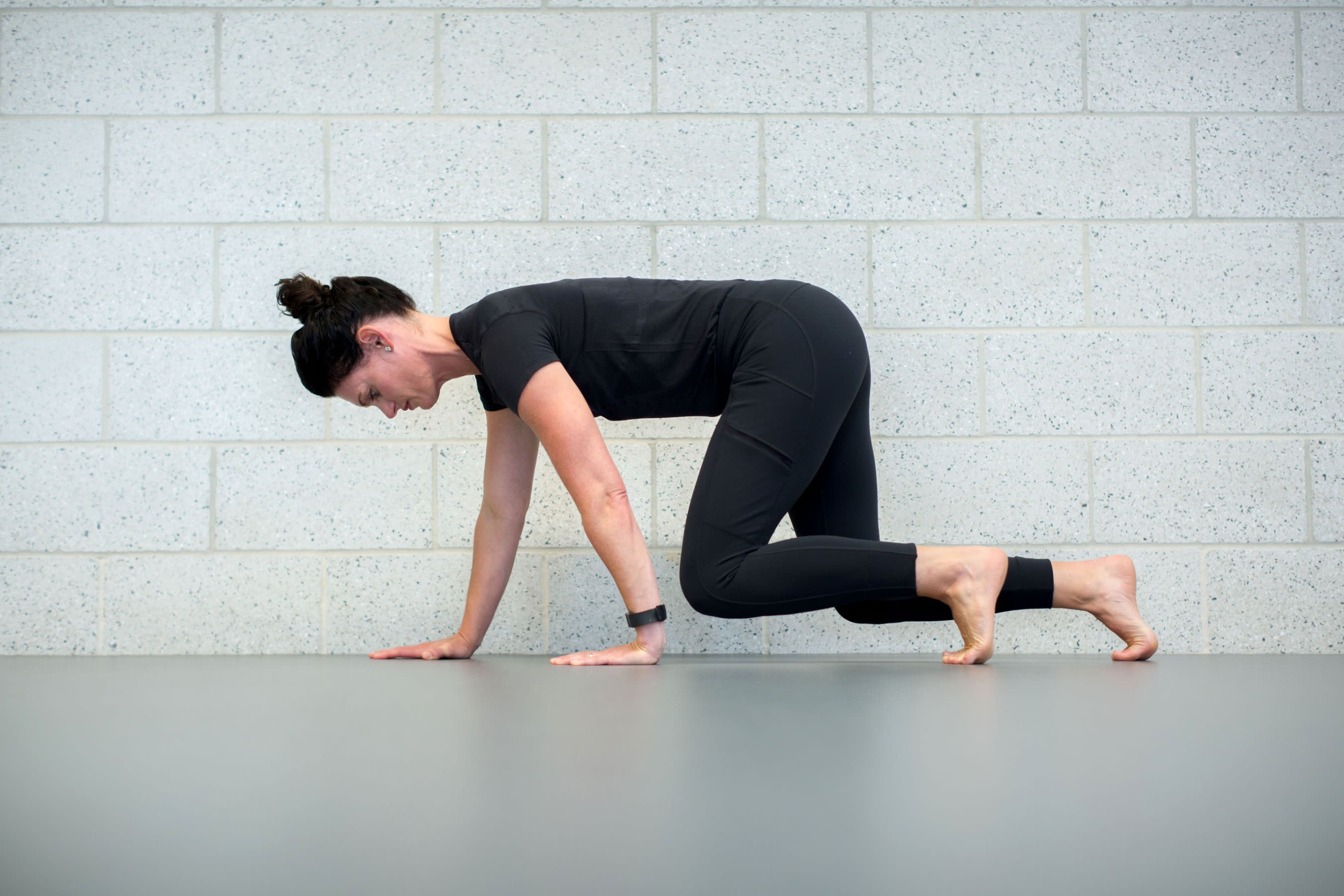

Cross-lateral movement (right arm with left leg) activates hemispheric integration.
Crawling re-patterns primitive motor pathways.
Rocking stimulates vestibular regulation.
Walking entrains bilateral rhythm and breathing.
Rhythm equals safety.
3. Connection
The vagus nerve is social.
Eye contact.
Warm tone of voice.
Safe touch.
These are biological regulators.
Co-regulation precedes self-regulation.
Isolation lowers HRV.
Safe connection raises it.
4. Cold Exposure
Brief cold exposure (when appropriate and safe) can:
-
Increase vagal tone over time
-
Improve stress resilience
-
Train the body to recover from shock
Cold is not punishment.
It is a controlled stressor that teaches recovery.
But dosage matters.
Adaptation, not aggression.
Regulation Is Not Willpower
You cannot “positive think” your HRV higher.
You cannot shame your nervous system into safety.
The body shifts when it feels safe enough.
Safety is created through:
-
Predictable rhythm
-
Breath cadence
-
Movement patterns
-
Consistent habits
-
Trustworthy relationships
Calm is built.
It is practiced.
It is embodied.
The Nervous System Fingerprint
HRV is sometimes called the nervous system’s fingerprint.
No two patterns are identical.
But healthy patterns share one trait:
Flexibility.
Life is unpredictable.
A healthy system bends without breaking.
Rigid systems shatter.
Chaotic systems exhaust.
Regulated systems flow.
From Overdrive to Flow
Chronic sympathetic dominance feels like:
-
Tight jaw
-
Shallow breathing
-
Sleep disruption
-
Irritability
-
Difficulty relaxing even in safe environments
The goal is not sedation.
The goal is capacity.
Capacity to:
-
Handle stress
-
Return to baseline
-
Feel fully without drowning
That capacity is physiological resilience.
Training the Shift
Think of nervous system training like strength training.
You don’t go to the gym once and expect muscle.
You expose the system to manageable stress and allow recovery.
Breath → regulate.
Move → integrate.
Connect → stabilize.
Rest → restore.
Repeat.
Over weeks and months, HRV improves.
Recovery shortens.
Emotional steadiness increases.
You don’t become numb.
You become adaptable.
Calm Is Power
Calm is not submission.
Calm is controlled responsiveness.
It is a nervous system that knows it can handle activation — and return safely.
That return is the key.
Anyone can activate.
Few can downshift.
The ability to shift gears is resilience.
Final Truth
Your heart was never meant to tick perfectly.
Those tiny gaps between beats are proof that you are alive, adaptable, responsive.
Fluid HRV means your vagus nerve is online.
And when your vagus nerve is online:
You are not fragile.
You are flexible.
And flexibility is strength.
Calm is not passive.
It is a trained nervous system built through breath, movement, rhythm, and safe connection.
And like any training — it compounds.
One breath at a time.