
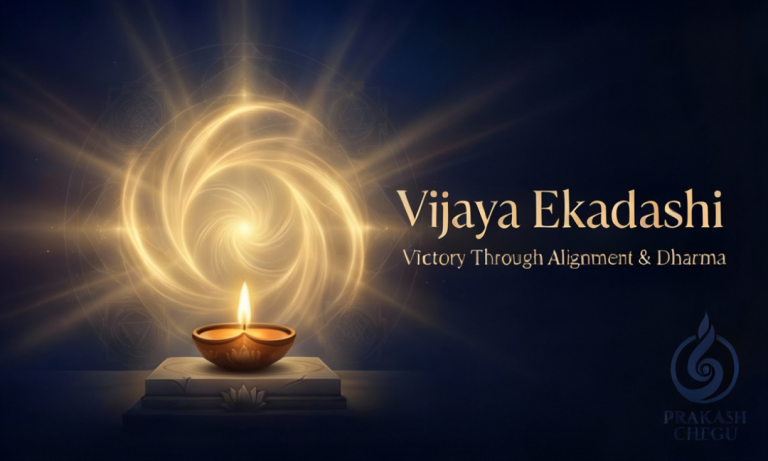
Vijaya Ekadashi is not merely a fasting day—it is a technology of inner victory. Observed during the Krishna Paksha (waning phase) of the lunar month of Phalguna, this Ekadashi is traditionally revered as the vrata that grants vijaya—success that is aligned, ethical, and spiritually sanctioned.
Unlike Ekadashis that emphasize renunciation or purification alone, Vijaya Ekadashi is about overcoming obstacles, dissolving karmic blocks, and restoring one’s alignment with dharma before decisive action is taken.
This is the Ekadashi invoked before battles, journeys, court cases, life transitions, and major undertakings—outer or inner.
The Deeper Meaning of “Vijaya”
The Sanskrit word Vijaya does not simply mean “winning.”
It means:
-
Victory without loss of integrity
-
Success without karmic residue
-
Movement forward without inner fracture
In yogic terms, Vijaya Ekadashi supports:
-
Manas (mind) → clarity
-
Buddhi (discernment) → right decision
-
Icchā Śakti (will) → steady execution
-
Prāṇa → unobstructed flow
This is why it is said that observing Vijaya Ekadashi removes:
-
Fear before action
-
Confusion before commitment
-
Resistance before progress
Scriptural Origin & Symbolism
According to the Padma Purāṇa, Vijaya Ekadashi was revealed to Lord Rāma by Sage Bakadālbhya before his campaign against Rāvaṇa.
At that moment:
-
The odds were not in Rāma’s favor
-
The terrain was foreign
-
The path was uncertain
The sage prescribed Vijaya Ekadashi Vrata so that:
-
Obstacles would dissolve
-
Forces would align
-
The outcome would unfold according to dharma
The teaching is clear:
Victory does not come from force alone—it comes from alignment.
Astrological & Energetic Context
Vijaya Ekadashi occurs during the waning Moon, a phase associated with:
-
Releasing excess mental noise
-
Letting go of fear-based projections
-
Refining intention
Ekadashi itself is ruled by Vishnu Tattva—the principle of cosmic order, sustainment, and intelligent movement.
From a nervous-system and prāṇic perspective:
-
Digestive fire (Agni) is naturally lower
-
Mental clarity increases with fasting
-
Subtle perception is heightened
This makes Vijaya Ekadashi especially powerful for:
-
Decision-making
-
Strategic planning
-
Conscious surrender before action
Who Should Observe Vijaya Ekadashi
This vrata is especially beneficial if you are:
-
At a crossroads in life or relationships
-
Facing legal, financial, or professional challenges
-
Preparing for a journey, relocation, or major transition
-
Experiencing internal conflict, doubt, or hesitation
-
Seeking victory over habitual patterns or inner resistance
Even householders, professionals, and caregivers can observe it—this Ekadashi is not ascetic by nature, but strategic and integrative.
How to Observe Vijaya Ekadashi (Step-by-Step)
1. Preparation (Dashami – The Day Before)
Victory begins before the fast.
-
Eat a simple, sattvic meal before sunset
-
Avoid heavy, oily, or processed foods
-
Reduce stimulants (caffeine, alcohol)
-
Mentally clarify what you are seeking victory over
Set an intention:
“May all obstacles—inner and outer—be removed in alignment with dharma.”
2. The Fast (Ekadashi Day)
Fasting Options (Choose According to Capacity):
-
Nirjala (water-only) – for advanced practitioners
-
Phala Ahara – fruits, nuts, milk
-
Light Sattvic Diet – if health requires (no grains, beans, onion, garlic)
What to avoid:
-
Grains and legumes
-
Excessive sleep during the day
-
Arguments, gossip, mental agitation
The goal is not deprivation—but conservation and redirection of prāṇa.
3. Morning Ritual
-
Wake up during Brahma Muhurta if possible
-
Bathe or wash the face and feet mindfully
-
Sit facing East or North
Chant one or more of the following:
-
Om Namo Nārāyaṇāya
-
Om Vishnave Namah
-
Vishnu Sahasranāma (full or selected verses)
Offer:
-
Water, tulasi leaves, or a simple flower
-
A lamp (ghee or oil)
4. Inner Sādhana for Vijaya Ekadashi
This is where the vrata becomes transformational.
Recommended practices:
-
Japa (108 repetitions minimum)
-
Silent sitting to observe fear or resistance without judgment
-
Journaling prompts:
-
Where am I hesitating despite knowing my truth?
-
What must be released for victory to occur naturally?
-
Am I aligned with dharma in this pursuit?
-
Victory that comes from Ekadashi is not forced—it is revealed.
5. Night Vigil (Optional but Powerful)
If possible:
-
Stay awake past midnight
-
Read sacred texts or sit in quiet contemplation
-
Avoid entertainment or stimulation
This practice sharpens discernment and seals the intention.
6. Breaking the Fast (Dvādaśī Morning)
-
Break the fast after sunrise, within the prescribed time window
-
Begin with water, fruit, or light food
-
Express gratitude before eating
Traditionally, offering food or charity on Dvādaśī multiplies the merit of the vrata.
The Inner Outcome of Vijaya Ekadashi
When observed sincerely, practitioners often report:
-
Clear decisions without mental noise
-
Reduction of fear around action
-
Timely help or “coincidental” support
-
Inner calm even before results appear
This is the signature of Vishnu’s grace:
Things move because they are meant to—without strain.
A Subtle but Important Reminder
Vijaya Ekadashi is not about winning against others.
It is about:
-
Winning over fragmentation
-
Winning over doubt
-
Winning over the parts of us that delay our own alignment
When that victory occurs, outer success becomes almost secondary—yet it arrives anyway.
Closing Reflection
If you are standing at the edge of something important—
a choice, a commitment, a departure, a return—
Vijaya Ekadashi is an invitation to align before you act.
Victory that arises from alignment does not need defense.
It simply unfolds.