How Seed Sounds Encode Consciousness, Energy, and the Hidden Design of Reality
There are sounds that communicate.
There are sounds that persuade.
There are sounds that soothe.
And then there are sounds that build worlds.
In the Vedic and Tantric traditions, sound is not merely symbolic, emotional, or artistic. It is ontological. It belongs to the very structure of existence. Reality itself is understood as vibrational before it becomes material. Before form, there is frequency. Before matter, there is resonance. Before the visible universe, there is shabdha—primordial sound.
Within this vast science of sacred sound, the most concentrated and potent units are known as bija mantras—seed syllables. These are not ordinary words. They are not sentences. They often do not carry conventional meaning in the way modern language does. Yet they are regarded as among the most powerful spiritual technologies ever discovered.
A bija is a seed. And a seed, though small, contains an entire tree in potential.
That is how these mantras are understood: as compressed intelligences, sonic blueprints, vibrational capsules of divine power. To chant a bija is not simply to repeat a syllable. It is to water a latent principle within consciousness until it awakens, organizes, and begins to express itself in one’s life.
Sound Is Not Describing Reality — It Is Generating It
The modern mind is trained to think of language as a tool for labeling things that already exist. In the Vedic view, sound does something far more radical: it brings reality into manifestation.
This insight is personified in the goddess Vāc, divine speech, who is not merely the patron of language but the very power through which the cosmos is articulated. Reality is spoken into existence, not metaphorically, but metaphysically. Sound is formative. It shapes the field from which all things arise.
The word mantra itself comes from the Sanskrit root man—to think, contemplate, or reflect—and the suffix tra, meaning instrument or vehicle. A mantra is therefore an instrument of thought, but not in the narrow psychological sense. It is a tool that organizes consciousness.
Bija mantras are the most concentrated form of that instrumentality.
They are the atomic units of sacred sound.
These syllables are said to be eternal, not invented but revealed. They are not believed to be human creations in the ordinary sense. Rather, they are discovered by sages who perceived the subtle vibrational structure of the cosmos and encoded those perceptions into sound. In this way, bija mantras function as bridges between the individual nervous system and universal intelligence.
The Seed Logic of Tantra
Why “seed”?
Because a seed does not look like the tree it will become. It appears small, simple, even unremarkable. But hidden inside it is pattern, order, intelligence, and destiny.
The same is true of a bija mantra.
A single syllable such as Hrim, Shrim, Klim, or Hum may appear minimal to the uninitiated ear, but within Tantric understanding it contains:
- a deity principle
- an energetic function
- an elemental correspondence
- a psycho-spiritual effect
- a cosmological intelligence
A bija is therefore not a random sound. It is a compressed field.
And just as a biological seed requires water, soil, light, and time, a sonic seed requires:
- repetition
- intention
- attention
- breath
- inner receptivity
When these are present, the bija begins to germinate within consciousness.
The Phonetic Intelligence of Sanskrit
One of the reasons bija mantras hold such importance is that Sanskrit is understood not merely as a cultural language, but as a vibrational science.
Unlike ordinary speech, where words may evolve arbitrarily over time, Sanskrit is traditionally viewed as a language whose sounds are intrinsically linked to specific energetic effects. The placement of the tongue, the quality of the breath, the resonance in the palate, the direction of vibration in the chest, throat, skull, or nasal passages—none of this is accidental.
Every phoneme matters.
This is especially true for bija mantras, where the exact arrangement of consonants, vowels, and terminal resonance determines the mantra’s energetic effect.
In this framework, sound is not symbolic ornamentation. It is functional architecture.
Consonants as Forces
Certain consonants are regarded as carriers of elemental or pranic power:
Ha (ह) is associated with prana, breath, the sun, and space. It opens and expands.
Ra (र) is linked to fire, light, dharma, and transformation. It stimulates and activates.
La (ल) carries the qualities of earth and water. It grounds, softens, and stabilizes.
Sha / Sa (श / स) are often associated with the moon, mind, cooling qualities, and mental refinement.
Va (व) is fluid, connective, and related to flow, often resonating with watery and emotional dimensions.
Vowels as Consciousness Currents
Vowels are not passive additions. In Tantric language mysticism, vowels often represent pure consciousness, the living current of Shakti, the animating power of a mantra.
The vowel I / Ī is especially significant. It is frequently associated with Shakti, the divine feminine force of activation, movement, and manifestation. In many bija mantras, this sound sharpens, energizes, and directs the mantra’s potency.
The Mystery of the Anusvara: Why So Many Bija Mantras End in “ṁ”
Most bija mantras conclude with a nasalized resonance written as ṁ or “m,” known as the anusvara.
This is more than a phonetic ending.
It is the point where articulated sound begins to dissolve back into silence.
If the opening consonant and vowel launch the vibration into the manifest field, the anusvara completes the circuit by returning it toward the unmanifest. It creates a humming resonance that extends beyond the mouth into the skull, subtle body, and higher centers of perception.
This ending is often represented by the bindu, the dot above the syllable—a symbol of concentrated infinity, the point from which all form emerges and into which all form returns.
In practice, this means a bija mantra is not just pronounced. It is allowed to resonate. Its completion lies in the way the sound lingers and fades into silence.
That fading is part of the mantra.
Silence is not the absence of the sound. It is its fulfillment.
Om: The Mother of All Seed Sounds
No exploration of bija mantras can begin anywhere other than Om.
Om is often called the Pranava, the primordial vibration, the mother of all mantras, the sound from which the universe unfolds. It is not simply one mantra among many. It is the foundational matrix from which other mantric structures emerge.
The Upanishadic seers describe Om as encompassing all time—past, present, and future—as well as that which transcends time altogether. It is both sound and the source of sound. Both vibration and the silence beyond vibration.
Phonetically, Om is traditionally understood as A-U-M, followed by silence.
- A corresponds to creation, waking consciousness, emergence, the physical realm
- U corresponds to preservation, dreaming, continuity, subtle experience
- M corresponds to dissolution, deep sleep, withdrawal, return
- Silence corresponds to Turiya, the fourth state beyond all fluctuation
This single mantra contains an entire cosmology.
To chant Om correctly is to move through the arc of existence itself:
birth, continuity, dissolution, transcendence.
This is why Om is often used before other mantras. It clears, aligns, and opens the practitioner to deeper resonance.
The Great Bija Mantras and Their Inner Functions
While Om is universal, other bija mantras operate as specialized currents, each carrying a distinct energetic signature.
Aim — The Seed of Wisdom
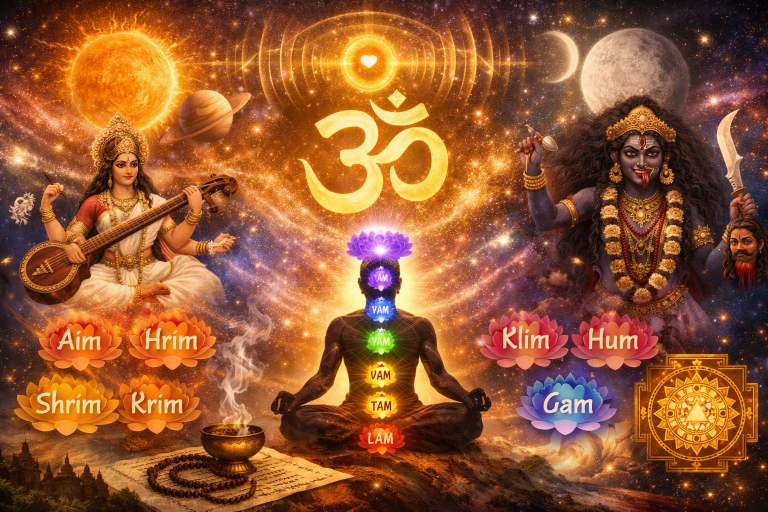
Aim is traditionally associated with Saraswati, goddess of knowledge, language, music, and refined intelligence. This mantra illuminates speech, creativity, and understanding. It is especially connected to the throat center and the power of expression.
To work with Aim is to invoke clarity in thought and beauty in articulation.
Hrim — The Mantra of the Heart’s Power
Hrim is often called the Maya Bija, one of the most profound and mysterious seed sounds in Tantra. It is linked to Bhuvaneshwari, the sovereign power of the manifest universe, and also to the expansive force of the heart.
Hrim transforms. It warms. It reveals. It burns through illusion, but not with violence—with radiance.
This is a mantra of spiritualization through the heart.
Shrim — The Seed of Abundance
Shrim is associated with Lakshmi, the goddess of prosperity, beauty, nourishment, and auspiciousness. It is often used to cultivate abundance, but true abundance here means more than money. It includes vitality, harmony, receptivity, sweetness, grace, and flourishing.
Shrim nourishes the field.
Krim — The Mantra of Fierce Transformation
Krim belongs to Kali, the great force of time, dissolution, and awakened power. It is often considered electrifying. It breaks stagnation, purifies inertia, and activates dormant potential.
This is not a comfort mantra. It is a mantra of movement, confrontation, and combustion.
Klim — The Magnetic Seed
Klim is the bija of attraction, desire, devotion, and relational magnetism. It is associated with Krishna, Kama, and Tripura Sundari in different contexts. Klim draws. It enchants. It harmonizes longing with subtle attraction.
Its deeper function is not seduction, but the alignment of desire with divine beauty.
Hum — The Fire of Protection
Hum is often understood as a protective and fiery bija, associated with Shiva, Chandi, and wrathful deities across Hindu and Buddhist Tantric contexts. It cuts, seals, protects, and destroys negativity.
Hum is armor in sonic form.
Bija Mantras and the Chakras
One of the most familiar applications of seed syllables is in relation to the chakras—the subtle energy centers aligned along the spinal axis.
Each chakra is understood to have an elemental quality, a geometric intelligence, a lotus structure, and a corresponding bija mantra that helps activate and harmonize it.
Root Chakra — LAM
At the base of the spine, connected to earth, grounding, and survival.
Sacral Chakra — VAM
Below the navel, connected to water, sexuality, creativity, and emotional flow.
Solar Plexus — RAM
Above the navel, connected to fire, willpower, metabolism, and confidence.
Heart Chakra — YAM
At the center of the chest, connected to air, love, forgiveness, and relational openness.
Throat Chakra — HAM
At the throat, connected to space, expression, vibration, and truth.
Third Eye — OM
At the brow, connected to intuition, subtle perception, and insight.
Crown — Silence
At the crown, beyond elemental structure, where mantra gives way to direct awareness.
This progression is profound. It suggests that the spiritual journey moves from dense structure to subtle openness, from survival to transcendence, from matter to spirit, and finally from sound to silence.
The Planets Also Respond to Sound
In the science of Jyotish, Vedic astrology, the nine grahas or planetary intelligences are not seen as inert celestial bodies but as living fields of influence. Each planet has mantra formulas and seed syllables through which its energies may be harmonized.
The Sun is strengthened through fiery sounds.
The Moon through soothing lunar patterns.
Mars through energizing and martial vibrations.
Mercury through clarity and articulation.
Jupiter through wisdom and expansion.
Venus through beauty and cohesion.
Saturn through discipline and endurance.
Rahu and Ketu through mantras that stabilize karmic turbulence.
This reflects a larger principle in Vedic thought:
sound is a means of relationship.
Through mantra, one does not merely ask the cosmos for help. One enters into resonance with its intelligence.
The Sanskrit Alphabet as a Garland of Power
An even deeper dimension of bija science lies in the doctrine of Matruka Shakti—the power of the letters themselves.
The Sanskrit alphabet is not merely a phonetic inventory. It is seen as a map of creative consciousness. Each letter is a force, a mother, a vibrational principle. This is why the letters are called matrukas, “little mothers.”
The goddess Kali is often depicted wearing a garland of skulls representing the letters of the Sanskrit alphabet. This iconography is not decorative. It is metaphysical. It signifies that all names, all forms, all mental constructs, all worlds emerge from the primordial matrix of sound—and that the Divine Mother both generates and devours them.
In this way, the entire alphabet becomes a spectrum of bija energies, each carrying the potential to create, stabilize, transform, or dissolve.
Language itself becomes sacred anatomy.
The Mahavidyas and the Spectrum of Wisdom-Power
In the Shakta tradition, the Divine Mother manifests as the Dasha Mahavidyas, the ten great wisdom goddesses. Each reveals a distinct face of truth, and each is accessed through powerful bija mantras.
Kali through Krim.
Tara through Strim or Trim.
Tripura Sundari through Klim.
Bhuvaneshwari through Hrim.
Bagalamukhi through Hleem.
Matangi through Aim.
Kamala through Shrim.
These are not merely names and sounds. They are pathways into specific dimensions of consciousness—time, speech, stillness, beauty, dissolution, courage, void, magnetism, nourishment, and sovereignty.
Each bija functions like a key tuned to a particular doorway of the psyche and cosmos.
More Than Devotion: Bija as Sonic Technology
It is tempting to romanticize bija mantras as mystical poetry from the ancient world. But that would miss their practical sophistication.
These traditions developed an extraordinarily precise understanding of how sound affects body, mind, and subtle energy.
The use of bija mantras is often accompanied by:
- Nyasa, the installation of mantra into different parts of the body
- Mudra, gestures that redirect and seal energy
- Japa, repeated recitation using a mala
- Visualization, to amplify resonance
- Breath coordination, to harmonize prana and sound
- Specific times of practice, especially dawn, when the inner field is more receptive
This is not superstition. It is a refined psychophysical method.
A mantra is not just said.
It is installed.
Embodied.
Circulated.
Sealed.
Absorbed.
The Three Levels of Japa
There are traditionally three major ways to repeat a mantra:
Vachika Japa
Recited aloud. This affects the physical environment and engages the body directly.
Upamsu Japa
Whispered or murmured softly. This is subtler and internalizes the vibration more deeply.
Manasika Japa
Repeated mentally. This is considered the most powerful because it works directly upon the mind and prana without dispersing energy outward.
As the practitioner matures, mantra often moves from gross sound to subtle thought to pure vibration.
Eventually, the mantra begins chanting itself.
What Modern Science Is Beginning to Notice
Although the metaphysical language of bija mantras may seem distant from modern scientific discourse, some points of convergence are beginning to emerge.
Rhythmic chanting has been shown to regulate breathing, improve vagal tone, reduce sympathetic overactivation, and induce parasympathetic states associated with healing and calm. Repetition of resonant sounds affects heart rate variability, attention, mood regulation, and emotional processing.
From an Ayurvedic perspective, bija mantras can be understood as forms of sonic medicine, influencing not only thought patterns but pranic flow and subtle elemental balance.
Science may not yet capture the full metaphysical claims of mantra, but it is increasingly observing what traditional systems long maintained:
sound changes the organism.
And in changing the organism, it changes perception.
In changing perception, it changes action.
In changing action, it changes destiny.
The Real Meaning of a Seed Syllable
A bija mantra is small enough to fit in a single breath.
Yet within it lies a universe.
It carries deity without narrative.
Power without explanation.
Wisdom without argument.
Transformation without ideology.
It does not persuade the intellect first.
It reorganizes the field beneath it.
This is why the sages treated sound with such reverence. They understood that what we repeat, we become. What we resonate with, we internalize. What we chant consistently begins to restructure the architecture of our being.
The bija is a seed.
But the practitioner is also a seed.
And mantra is the meeting point where dormant potential begins to awaken.
Final Reflection
The study of bija mantras reveals something astonishing: that the ancient spiritual traditions of India were not merely philosophical or devotional, but deeply technical. They recognized that consciousness, energy, language, and embodiment are not separate domains. They are interwoven.
A seed syllable is not just a sound.
It is a frequency.
A code.
A deity in compression.
A bridge between matter and spirit.
A technology for inner evolution.
To work with bija mantras sincerely is to enter into a science of resonance.
And perhaps that is what the sages knew all along:
That the universe is not held together by force alone,
but by pattern, vibration, and intelligence—
and that at the heart of that intelligence
is sound.