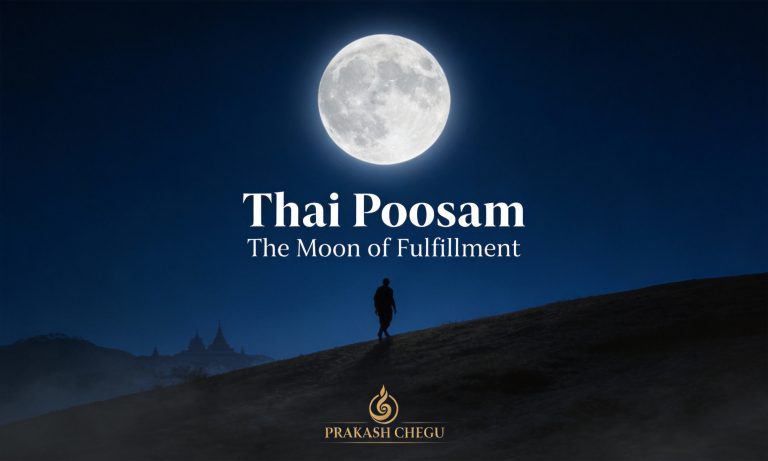
There are Full Moons that illuminate.
There are Full Moons that activate.
And then there is Thai Poosam — the Full Moon that gives back.
Known across South India and the Tamil spiritual world as Thai Pusam or Thaipusam, this Full Moon rises during the lunar month of Thai, when the Moon aligns with the Pushya (Poosam) Nakshatra. In yogic cosmology, Pushya is the star of nourishment, expansion, protection, and earned grace.
This is not a passive blessing Moon.
This is a Moon that responds to sincere effort.
Thai Poosam is remembered outwardly for dramatic acts of devotion — kavadi, barefoot pilgrimages, fasting, vows, offerings carried up steep hills. But beneath the spectacle is a far subtler intelligence:
This Full Moon fulfills what you are willing to carry consciously.
It is called the most generous Full Moon of the year not because it gives freely — but because it gives precisely in proportion to devotion, integrity, and follow-through.
The Moon of Fulfillment — What Does That Really Mean?
Fulfillment is often misunderstood as arrival.
In yogic language, fulfillment means completion through alignment.
Thai Poosam marks a moment when:
-
Intention meets effort
-
Prayer meets action
-
Inner vow meets outer embodiment
This Moon does not ask, “What do you want?”
It asks, “What are you willing to commit to fully?”
And it responds across four planes of life:
1. The Physical Plane — The Body as Offering
Thai Poosam is profoundly somatic.
Devotees traditionally fast, walk long distances, carry weight, sweat, tremble, ache, and endure discomfort — not as punishment, but as purification of excess.
On the physical level, this Full Moon supports:
-
Completing long-delayed health commitments
-
Releasing habits sustained by comfort rather than vitality
-
Building discipline that strengthens the nervous system
-
Restoring trust between body, will, and breath
This is an excellent Moon to:
-
Commit to a daily sādhanā
-
Begin a disciplined physical practice (yoga, breathwork, pilgrimage walking)
-
Offer one physical attachment back to life
Fulfillment here is strength without rigidity.
The body remembers how to carry life again.
2. The Material Plane — Earned Abundance, Not Entitlement
Thai Poosam is deeply misunderstood in modern “manifestation culture.”
This Moon does not reward shortcuts.
Materially, it supports:
-
Clearing karmic debts (financial, ethical, energetic)
-
Stabilizing income through responsibility, not risk
-
Completing projects that were started with sincerity
-
Offering wealth, food, or service back into circulation
This is the Moon where:
-
Giving unlocks receiving
-
Completion unlocks expansion
-
Integrity unlocks protection
If you’ve been:
-
Avoiding a responsibility
-
Delaying a necessary structure
-
Hoping for abundance without commitment
This Moon will gently — and firmly — redirect you.
Fulfillment here feels like relief, not excitement.
The nervous system relaxes because life is back in order.
3. The Spiritual Plane — When Devotion Becomes Real
Thai Poosam is traditionally associated with Lord Murugan — the deity of embodied wisdom, courage, and disciplined devotion. Murugan does not grant favors; he grants clarity through effort.
Spiritually, this Full Moon supports:
-
Re-dedicating oneself to a spiritual path
-
Completing a vow or sādhana that has been wavering
-
Transforming prayer into lived practice
-
Choosing depth over spiritual novelty
This is a Moon for:
-
Renewing your relationship with lineage
-
Committing to a teacher, path, or practice
-
Letting go of spiritual consumerism
Grace flows where sincerity is proven.
Fulfillment here is humility.
The ego softens, and something steadier takes its place.
4. The Relational Plane — Devotion Without Drama
Thai Poosam is not romantic in the modern sense — but it is deeply relational.
In relationships, this Moon asks:
-
Where are you committed — and where are you comfortable?
-
Where do you show up — and where do you withdraw?
-
What vows are you keeping? What vows are you avoiding?
This Full Moon supports:
-
Committing more deeply to a relationship that is aligned
-
Releasing dynamics sustained by obligation or guilt
-
Clarifying roles, responsibilities, and boundaries
-
Choosing devotion over validation
This is not a Moon for chasing affection.
It is a Moon for embodying reliability.
Fulfillment here is trust.
Trust in yourself first — then with another.
The Call to Pilgrimage — Outer Movement, Inner Completion
Thai Poosam has always been a pilgrimage Moon.
Traditionally, devotees walk — sometimes for days — toward temples, hills, sacred sites. The journey itself is the ritual.
You don’t need to travel to South India to answer this call.
Pilgrimage means:
-
Moving toward something sacred with intention
-
Leaving comfort to meet clarity
-
Allowing effort to refine desire
Your pilgrimage may be:
-
A physical journey to a sacred place
-
A 40-day commitment to practice
-
A conscious offering of time, service, or discipline
-
A return to something you once abandoned
The Moon does not require distance — it requires direction.
How to Work with Thai Poosam Intentionally
On the night of the Full Moon:
-
Light a lamp or candle
Not for asking — but for offering. -
Name one commitment
Something you will complete, not start endlessly. -
Offer something tangible
Food, money, time, service — something that costs you a little comfort. -
Walk
Even a silent, intentional walk under the Moon counts. -
Do not rush to interpret
Let fulfillment unfold over the next lunar cycle.
The Deeper Gift of This Moon
Thai Poosam reminds us of something ancient and unfashionable:
Fulfillment is not given.
Fulfillment is earned through alignment.
This is the Moon that restores dignity to effort, holiness to discipline, and grace to completion.
If you answer it sincerely,
it will answer you generously.
Not with fireworks —
but with steadiness, protection, and peace.