Imagine this.
No phone.
No television.
No glowing alarm clock.
No streetlights sneaking through the curtains.
No notifications.
No LED indicators blinking from chargers across the room.
Just darkness.
The kind of darkness your ancestors knew.
The kind of darkness that most modern humans have never experienced.
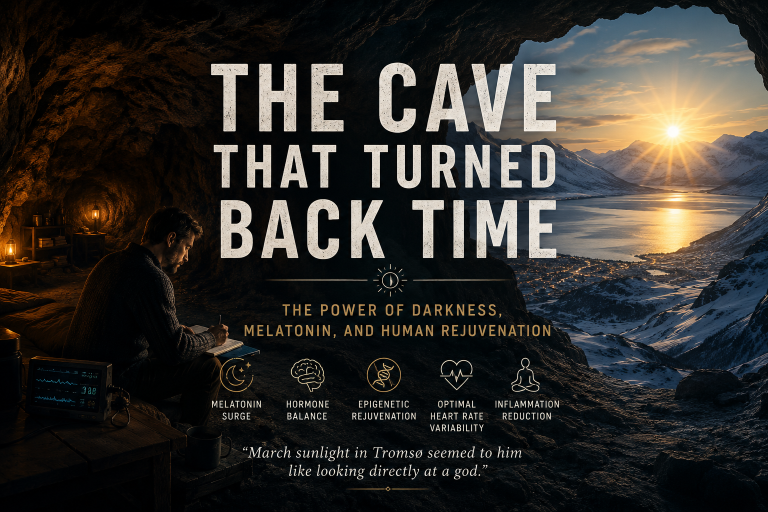
A story has circulated in chronobiology circles about a Norwegian researcher who spent months living inside a cave in northern Norway, removed from sunlight and modern artificial lighting. Whether every detail of the story is perfectly accurate is less important than the question it raises:
What happens to the human body when it is finally given what it evolved with for hundreds of thousands of years—true darkness?
The answer may be far more profound than most people realize.
We Are Living in an Evolutionary Mismatch
Human biology was not designed for illuminated nights.
For almost all of human history, the setting sun marked the beginning of darkness. Firelight, moonlight, and starlight were the only sources of illumination.
The body evolved around this rhythm.
As daylight faded, melatonin rose.
As darkness deepened, repair mechanisms activated.
Growth hormone surged.
Cells cleaned themselves.
DNA damage was repaired.
The immune system recalibrated.
The brain washed away metabolic waste.
The nervous system entered restoration mode.
Night was not simply a period of unconsciousness.
Night was when the body rebuilt itself.
Today, however, darkness rarely exists.
We sit under bright indoor lighting.
We watch television.
We scroll social media.
We answer emails.
We expose our eyes to wavelengths of light that did not exist during most of human evolution.
And then we wonder why we feel exhausted.
Melatonin Is Not a Sleep Hormone
Most people think melatonin is merely the hormone that helps us fall asleep.
That is only a small part of the story.
Melatonin is one of the most powerful molecules the human body produces.
It functions as:
- An antioxidant
- A mitochondrial protector
- An immune regulator
- A circadian signal
- A cellular repair coordinator
Researchers have discovered melatonin receptors throughout the body—not just in the brain.
Every organ appears to listen for the signal of darkness.
When melatonin rises appropriately, the body receives a message:
“It is safe to repair.”
When melatonin is suppressed, the body receives a different message:
“Stay alert. Stay vigilant. Delay restoration.”
The modern world has become exceptionally good at sending the second message.
Darkness Is Information
Most people think light is information.
Chronobiology teaches us that darkness is information too.
The body does not merely need daylight.
It needs contrast.
Bright days.
Dark nights.
The greater the contrast, the stronger the circadian signal.
This is why spending all day indoors and all evening under artificial lighting creates confusion for the nervous system.
The body can no longer distinguish day from night.
The circadian orchestra begins to lose synchronization.
Sleep quality declines.
Hormonal rhythms flatten.
Energy becomes inconsistent.
Recovery slows.
Inflammation increases.
We often search for supplements when what we are missing is darkness.
The Forgotten Medicine
What if one of the most powerful anti-aging interventions is free?
What if it has no side effects?
What if it requires no prescription?
What if it has been available since the beginning of humanity?
Darkness.
Not partial darkness.
Not darkness interrupted by Instagram.
Not darkness interrupted by checking messages.
Not darkness with the television glowing in the background.
Real darkness.
Deep darkness.
Complete darkness.
The kind that allows the body to remember what night actually is.
Many people spend thousands of dollars searching for longevity protocols while sleeping beside a glowing phone.
The irony is difficult to ignore.
The Yogic Perspective
The yogic tradition understood this long before laboratories existed.
The hours before midnight have always been considered especially important.
The ancient yogis observed that the quality of rest obtained before midnight is profoundly different from the quality of rest obtained after midnight.
They understood that there are windows of restoration governed by subtle rhythms of nature.
When we align with those rhythms, healing accelerates.
When we resist them, vitality slowly declines.
Yogic teachings also describe darkness not merely as the absence of light but as a field of regeneration.
Within darkness, sensory input decreases.
Mental activity softens.
Prana reorganizes itself.
The nervous system releases unnecessary vigilance.
The body begins to return to coherence.
A Practical Experiment
You do not need six months in a cave.
You do not need to move to northern Norway.
Try this for thirty days:
- No screens 90 minutes before bed
- Dim lights after sunset
- Blackout curtains
- Cover all LEDs in the bedroom
- Remove phones from the sleeping space
- Sleep before 10:30 PM whenever possible
- Get sunlight in your eyes within 30 minutes of waking
Then observe.
Not just your sleep.
Observe:
- Mood
- Energy
- Digestion
- Recovery
- Cravings
- Focus
- Emotional stability
- Meditation depth
Many people discover that what they thought was aging was actually exhaustion.
What they thought was stress was circadian disruption.
What they thought required another supplement simply required darkness.
The Question We Must Ask
The modern world is obsessed with optimizing daylight performance.
But perhaps the real secret lies elsewhere.
Perhaps the greatest performance enhancer is not another productivity tool.
Perhaps the greatest longevity strategy is not another biohacking device.
Perhaps the most neglected medicine on Earth is the night itself.
So before asking how many hours you sleep, ask a deeper question:
How many hours of true darkness do your nights contain?
Because your body may not be suffering from a lack of sleep.
It may be suffering from a lack of night.