
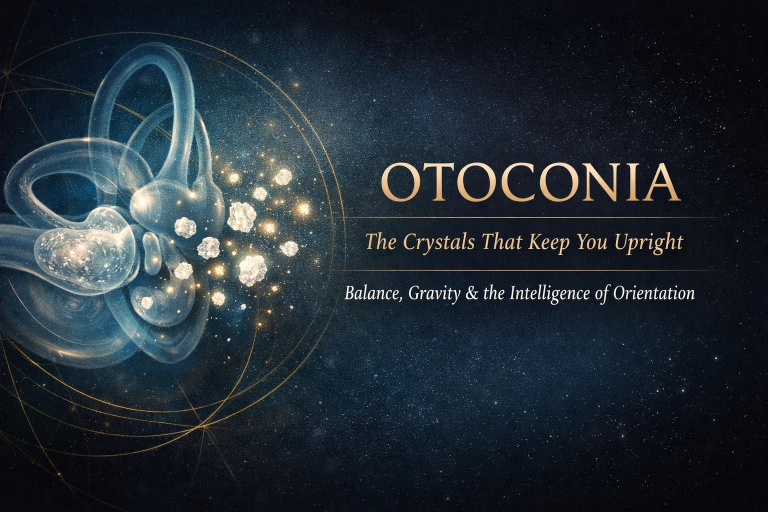
There are microscopic crystals inside your head that determine whether you feel stable… or like the world is spinning out of control.
They are called otoconia.
Most people have never heard of them—until something goes wrong.
And when they do go wrong, it feels like reality itself has tilted.
But what if we understood them not just medically… but energetically?
Not just as calcium carbonate particles… but as biological gyroscopes that help you stay upright in both body and being?
Let’s go deep.
What Are Otoconia?


Otoconia are tiny crystals made of calcium carbonate located in the utricle and saccule of your inner ear.
They sit on a gelatinous membrane within the vestibular system—the part of your inner ear responsible for:
-
Balance
-
Linear acceleration
-
Head position relative to gravity
These crystals are incredibly small. But they are heavy enough (relative to surrounding fluid) to respond to gravitational pull.
When you tilt your head, move forward, or accelerate, the otoconia shift slightly.
This movement bends microscopic hair cells beneath them.
Those hair cells send signals to your brain.
Your brain then says:
“Ah. We are upright.”
“We are turning.”
“We are leaning.”
“We are safe.”
Without otoconia, you would not know where “up” is.
Pause and feel that.
When the Crystals Move: Vertigo & BPPV


Sometimes these crystals dislodge.
Instead of resting in the utricle, they migrate into the semicircular canals—fluid-filled structures that detect rotational movement.
When that happens, the brain receives false signals.
You move your head slightly… and suddenly:
-
The room spins
-
You feel nauseous
-
Your eyes flicker uncontrollably (nystagmus)
-
You feel disoriented
This condition is called Benign Paroxysmal Positional Vertigo (BPPV).
“Benign” because it’s not life-threatening.
“Paroxysmal” because it comes in sudden bursts.
“Positional” because it’s triggered by head position.
But when you’re in it?
It does not feel benign.
It feels like gravity has betrayed you.
The Science Behind the Spin
When otoconia enter the semicircular canals, they interfere with the natural flow of endolymph (inner ear fluid).
This fluid is supposed to move only when your head rotates.
But the misplaced crystals continue shifting after you stop moving.
Your brain gets two conflicting messages:
-
Eyes say: “We are still.”
-
Inner ear says: “We are spinning.”
The brain chooses confusion.
Vertigo is not just dizziness.
It is a sensory disagreement.
Why Do Otoconia Dislodge?
Common triggers include:
-
Head trauma
-
Aging (natural degeneration of otoconial matrix)
-
Vitamin D deficiency
-
Inflammation
-
Prolonged bed rest
-
Vestibular infections
There is also emerging research suggesting metabolic and hormonal shifts may influence stability.
From a systems perspective, otoconia are sensitive to:
-
Calcium regulation
-
Bone metabolism
-
Inner ear fluid balance
-
Neuroinflammation
In Ayurveda, this would map closely to Vata imbalance—movement disturbance.
In yogic physiology, it resembles unregulated pranic flow in the head region.
The Epley Maneuver: Returning the Crystals Home

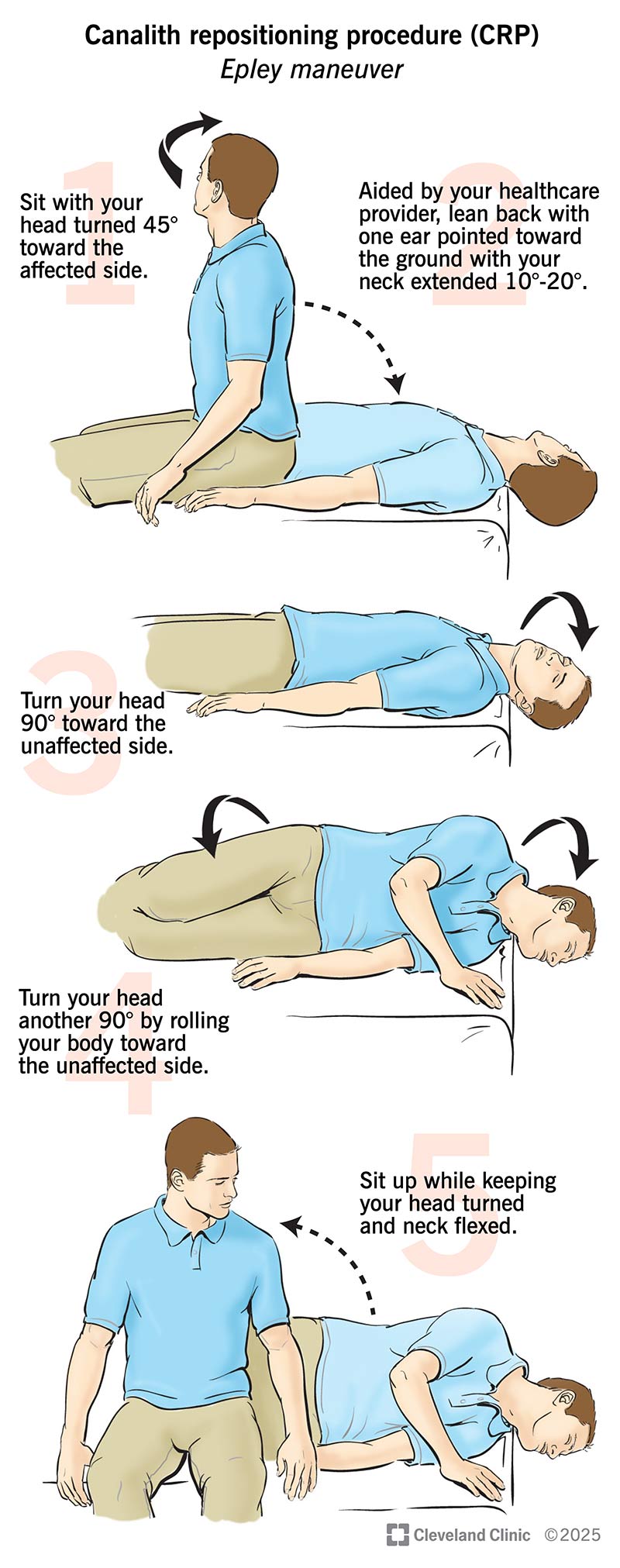

The primary treatment for BPPV is mechanical—not pharmaceutical.
The Epley maneuver is a sequence of head positions designed to guide the crystals back into the utricle where they belong.
It works because gravity works.
You are literally rolling the crystals home.
There is something profoundly poetic about that.
Your body contains its own disorientation.
And also the map back to stability.
Otoconia & the Metaphor of Orientation
Let’s go deeper.
Otoconia determine whether you feel upright.
But what determines whether you feel internally upright?
In yogic language:
-
Your spine is your axis.
-
Your breath is your stabilizer.
-
Your inner ear is your gravitational interpreter.
When the crystals shift, you lose orientation.
When your values shift without integration, you lose orientation.
When your nervous system is overloaded, you lose orientation.
Vertigo is not just physical.
It can mirror emotional or existential destabilization.
-
Sudden loss
-
Shock
-
Grief
-
Overstimulation
-
Anger stored in the jaw and upper cervical spine
The vestibular system is deeply connected to the brainstem and autonomic regulation.
So when someone experiences vertigo, we must ask:
Is the system overwhelmed?
Is there inflammation?
Is there mineral depletion?
Is there unresolved tension in the upper spine?
Supporting Otoconia Health
Let’s approach this intelligently.
1. Optimize Calcium Metabolism
-
Vitamin D3 (check serum levels)
-
Magnesium
-
Vitamin K2
-
Weight-bearing movement
Otoconia are calcium crystals.
Mineral balance matters.
2. Regulate Inflammation
-
Omega-3 fatty acids
-
Turmeric
-
Adequate sleep
-
Blood sugar regulation
3. Support Vestibular Integration
-
Gentle head movements
-
Balance training
-
Walking on uneven surfaces
-
Eyes-closed balance drills
4. Nervous System Stability
-
Long exhale breathing
-
Nadi Shodhana
-
Slow spinal flex
-
Gentle cervical alignment work
If the inner gyroscope is unstable, calm the system.
A Yogic Reflection
In Kundalini physiology, the inner ear corresponds loosely to the Agnya–brainstem axis—your command center for orientation.
When breath becomes erratic, the head destabilizes.
When prana becomes scattered, grounding disappears.
Practices that help:
-
Long Deep Breathing
-
Sat Kriya (grounding through navel)
-
Shambhavi Mudra (stabilizes gaze)
-
Slow spinal rolls
Your otoconia respond to gravity.
Your consciousness responds to alignment.
The Subtle Teaching of Otoconia
These microscopic crystals remind us:
You do not stay upright because you are strong.
You stay upright because you are calibrated.
Balance is not muscular.
It is neurological.
It is mineral.
It is relational.
When the smallest particles shift, your whole perception changes.
That is true in the body.
That is true in life.
Final Integration
If you or your student experiences vertigo:
-
Rule out serious causes.
-
Assess for BPPV.
-
Perform the Epley maneuver properly.
-
Evaluate vitamin D and mineral status.
-
Address cervical tension.
-
Regulate the nervous system.
And perhaps most importantly—
Ask where orientation has been disturbed.
Because sometimes the crystals fall when life tilts too fast.
And sometimes the work is not just returning them home…
But recalibrating how you stand in gravity.