There is a silent distortion that has crept into modern relationships.
A belief so normalized that people rarely question it:
“Till death do us part.”
It sounds poetic.
It sounds romantic.
But beneath the surface…
It has quietly romanticized suffering.
The Problem With “Till Death”
The idea suggests permanence—no matter what.
No matter the betrayal.
No matter the violence.
No matter the decay of truth, respect, or alignment.
And that is where it becomes dangerous.
Because permanence without discernment becomes bondage.
Not love.
Not devotion.
Not sacred union.
Bondage.
Sanatan Dharma Never Supported Blind Endurance
In the Dharmic framework, marriage was never designed as a prison.
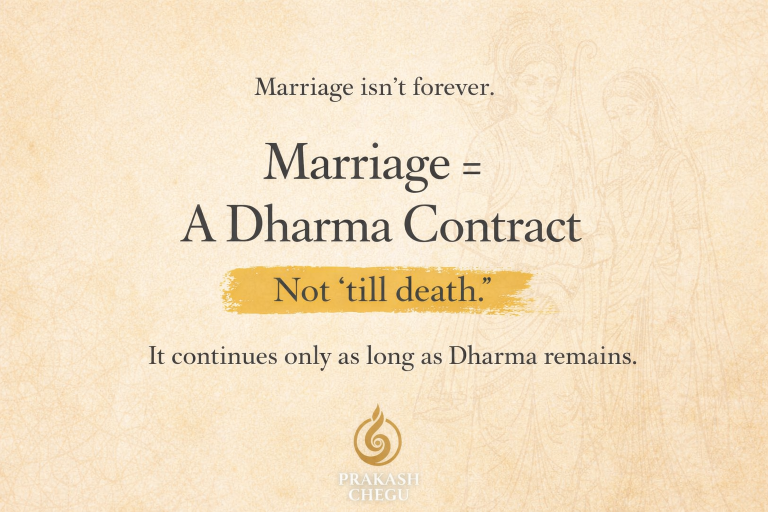
It was designed as a contract of purpose.
A Dharma Contract.
Not a vow of endless emotional attachment,
but a commitment to shared alignment with truth, growth, and responsibility.
What Marriage Actually Is (In the Vedic Lens)
Marriage in Sanatan Dharma is rooted in one core idea:
Sahadharmacharini — A Partner in Dharma
Not just a lover.
Not just a companion.
A co-traveler in purpose.
Which means:
- The relationship exists to fulfill Dharma
- Not to preserve comfort
- Not to maintain appearances
- Not to avoid social shame
The Grihastha (Householder) Framework
Marriage sits within the Grihastha Ashrama—the householder phase of life.
And it has clear functional purposes:
1. Praja (Progeny with Values)
Not just having children,
but raising them with integrity, culture, and consciousness.
2. Dharmic Growth
Mutual evolution.
Spiritual, emotional, and ethical expansion together.
3. Loka Sangraha
Contribution to society.
Stability, order, and collective wellbeing.
And here is the part most people ignore:
When these purposes fail, the marriage has failed its Dharma.
And when Dharma fails…
The contract dissolves.
This Is Where Modern Confusion Begins
Modern narratives say:
“Divorce = Failure”
But Dharma says something very different:
Enduring Adharma is the real failure.
The Fundamental Difference
Western Model
Love → Marriage → Forever
(Regardless of alignment)
Dharmic Model
Dharma → Marriage → Continuation only if Dharma remains
This is not cold.
This is not cynical.
This is radically honest.
Scriptural Logic for Ending a Marriage
Dharmic systems were not naive.
They understood human complexity.
They allowed dissolution under clear conditions:
1. Abuse or Violence
Violation of Maryada (boundaries)
2. Adultery
Violation of Satya (truth and commitment)
3. Abandonment
Failure of Kartavya (duty)
4. Adharma
Living in ways that oppose righteousness
In simple terms:
Contract breach = Contract ends
Not as punishment.
Not as rebellion.
But as restoration of Dharma.
Dharma Protects Those Who Protect It
There is a well-known principle:
“Dharmo Rakshati Rakshitah”
Dharma protects those who protect it.
This is not a poetic line.
It is a structural law of life.
If a relationship becomes:
- Toxic
- Abusive
- Dishonest
- Spiritually regressive
Then preserving it in the name of “love”…
Is not virtue.
It is complicity with Adharma.
Why This Feels Uncomfortable
Because we have been conditioned to believe:
- Endurance = strength
- Sacrifice = virtue
- Staying = success
But Dharma asks a deeper question:
Is what you are preserving aligned with truth?
Love vs Dharma
Love alone is not enough.
Love can be:
- Blind
- Attached
- Fear-based
- Trauma-bonded
Dharma brings:
- Clarity
- Structure
- Boundaries
- Direction
Dharma does not reject love.
It refines it.
No Bondage in the Name of Love
A relationship that:
- Restricts your growth
- Violates your dignity
- Breaks your inner alignment
Is not sacred.
No matter how long it lasts.
Real union is not about staying forever.
It is about:
Walking together as long as truth is honored.
The Higher Standard of Relationships
Sanatan Dharma does not aim for:
- Emotional dependency
- Endless attachment
- Social validation
It aims for:
- Conscious partnership
- Shared purpose
- Aligned evolution
What We Need to Reclaim
We need to shift from:
Romantic Idealism → Dharmic Clarity
From:
“Stay no matter what” → “Stay as long as it is true”
Final Truth
Marriage was never meant to be a cage.
It was meant to be a path.
A path of:
- Responsibility
- Growth
- Alignment
- Contribution
And when that path is no longer walked together…
Ending it is not failure.
Ending it can be Dharma.
Closing Reflection
Ask yourself honestly:
- Is this relationship aligned with truth?
- Is it supporting growth—or suppressing it?
- Is Dharma alive here—or has it been abandoned?
Because at the end of the day:
Sanatan Dharma does not prioritize romance.
It prioritizes righteousness.