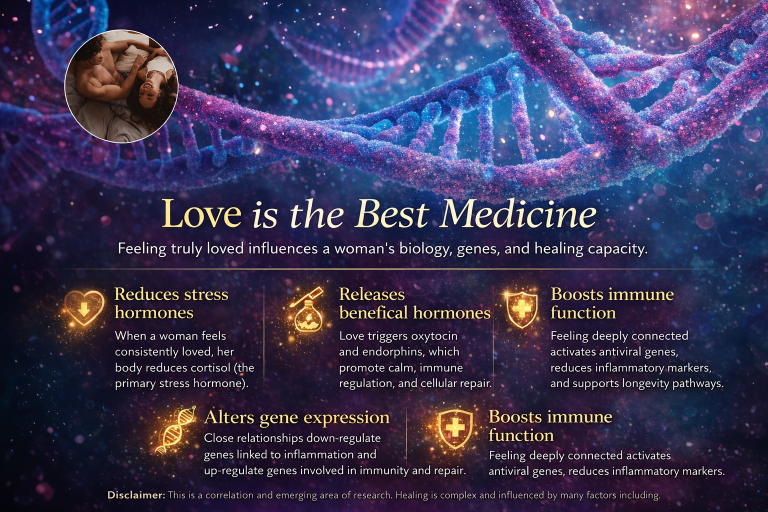
How Feeling Truly Loved Influences a Woman’s Biology, Genes, and Healing Capacity
For much of human history, love was understood as medicine in spiritual, poetic, and indigenous traditions. Modern science, however, is only now beginning to map how this medicine works inside the body.
Emerging research in epigenetics, psychoneuroimmunology, and neuroendocrinology suggests that feeling truly loved can influence a woman’s physiology at a deep level—affecting stress hormones, immune signaling, inflammation, and even gene expression related to healing and longevity.
Love, it turns out, is not merely emotional.
It is biological information.
Love as a Signal of Safety
The human nervous system is constantly asking one question:
Am I safe right now?
When a woman experiences consistent emotional attunement, affection, and relational security, her nervous system shifts out of survival mode. This shift has measurable downstream effects.
Studies show that women in nurturing relationships often exhibit:
-
Lower baseline levels of cortisol (the primary stress hormone)
-
Improved autonomic nervous system regulation
-
Reduced inflammatory markers
From a spiritual lens, this is the body returning to coherence.
From a scientific lens, this is the parasympathetic nervous system coming online.
Both describe the same state: repair becomes possible.
Hormones: The Translators Between Love and Genes
The body translates emotional experience into chemistry through hormones.
Oxytocin: The Bonding & Repair Hormone
Released through touch, emotional closeness, trust, and intimacy, oxytocin:
-
Calms the nervous system
-
Suppresses excessive cortisol release
-
Reduces inflammation
-
Enhances immune signaling
-
Supports tissue repair
Oxytocin communicates a powerful message to the body:
Connection is present. Defense can soften.
Endorphins: Pleasure, Relief, and Regulation
Endorphins released through joy, intimacy, laughter, and affection reduce pain perception and support emotional resilience.
Together, these hormones create an internal environment favorable to anti-inflammatory gene expression and cellular restoration.
Epigenetics: How Love Influences Gene Expression
Epigenetics does not change DNA itself—it changes how genes are expressed.
Research indicates that women who feel emotionally supported and loved may show:
-
Up-regulation of genes involved in immune defense, including antiviral pathways
-
Activation of genes linked to cellular repair and longevity mechanisms
-
Down-regulation of genes associated with chronic inflammation and stress response
In spiritual language, love turns the body toward life-affirming intelligence.
In scientific language, it shifts transcription pathways toward healing.
The body listens to emotional context.
Stress, Inflammation, and the Absence of Love
Chronic emotional stress—especially relational stress—keeps cortisol elevated over time. Prolonged cortisol exposure is associated with:
-
Suppressed immune function
-
Increased inflammation
-
Impaired tissue repair
-
Stress-related changes in gene expression
This is not about romance alone.
Loneliness, emotional neglect, or unstable attachment can register as biological threat.
The feminine body is especially sensitive to relational safety because connection has always been a survival cue.
Love as a Genetic Buffer Against Stress
One of the most compelling findings in this field is that close relationships buffer the effects of stress on gene expression.
Even under psychological strain, women with strong emotional bonds show:
-
Reduced stress-related inflammatory gene activation
-
Greater immune resilience
-
Better recovery after stress exposure
Love does not remove life’s challenges.
It changes how deeply they imprint the body.
Healing, Longevity, and the Feminine Design
When inflammation decreases and repair pathways activate, the body can invest energy in:
-
Cellular maintenance
-
Hormonal balance
-
Immune intelligence
-
Longevity mechanisms
This is why loving relationships consistently correlate with better long-term health outcomes—not as sentiment, but as physiology.
Love creates the conditions for life to regenerate itself.
Love Is Not Dependency — It Is Regulation
This science does not suggest that a woman must rely on another person to be whole. Rather, it affirms that authentic connection is a biological nutrient.
Love—whether from a partner, community, deep friendship, or spiritual connection—communicates safety. Safety allows healing.
Ancient traditions called this shakti settling into coherence.
Science calls it nervous system regulation and epigenetic modulation.
Different languages. Same truth.
Love Is the Best Medicine
Not because it replaces medical care.
Not because it erases hardship.
But because love tells the body it can stop bracing—and start repairing.
And the genes respond.
Disclaimer:
This article is for educational and informational purposes only. It does not replace medical advice, diagnosis, or treatment. The research referenced reflects correlations and emerging findings in psychoneuroimmunology and epigenetics. Individual experiences vary, and healing is influenced by many factors including lifestyle, environment, and professional care.