A Complete, Integrative Guide to Healing Fear Through Mantra, Prāṇa & Connection
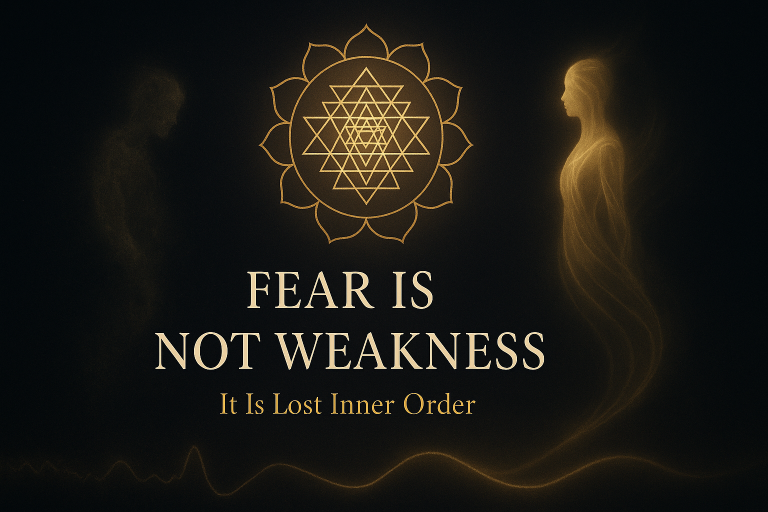
Fear is not a flaw in your character.
It is not proof that you are spiritually behind or emotionally fragile.
In the Vedic view, fear simply means your inner order has been disturbed — the rhythm of your mind, the flow of your prāṇa, and your sense of connection with the Divine and with others.
The Atharva Veda, Upaniṣads, and Bhagavad Gītā all teach that fear arises when:
-
the mind becomes scattered,
-
the breath becomes irregular,
-
and the sense of separateness increases.
Modern science agrees.
Fear shows up when the nervous system becomes dysregulated, the breath becomes shallow, and the body loses its sense of safety.
This is where Vedic wisdom shines: it doesn’t shame fear — it re-orders it.
Below is a deeply integrated guide blending ancient Vedic insight with modern research on anxiety, nervous-system healing, and relational safety.
1. The Vedic Insight: Fear Comes From “Secondness”
One of the most profound statements on fear appears in the Bṛhadāraṇyaka Upaniṣad (1.4.2):
“Dvitīyād vai bhayaṁ bhavati — From a second, fear arises.”
According to the sages:
-
Fear happens when you perceive an other — someone or something that can reject you, harm you, judge you, or leave you.
-
The more consciousness moves toward oneness, the less fear can exist.
-
Fear dissolves when you remember your unity with Life, with the Divine, and with the deeper Self.
This doesn’t mean fear is “illusion” or that you should ignore it.
It means fear is a signal — you drifted from inner alignment, from Self-recognition, from connection.
This understanding becomes even clearer when we consider the psychology of the Gītā.
2. Abhayam — Fearlessness as a Divine Quality
The Bhagavad Gītā (16.1) begins its list of divine qualities with:
Abhayam — Fearlessness.
Traditional commentators say:
-
Fearlessness arises from trust in the Divine presence as inner protector.
-
When you identify with the body or ego alone, fear is unavoidable.
-
When you identify with the deeper Self (ātman), fear thins out — even death no longer feels like a threat.
But the Vedas never jump straight to philosophy.
They also give us tools to stabilize the mind, breath, and prāṇa, so fear can be healed at the root.
And for this, the Atharva Veda is unmatched.
3. Atharva Veda: The Sonic Technology of Fearlessness
The Atharva Veda contains entire hymns dedicated to calming fear, restoring safety, and invoking protection.
3.1 The Abhaya Sūktam (AV 19.15)
A hymn that systematically removes fear from:
-
all directions
-
all relationships
-
all known and unknown threats
-
day and night
-
the past and the future
One section prays:
“May there be no fear from friend, no fear from not-friend,
no fear from the known, no fear from the unknown.
May all directions become our friends.”
This is not superstition.
It is psychological brilliance encoded in sacred sound.
It maps fear onto space and time, then fills each dimension with safety, connection, and Divine holding.
This is the origin of the teaching:
“You are held — awake and asleep, in all directions.”
3.2 Mantras Directly Addressing Mind & Prāṇa (AV 2.15)
These hymns speak to the mind the way a loving parent might speak to a frightened child:
“O my mind and prāṇa, do not fear.
As heaven and earth do not fear, so may you not fear.”
This is emotional regulation expressed in sacred poetry.
And today, neuroscience finally understands why it works.
4. Vedic Psychology: Fear = Disturbed Mind + Disturbed Prāṇa
According to Vedic and Ayurvedic psychology, fear arises when:
-
vāta becomes disturbed
-
prāṇa becomes erratic
-
manas (the emotional mind) loses rhythm
-
thoughts lose coherence
-
connection feels broken
This is nearly identical to the modern description of:
-
sympathetic overdrive
-
amygdala activation
-
scattered attention
-
nervous system dysregulation
-
loss of relational safety
In other words, the Vedic view and the neuroscientific view are describing the same phenomenon using different languages.
The solution in both traditions is also remarkably aligned.
5. The Three Vedic Medicines for Fear
Fear is not overcome by force, suppression, or denial.
Fear is healed by re-ordering the system.
5.1. Mantra — Restoring Rhythm to the Mind
Mantra entrains:
-
breathing
-
brainwaves
-
emotional charge
-
attention
-
autonomic regulation
Modern research shows:
-
mantra meditation reduces anxiety significantly
-
improves emotional regulation
-
enhances vagal tone
-
increases brain coherence
-
reduces stress hormones
The Vedic sages were right:
Sound heals mind. Rhythm heals fear.
5.2. Prāṇāyāma — Stabilizing the “Wind” of Fear
Fear appears when prāṇa becomes unstable.
Prāṇāyāma:
-
slows the breath
-
stabilizes CO₂/O₂ balance
-
calms the amygdala
-
increases vagal activation
-
restores internal safety
Studies show pranayama can reduce anxiety levels by 30–50% in only a few weeks.
The breath is the doorway out of fear.
5.3. Connection — Healing the Illusion of Aloneness
The deepest Vedic teaching is this:
Fear arises from feeling separate.
Safety arises from feeling connected.
Connection happens through:
-
satsanga
-
devotional relationship with the Divine
-
safe relationships
-
co-regulation
-
shared breath and mantra
-
loving-kindness practices
-
remembering Oneness
Modern Polyvagal Theory confirms this:
-
Safety is not a thought, but a physiological state.
-
Social engagement regulates the nervous system.
-
Eye contact, tone of voice, and safe presence down-regulate fear circuits.
We heal fear together, not alone.
6. A Vedic–Scientific Framework to Reorder Fear
Below is a simple but powerful structure you can use daily.
6.1 The Daily Abhaya Mantra Practice
Choose a mantra such as:
“Sarvā āśā mama mitraṁ bhavantu —
May all directions become my friends.”
Chant:
-
9, 27, or 108 times
-
in a steady rhythm
-
at the same time each day
This is how you restore mental rhythm.
6.2 Nervous System Reset Breath
Use:
-
slow nasal breathing (5–6 breaths per minute)
-
long exhalations
-
gentle nāḍī śodhana
10–15 minutes is enough to begin calming fear responses.
This reorders prāṇa.
6.3 Non-Dual Reflection
Sit for a moment and contemplate:
-
“Where am I creating a second?”
-
“In what way am I believing I am separate?”
-
“Who am I when I observe fear rather than become it?”
This heals the root cause of fear.
6.4 Connection as Medicine
Reach out to a safe person.
Or sit with the Divine.
Or place your hand on your heart.
Say silently:
“I am not alone.
I am held.”
This restores the felt sense of belonging that dissolves fear at its core.
7. Conclusion: Fear Is an Invitation Back to Order
The Vedas never say fear is weakness.
They say fear is a sign — a sacred message — that inner order is calling to be restored.
When mind regains rhythm,
when prāṇa stabilizes,
when connection deepens,
fear naturally dissolves.
Fear is not an enemy.
Fear is a doorway.
Fear is a reminder:
“Come back home to your inner order —
to your breath, your Self, your connection, your truth.”
This is the Vedic science of fearlessness.
This is abhayam.