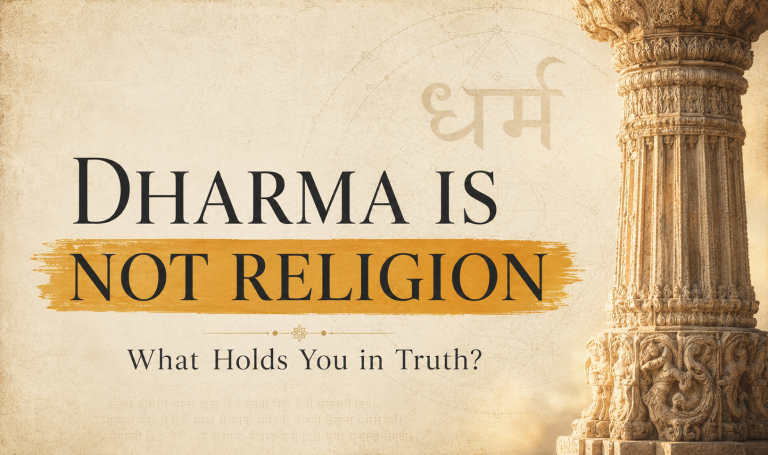
Dharma Is Not Religion: Recovering the Living Architecture of an Ancient Word
There are translations that carry meaning across languages.
And there are translations that quietly alter the way an entire civilisation is understood.
One of the most consequential examples is the Sanskrit word dharma—a term so expansive, layered and context-sensitive that no single English word can contain it. Yet for nearly two centuries, it has repeatedly been translated as “religion.”
This translation is not entirely wrong in every context. Dharma can include religious teachings, sacred observances and spiritual obligations. In modern Indian languages, dharma is also commonly used when speaking about religious affiliation.
But to say that dharma simply means religion is like saying that the ocean means water. Water is certainly part of the ocean, but the ocean is also depth, movement, ecology, atmosphere, force and life.
Religion may be one expression of dharma.
It is not the whole of dharma.
A Necessary Clarification: Does Sanskrit Really Have No Word for Religion?
The provocative statement that “Sanskrit has no word for religion” contains an important insight, but it must be handled carefully.
Sanskrit possesses many words connected with faith, worship, doctrine and spiritual belonging:
- Mata can mean a view, belief, opinion or doctrine.
- Sampradāya refers to a lineage or transmitted tradition.
- Pantha or mārga indicates a path.
- Darśana refers to a philosophical vision or way of seeing reality.
- Āgama may refer to a received scriptural or ritual tradition.
- Upāsanā means worship, contemplation or devotional practice.
- Śraddhā suggests trust, reverence or deeply placed faith.
Dharma itself can, in certain contexts, include what English speakers call religion.
The more accurate claim, therefore, is this:
Classical Sanskrit does not offer one exact equivalent for the modern Western category of “religion,” because the civilisation did not always divide life into the same categories that modern Western thought does.
Religion, in its familiar modern sense, is often imagined as a distinct sphere of life: a system of beliefs about God, a scripture, a founder, an institution, a congregation and a set of prescribed acts of worship.
Dharma is much more permeable. It can include ethics, law, responsibility, character, social order, spiritual practice, cosmic harmony, personal vocation and the inherent nature of a being or thing.
It does not merely ask:
What do you believe?
It asks:
What sustains you? What is yours to uphold? What preserves the integrity of life?
The Root of Dharma: That Which Holds
The Sanskrit word dharma, धर्म, is associated with the verbal root dhṛ, धृ—“to hold,” “to bear,” “to support,” “to sustain” or “to maintain.”
From this root emerges a profound understanding: dharma is that which supports the integrity, continuity and proper order of something.
Traditional Sanskrit dictionaries give dharma a wide range of meanings, including that which is established, law, custom, right conduct, duty, virtue, justice, moral merit and an essential quality. This range itself shows why no single English word is sufficient.
A well-known verse from the Mahābhārata expresses the sustaining dimension of dharma:
dhāraṇād dharmam ity āhur
dharmo dhārayate prajāḥ
It is called dharma because it upholds;
dharma is that which sustains the people.
The verse continues by identifying as dharma that which possesses this power of sustaining. Dharma, then, is not merely a private conviction. It is a principle of coherence.
It is what keeps a person, a community and potentially the cosmos from falling into disorder.
Dharma Is More Than Belief
Belief concerns what the mind accepts as true.
Dharma concerns how truth is embodied, upheld and expressed through life.
A person may profess beautiful beliefs and still act without integrity. Another may possess no elaborate theology yet live with courage, compassion, responsibility and truthfulness.
From a dharmic perspective, what one declares is not enough. The deeper question is whether one’s life participates in the sustaining order of existence.
Does your presence increase harmony or fragmentation?
Does your work serve life or exploit it?
Do your words clarify or confuse?
Does your power protect the vulnerable or merely enlarge the self?
Do your choices strengthen the web of relationships upon which life depends?
Dharma is not confined to what happens in a temple. It is present in how a ruler governs, how a healer treats a patient, how a parent raises a child, how a teacher guides a student and how a human being relates to the Earth.
It includes contemplation, prayer and worship, but it also includes justice, restraint, service, honesty and responsibility.
The Dharma of Fire and Water
One accessible way of understanding dharma is through the characteristic nature of things.
Fire gives heat and light. Water flows, nourishes and adapts to the form of its container. The sun radiates. A seed carries within itself the impulse to germinate and become what it is capable of becoming.
In this sense, we might poetically say:
- The dharma of fire is to burn and transform.
- The dharma of water is to flow and nourish.
- The dharma of the sun is to illuminate.
- The dharma of a teacher is to awaken understanding.
- The dharma of a healer is to serve the restoration of wholeness.
If fire possessed no heat, we would no longer recognise it as fire. If water lost every quality by which it flows, cools and nourishes, it would no longer behave as water.
This does not mean that dharma is simply a fixed property or biological destiny. In human life, dharma is more complex. We possess freedom, conflicting desires, inherited conditions and changing responsibilities. Our dharma must therefore be discerned, cultivated and consciously lived.
Still, the metaphor points towards something essential:
Dharma is the principle through which a being remains aligned with its deepest nature and rightful participation in the whole.
From Dharma to Svadharma
The word svadharma combines sva, meaning “one’s own,” with dharma.
It is frequently translated as “one’s own duty.” This is not necessarily incorrect, but “duty” can sound external, compulsory and lifeless—as though svadharma were simply a list of obligations imposed by authority.
Svadharma is richer than that.
It can refer to the responsibilities arising from one’s nature, capacities, relationships, circumstances and place within the greater order of life. It is not merely what one happens to enjoy, nor is it permission to follow every personal impulse.
Svadharma is where inner nature and ethical responsibility meet.
Your svadharma may include your vocation, but it is not reducible to your profession. A person may change careers while continuing to express the same essential dharma through different forms.
A healer may heal through medicine, touch, listening, teaching or social action. A teacher may teach in a classroom, raise conscious children, mentor a community or write books. The external form can change while the underlying movement remains.
Svadharma is not simply, “What do I want to do?”
It asks:
What is life asking me to embody through the particular instrument that I am?
Arjuna’s Crisis Was Not About Religious Belief
This understanding becomes especially important in the Bhagavad Gītā.
Arjuna does not stand on the battlefield suffering from a lack of religious belief. He is not asking Kṛṣṇa which religion he should join. Nor is the central problem solved by persuading him to accept a new creed.
Arjuna is undergoing a crisis of action, identity, relationship and moral responsibility.
He sees teachers, elders, relatives and friends on both sides of a catastrophic conflict. His body trembles. His bow slips from his hand. He questions whether any victory could justify the destruction before him.
This is a profound dharmic crisis because multiple obligations appear to collide:
- His responsibility as a warrior
- His love for his family
- His respect for his teachers
- His resistance to violence
- His concern for social order
- His fear of moral consequence
- His longing for spiritual clarity
In Bhagavad Gītā 2.31, Kṛṣṇa asks Arjuna to consider his svadharma. Many translations render this as his duty as a warrior. That is certainly part of the verse, but its philosophical setting is larger than obedience to a social role.
Arjuna must discover how to act without being ruled by fear, attachment, vanity or the hunger for personal reward. His question is not simply, “What is my duty?” It is also:
What action preserves truth when every available choice carries pain?
The Gītā therefore does not present dharma as simplistic moral certainty. Dharma frequently requires discernment precisely because life is complex.
Dharma Is Structural, Ethical and Spiritual
The images describe svadharma as a “structural question” rather than a devotional one. This is a useful insight, provided we do not separate structure from sacredness too sharply.
Dharma is structural because it concerns what holds a life together.
It is ethical because it governs our relationship with others.
It is spiritual because it aligns human action with a reality larger than the individual ego.
It is social because our actions either sustain or weaken the collective.
It is ecological because human life cannot be separated from the systems that nourish it.
It is inward because discernment requires self-knowledge.
It is outward because dharma must eventually become conduct.
Dharma is not simply found in a book. Scriptures, teachers and traditions may illuminate it, but dharma must be recognised within the living circumstances of each moment.
A rule may be clear, yet its compassionate application may require wisdom. Two responsibilities may conflict. What preserves one relationship may damage another. Silence may be dharmic in one moment and cowardice in the next. Speaking may be courageous in one situation and needlessly harmful in another.
This is why dharma cannot be reduced either to belief or to mechanical duty.
It requires consciousness.
How Colonial Categories Changed the Conversation
The claim that British administrators simply invented the equation “dharma equals religion” is too sweeping. Dharma had religious meanings long before British rule, and translators have never agreed on one English equivalent.
Colonial administration did, however, intensify and standardise the use of categories familiar to European governance.
British courts sought definable systems of “Hindu law” and “Muslim law.” Census operations attempted to sort a vast population into discrete religious communities. Administrators, missionaries, Orientalist scholars and Indian intellectuals all participated—though with very different intentions—in translating fluid, overlapping traditions into more rigid classifications.
The colonial census itself encountered people whose practices did not fit neatly into exclusive boxes. Communities could participate in customs associated with several traditions, identify by lineage or region rather than creed, or understand belonging in ways that frustrated the demand for a single religious label.
When a civilisation must be administered through forms, censuses and legal codes, subtle realities tend to become fixed categories.
Dharma could consequently appear as “religion,” just as many diverse traditions could be gathered into a supposedly singular system called “Hinduism.” These translations were not pure inventions, but neither were they neutral. They reshaped the realities they attempted to describe.
The problem was not that the category of religion had no relevance at all.
The problem was that a category shaped by European Christian history could not hold the full civilisational meaning of dharma.
The box was smaller than the word.
Dharma Is Not Whatever Feels Authentic
In recovering dharma from mistranslation, another danger must be avoided.
Modern spiritual culture sometimes converts svadharma into radical individualism:
“My dharma is whatever makes me feel alive.”
“My truth is my dharma.”
“If I desire it strongly, it must be my path.”
But classical dharma is not merely self-expression. It always exists in relationship with something greater than private preference.
A person may feel drawn to power, but that does not make domination dharmic. Someone may call avoidance “freedom,” selfishness “authenticity” or impulsiveness “following the soul.”
Dharma must sustain—not merely gratify.
A possible path of svadharma should therefore be tested:
- Does it deepen truthfulness?
- Does it serve more than the ego?
- Does it honour legitimate responsibilities?
- Does it cultivate courage and compassion?
- Does it reduce unnecessary harm?
- Does it strengthen life?
- Can it endure discipline, sacrifice and time?
Desire asks, “What do I want?”
Ego asks, “How will this enhance me?”
Fear asks, “How can I remain safe?”
Dharma asks, “What is mine to uphold?”
Dharma Changes Form Without Losing Its Centre
At first, the language of inherent nature may make dharma sound rigid. Yet human dharma is not always expressed through one permanent role.
A person’s responsibilities change across the stages of life. The dharma of a student is not identical to that of a householder, parent, elder or renunciate. Illness may alter what is possible. A crisis may create obligations that did not previously exist. A teacher may become a caregiver; a leader may need to become a student again.
The form changes.
The deeper principles—truth, non-harm, responsibility, wisdom, compassion and service—continue to guide the changing form.
This is why dharma is neither absolute rigidity nor unlimited relativism. It contains enduring principles, but those principles require intelligent application within time, place, capacity and circumstance.
Dharma is alive.
What Happens When We Translate Dharma as Religion?
When dharma becomes merely religion, several dimensions disappear.
A question of embodied integrity becomes a question of affiliation.
A path of discernment becomes a system of belief.
A cosmic and ecological principle becomes a private spiritual preference.
A lived responsibility becomes an identity label.
A civilisation’s diverse ways of knowing become competing denominations.
Someone then asks, “What is your dharma?” and hears, “What religion do you belong to?”
But the deeper question may be:
What truth structures your life?
What responsibilities have been entrusted to you?
What quality must you embody for your life to remain coherent?
What do you serve when no one is watching?
What would you continue to uphold even when recognition, comfort and reward were removed?
Remembering Dharma in Modern Life
The recovery of dharma is not merely a linguistic exercise. It can transform how we understand purpose.
Many people today are searching for purpose as though it were a hidden profession waiting to be discovered. They imagine that once they find the perfect career, relationship or location, their entire life will align.
Dharma suggests a different approach.
Purpose is not only something you find. It is something you uphold.
It appears in the quality of your attention, the integrity of your choices and your willingness to serve what matters. Your work may be one vehicle of dharma, but so are your relationships, your speech, your treatment of the body, your use of resources and your response to suffering.
Dharma is revealed through repeated alignment.
You begin to recognise it through the actions that create deeper coherence—even when those actions are difficult. You feel its absence when you repeatedly betray what you know to be true.
The loss of dharma is not always dramatic. Sometimes it begins as a subtle fragmentation: saying yes when the truth is no, teaching what one does not practise, remaining silent when conscience asks for speech, or chasing success at the cost of the soul.
Returning to dharma is the return to integrity.
The Question Beneath Every Question
Dharma cannot be confined to “religion,” but neither must religion be excluded from it. Sacred ritual, devotion, mantra, pilgrimage, scripture and worship can all become expressions of dharma when they sustain truth, awaken consciousness and guide right relationship.
The essential distinction is this:
Religion often tells us the tradition to which we belong.
Dharma asks how we belong to life itself.
Religion may offer a name, theology or community.
Dharma asks what we uphold through our actions.
Religion may shape belief.
Dharma shapes being.
Perhaps the most important question is therefore not:
What do you believe?
Nor even:
What do you want to become?
It is:
What holds you in truth—and what are you here to hold for the world?
That is the living inquiry of dharma.
It is not merely a word to be translated.
It is an architecture to be lived.