
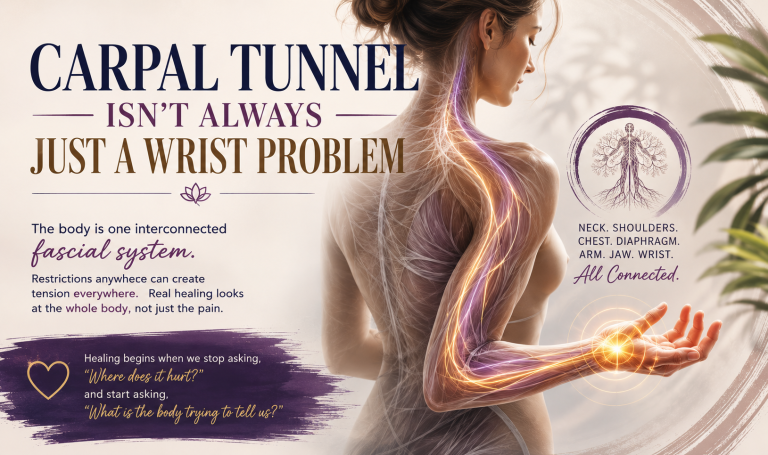
Many people are told that carpal tunnel syndrome is a wrist problem.
The median nerve becomes compressed as it passes through a narrow tunnel formed by the carpal bones and a thick ligament in the wrist. This explanation is anatomically correct, but it often leaves a much deeper question unanswered:
Why is the nerve being compressed in the first place?
For many people, the wrist is simply where the symptoms appear.
It may not be where the story begins.
The Body Is a Continuous Fascial Network
Modern anatomy is gradually moving away from viewing the body as isolated parts and toward understanding it as a living web of interconnected tissues.
Fascia is the three-dimensional connective tissue matrix that surrounds muscles, nerves, blood vessels, bones, and organs. Rather than existing as separate pieces, the body functions as one continuous fascial system.
A restriction in one area can create compensations and tension patterns that affect regions far away.
This means discomfort experienced in the hand may have origins elsewhere:
- Tightness in the neck
- Restrictions around the shoulder girdle
- Compression in the chest
- Dysfunction in the diaphragm
- Fascial limitations through the upper arm and forearm
- Jaw tension and chronic clenching
- Postural adaptations developed over decades
The body rarely works in isolated segments.
It works as a whole.
Symptoms Are Often Messengers
People suffering from carpal tunnel syndrome commonly experience:
✨ Tingling in the thumb, index, and middle fingers
✨ Numbness and altered sensation
✨ Burning or electrical feelings
✨ Wrist pain
✨ Weakness when gripping objects
✨ Difficulty opening jars
✨ Reduced dexterity
✨ Nighttime symptoms that disturb sleep
These symptoms are real.
But symptoms are not always the problem.
Often, they are the body’s attempt to communicate that something larger is occurring within the system.
The place that hurts may simply be the place that finally reaches its limit.
The Fascial Web and Tension Transmission
Imagine pulling one corner of a sweater.
The tension spreads throughout the entire garment.
The body behaves similarly.
Restrictions around the pectoral muscles can affect the shoulder.
Shoulder restrictions influence the upper arm.
Upper arm tension alters the mechanics of the forearm.
The forearm affects the wrist.
Eventually, enough stress accumulates that the tissues surrounding the median nerve become irritated and compressed.
The wrist becomes the site of pain.
But the true source may lie much higher.
Sometimes practitioners discover that a person’s hand symptoms improve after releasing restrictions in:
- The scalenes and neck muscles
- The collarbone region
- The chest and pectoral fascia
- The diaphragm
- The rib cage
- The shoulder blade
- The jaw and temporomandibular joint
At first glance, this seems surprising.
Yet the body has always functioned this way.
Everything is connected.
The Hidden Role of Posture and Stress
Modern life encourages positions that place enormous strain on the fascial system.
Hours spent:
- Working at computers
- Looking down at phones
- Driving
- Sitting with rounded shoulders
- Breathing shallowly
- Clenching the jaw during stress
Gradually, the chest collapses inward.
The shoulders roll forward.
The neck muscles tighten.
Breathing becomes restricted.
Fascial tensions accumulate.
Years later, symptoms may emerge in the hands.
The diagnosis becomes “carpal tunnel.”
Yet the body may have been adapting to deeper restrictions for decades.
Why Surgery Doesn’t Always Solve Everything
Carpal tunnel surgery can be extremely helpful and necessary in certain cases.
Releasing the transverse carpal ligament creates more room for the median nerve and often provides significant relief.
But some people continue to experience symptoms even after surgery.
Why?
Because decompressing the wrist addresses one location where tension manifested, but it may not address the broader fascial patterns that contributed to the problem.
If restrictions remain throughout the neck, chest, shoulder, and arm, the underlying mechanical stresses may persist.
This does not mean surgery is wrong.
It simply highlights that the body is more complex than a single anatomical structure.
The John F. Barnes Myofascial Release Perspective
The approach developed by John F. Barnes asks a different question.
Instead of asking:
“Where does it hurt?”
It asks:
“What restrictions are preventing the body from functioning freely?”
Through gentle, sustained pressure, fascial restrictions can begin to soften and unwind.
As mobility improves, compression on nerves, blood vessels, muscles, and joints may lessen.
Circulation can improve.
Movement becomes easier.
The nervous system often settles.
And sometimes symptoms disappear from areas that were never touched directly.
Because the body recognizes no separation between parts.
Healing Through Listening
One of the most profound shifts in healing occurs when we stop fighting symptoms and begin listening to them.
Pain is not always an enemy.
Sometimes it is information.
The numbness in the fingers may be telling us about restrictions in the chest.
The wrist pain may be revealing tension held in the shoulders.
The burning sensation may reflect years of unconscious guarding and compensation.
Symptoms are not failures.
They are messages.
And messages deserve curiosity, not punishment.
Beyond the Wrist
Perhaps the greatest lesson carpal tunnel teaches us is that the body is remarkably intelligent.
It is not a collection of independent pieces.
It is a unified organism in constant conversation with itself.
The hand speaks to the shoulder.
The shoulder speaks to the chest.
The chest speaks to the diaphragm.
The diaphragm speaks to the jaw.
And the entire system speaks through sensation.
Sometimes the greatest restriction isn’t in the wrist at all.
It may be hidden in the chest.
The neck.
The shoulder.
Or another area compensating silently for years.
Healing often begins when we stop asking:
“Where does it hurt?”
And start asking:
“What is the body trying to tell me?”
Because when we treat the body as a whole, extraordinary changes become possible.
And sometimes, what appears to be a wrist problem is really the body’s invitation to rediscover the deeper interconnectedness that has been there all along.