Introduction: When Experience Refuses to Stay in a Box
There are moments in human experience that refuse to fit neatly into categories.
A dream that feels more real than waking life.
A sensation of floating above your own body.
An encounter with someone in a dream that feels… mutual.
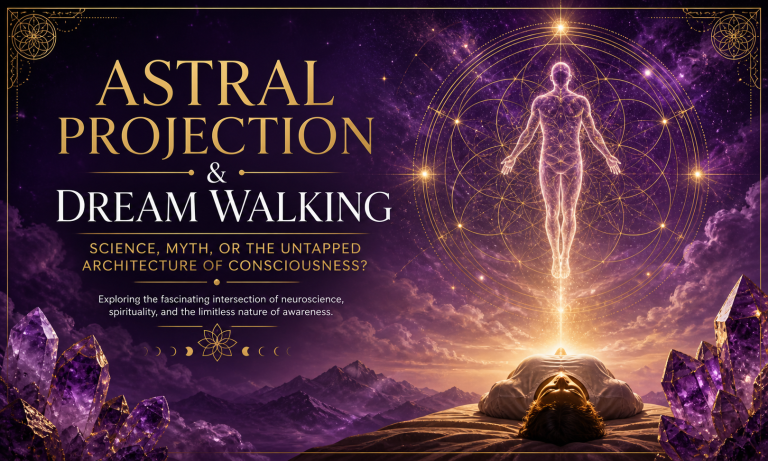
For centuries, these experiences have been described as astral projection, dream walking, or conscious travel beyond the body.
Modern science, however, tends to reduce them to neurological events—hallucinations, misfiring sensory maps, or vivid dream states.
So which is it?
Are these experiences nothing more than clever tricks of the brain…
or are they glimpses into a deeper architecture of consciousness that we are only beginning to understand?
Part I: The Neuroscience of Leaving the Body


Let’s begin with what we know—or at least, what we can measure.
1. The Brain’s Internal Reality Generator
Your brain is not a passive observer of reality.
It is an active simulation engine.
At every moment, it is:
- Predicting sensory input
- Constructing spatial awareness
- Maintaining a sense of “self” located inside the body
This sense of “I am here” is not fixed—it is computed.
2. The Temporoparietal Junction (TPJ): Your Location Anchor
A key player in this process is a region called the Temporoparietal Junction.
This area integrates:
- Vision
- Touch
- Proprioception (your sense of where your body is)
When this system becomes disrupted—through sleep, trauma, meditation, or even electrical stimulation—the brain can lose track of where “you” are.
The result?
- You feel like you’re floating
- You perceive yourself outside your body
- You observe your own physical form from a distance
From a scientific standpoint, astral projection is a mislocalization of consciousness within the brain’s spatial model.
Convincing? Yes.
Complete? Not necessarily.
3. REM Sleep & Lucid Dreaming: Consciousness Without the Body
During REM sleep:
- The body is paralyzed (to prevent movement)
- The brain becomes highly active
- Sensory input from the external world is reduced
This creates the perfect condition for lucid dreaming—where awareness awakens inside the dream.
In this state:
- You can move freely without a physical body
- You can “travel” instantly
- You can interact with environments that feel tangible and real
From this lens, astral projection may simply be lucidity combined with a strong sensation of disembodiment.
4. Shared Dreams: Coincidence or Construction?
Science does not support the idea that people can literally enter each other’s dreams.
However:
- Emotional bonds increase dream overlap
- Memory and imagination can reconstruct familiar people with stunning realism
- Retrospective interpretation fills in the gaps
Two people dreaming of each other on the same night is possible.
But it doesn’t necessarily imply a shared space.
Part II: The Yogic & Mystical Map of Consciousness


Now let’s step into a very different framework—one that predates modern neuroscience by thousands of years.
1. You Are Not Just a Body
In yogic science, the human being is described as multilayered:
- Physical body (Annamaya Kosha)
- Energy body (Pranamaya Kosha)
- Mental body (Manomaya Kosha)
- Wisdom body (Vijnanamaya Kosha)
- Bliss body (Anandamaya Kosha)
Astral projection is often associated with movement within the subtle or energetic layers, not the physical one.
2. The Astral Plane as a Functional Reality
Unlike the scientific view, these traditions do not consider dreams to be random.
Instead, dreams are:
- A field of subtle perception
- A space where the mind is less constrained by physical laws
- A bridge between conscious and unconscious awareness
In practices like Tibetan Dream Yoga:
- One trains to remain conscious during dreaming
- One learns to navigate dream states intentionally
- One uses dreams as a path to liberation
3. Dream Walking: A Rare but Claimed Phenomenon
Some esoteric traditions suggest that entering another person’s dream is possible—but with strict conditions:
- Deep energetic resonance
- Advanced meditative mastery
- Clear intention and awareness
Even within these traditions, this is considered:
- Rare
- Difficult
- Not something to assume casually
Which is important—because the mind is exceptionally good at convincing itself of connection.
Part III: Where Science and Spirituality Quietly Agree
At first glance, these two perspectives seem opposed.
But look closer—and something interesting emerges.
Both agree on this:
👉 Reality, as you experience it, is constructed.
Science says:
- The brain builds your world from sensory input and prediction
Spiritual traditions say:
- Consciousness projects reality through perception and awareness
Different language.
Same underlying insight.
Part IV: The Real Question Isn’t “Is It Real?”
The most common question people ask is:
“Is astral projection real?”
But that question is limited.
A more precise question would be:
👉 “What is the mechanism of the experience, and what does it reveal about consciousness itself?”
Because consider this:
If your brain—or your consciousness—can generate:
- Entire worlds
- Autonomous characters
- Emotional depth
- Spatial immersion
Then the line between “internal” and “external” becomes less clear than we assume.
Conclusion: The Edge of the Known
Astral projection sits at a fascinating boundary.
- Too structured to dismiss as random
- Too subjective to confirm as objective travel
It is an experience that challenges both reductionist science and ungrounded mysticism.
And perhaps that’s exactly its purpose.
Not to prove that we can leave the body…
but to show us that we don’t fully understand what it means to be in it.
A Final Reflection
Whether you interpret these experiences as:
- Neurological simulations
- Energetic explorations
- Or something in between
One thing is undeniable:
Consciousness is far more flexible, creative, and mysterious than we’ve been taught to believe.
And maybe the real journey is not leaving the body…
…but learning how to fully arrive within awareness itself.