There are moments in the celestial calendar when the most useful response is not more interpretation.
It is practice.
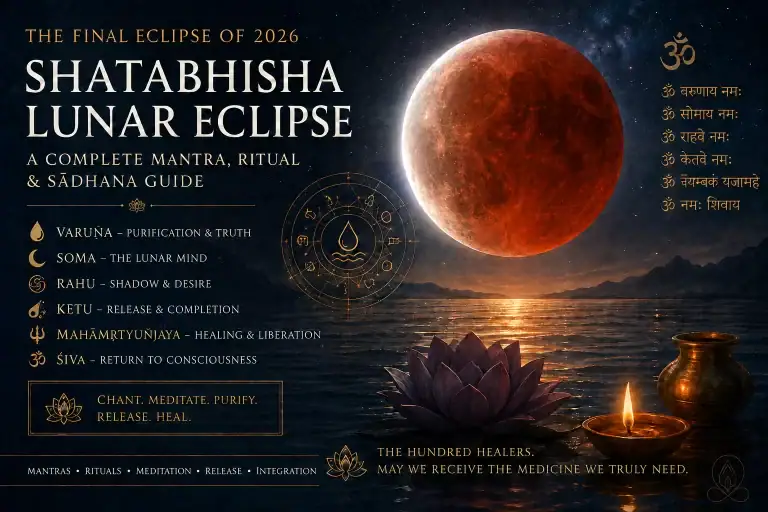
The final eclipse of 2026 arrives as a lunar eclipse during the Full Moon, with the Moon moving through Kumbha—Aquarius—and the nakshatra of Śatabhiṣā.
Much can be said about what this means astrologically.
In fact, I have already written extensively about the deeper Jyotisha, psychological, karmic and spiritual significance of this eclipse in my earlier article:
Lunar Eclipse in Aquarius: The Healing Threshold of Shatabhisha
That article explores the eclipse as a threshold of healing: Aquarius and collective consciousness, Rahu and insatiable desire, Varuṇa and truth, the mysterious empty circle of Śatabhiṣā, solitude, boundaries, completion and the possibility of releasing an identity that has fulfilled its purpose.
This article is intentionally different.
Here I want to answer a much more practical question:
What should we actually DO during this eclipse?
What should we chant?
How should we prepare?
Which mantras are particularly appropriate?
Should we meditate?
Should we manifest?
What do we do with food?
What do we do with the intensity that sometimes accompanies eclipse periods?
And perhaps most importantly:
How do we turn an eclipse from something we merely experience into something we consciously practice through?
This is your sādhana guide.
First: Do Not Be Afraid of an Eclipse
There are two extremes surrounding eclipses.
One is to dismiss them completely.
The other is to become terrified of them.
Neither is necessary.
An eclipse is a real astronomical event.
A lunar eclipse occurs when the Sun, Earth and Moon align closely enough that Earth’s shadow falls across the Full Moon.
But within the spiritual traditions of India, an eclipse—grahaṇa—has also been regarded as an unusual window for inward practice.
That does not mean something terrible is about to happen.
It means:
Pay attention.
Reduce unnecessary distraction.
Become quieter.
Chant.
Meditate.
Observe what arises.
Rather than turning the eclipse into superstition, we can turn it into sādhana.
Why Eclipses Are Traditionally Used for Mantra
This is perhaps the most important distinction to understand.
The eclipse itself is not the mantra.
The eclipse is the container.
In ordinary life, our awareness is constantly moving outward.
Messages.
Work.
Food.
Conversation.
Social media.
Relationships.
Planning.
Problems.
Desires.
During sacred periods, traditional practice reverses that movement.
Instead of allowing prāṇa to continuously disperse outward, we consciously gather it inward.
This is why eclipse periods have traditionally been associated with:
- mantra japa
- meditation
- prayer
- purification
- contemplation
- silence
- fasting or simplified eating
- charity
- bathing
- spiritual study
The intention is not punishment.
The intention is concentration.
If an eclipse amplifies anything, let it amplify your practice.
Why This Particular Eclipse Is So Interesting
This eclipse occurs in Śatabhiṣā, the twenty-fourth nakshatra.
Śatabhiṣā occupies a portion of sidereal Aquarius and is traditionally ruled by Rahu, while its presiding deity is Varuṇa. It is commonly translated as “the hundred healers,” “the hundred physicians,” or “possessing a hundred medicines.”
That combination is remarkable.
We have:
The Moon — mind, emotion, memory and receptivity.
The Full Moon — culmination and fullness.
The eclipse — obscuration and revelation.
Rahu — amplification, disruption, hunger and unconventional perception.
Śatabhiṣā — medicine, diagnosis, mystery and healing.
Varuṇa — cosmic waters, truth, purification and ṛta, the deeper order of existence.
This is why I would approach this eclipse less as a manifestation portal and more as a purification portal.
Do not spend the eclipse shouting your desires into the universe.
Listen.
Something subtler may be trying to speak.
Śatabhiṣā: When the Medicine Begins With the Diagnosis
Śatabhiṣā contains one of my favorite spiritual paradoxes.
It is associated with healing.
But before there can be healing, there must be an accurate diagnosis.
If you keep treating the wrong condition, even excellent medicine will fail.
The same thing happens spiritually.
Sometimes we believe we need more confidence when we actually need rest.
We think we need another relationship when we need to heal our relationship with ourselves.
We think we need another spiritual technique when we need consistency with the practices we already know.
We think we need motivation when we need boundaries.
We think we need abundance when we need to stop leaking energy.
We think we need somebody to understand us when we need to finally tell ourselves the truth.
This is very Śatabhiṣā.
The hundred medicines are available.
But first:
What actually needs healing?
Varuṇa: The Hidden Key to This Eclipse
Śatabhiṣā’s presiding deity is Varuṇa.
This is important because Varuṇa should not be reduced merely to “the god of water.”
In the Vedic imagination, Varuṇa is associated with something much greater:
ṛta.
Cosmic order.
The invisible law through which the universe remains coherent.
Varuṇa is associated with the celestial waters, but also with truth, vows, moral order, hidden things and the restoration of harmony.
That makes Varuṇa profoundly relevant to healing.
Because sometimes healing is simply the restoration of order.
Your body has an order.
Your breath has an order.
Sleep has an order.
Digestion has an order.
Relationships have an order.
Nature has an order.
Dharma has an order.
And suffering frequently increases when we repeatedly violate an order that somewhere inside ourselves we already understand.
So one of the deepest questions of this eclipse is not:
“What can I attract?”
It is:
“What must return to its proper place?”
The Primary Mantra of This Eclipse
If you chant only one special mantra for this eclipse, I would make it the mantra of Varuṇa:
ॐ वरुणाय नमः
Om Varuṇāya Namaḥ
Pronunciation:
Om Va-roo-naa-ya Na-ma-ha
A simple translation is:
Salutations to Varuṇa.
But mantra is not merely a sentence translated from Sanskrit into English.
The repetition itself is the practice.
For this eclipse, you may chant:
11 repetitions — simple invocation
27 repetitions — corresponding beautifully with the 27 nakshatras
54 repetitions — half mālā
108 repetitions — one complete mālā
If you have time, I recommend 108 repetitions during the eclipse period.
Sit quietly.
Keep a vessel of clean water nearby if you wish.
Do not ask Varuṇa for twenty things.
Instead, hold one prayer:
May what is out of alignment return to alignment.
May what is hidden be revealed.
May what requires purification be purified.
May I have the courage to see the truth.
Then begin:
Om Varuṇāya Namaḥ.
The Moon Mantra: Stabilizing the Inner Waters
Because this is a lunar eclipse, Chandra—the Moon—deserves special attention.
Within Jyotisha, the Moon is associated with manas, the mind: emotional perception, memory, receptivity, instinctive response and the way experience is internally processed.
During a lunar eclipse, therefore, the symbolic emphasis falls strongly upon the inner world.
For Chandra, use:
ॐ सोमाय नमः
Om Somāya Namaḥ
or the equally familiar:
ॐ चन्द्राय नमः
Om Chandrāya Namaḥ
You do not need to chant both.
Choose one.
For most people I would use:
Om Somāya Namaḥ — 108 times.
Soma carries beautiful associations with nourishment, cooling, nectar, restoration and the subtle lunar principle.
If emotions are moving strongly, do not fight them while chanting.
Allow the mantra to create a container around them.
The purpose is not:
“I must stop feeling.”
The purpose is:
“I can remain conscious while feeling.”
That is an enormous difference.
Rahu: The Shadow That Swallows the Light
We cannot speak about an eclipse within Jyotisha without speaking about Rahu and Ketu.
Astronomically, Rahu and Ketu correspond to the lunar nodes—the points where the Moon’s orbital path intersects the ecliptic.
This is precisely why eclipses occur in connection with them.
Mythologically, however, the story becomes extraordinary.
During the churning of the cosmic ocean—Samudra Manthana—the devas and asuras sought amṛta, the nectar of immortality.
An asura disguised himself and sat among the devas, drinking the nectar.
Surya and Chandra—the Sun and Moon—recognized him and revealed his deception.
Viṣṇu severed him with the Sudarshana Chakra.
But the nectar had already touched him.
He could no longer die.
The head became Rahu.
The body became Ketu.
And in the mythic imagination, Rahu periodically attempts to swallow the Sun or Moon.
But because Rahu has no body, the luminary eventually emerges again.
Thus:
the eclipse.
This mythology is not astronomy.
But mythology was never trying to be astronomy.
It is describing the inner experience of shadow.
Sometimes something temporarily swallows our light.
Fear.
Obsession.
Desire.
Confusion.
Attachment.
Projection.
Ambition.
Trauma.
Compulsion.
Yet the light itself has not ceased to exist.
It has become temporarily obscured.
That distinction is essential.
Rahu Mantra for the Eclipse
Because Śatabhiṣā itself is ruled by Rahu, Rahu becomes particularly relevant during this eclipse.
The simple mantra is:
ॐ राहवे नमः
Om Rāhave Namaḥ
Chant it 27 or 108 times.
But understand what you are doing.
This is not worshipping confusion.
It is bringing awareness to the force that creates amplification, fascination and obscuration.
As you chant, ask:
What am I unable to stop wanting?
Where has desire become compulsion?
Where am I chasing an experience rather than integrating one?
Where has fascination replaced discernment?
Rahu is extraordinarily powerful when conscious.
Unconscious Rahu consumes.
Conscious Rahu explores.
Unconscious Rahu obsesses.
Conscious Rahu innovates.
Unconscious Rahu wants endlessly.
Conscious Rahu can take us beyond inherited limitations.
The question is never simply whether Rahu is “good” or “bad.”
The question is:
Who is driving?
Ketu Mantra: The Medicine of Release
If Rahu represents the hungry head, Ketu represents the headless body.
Rahu reaches.
Ketu releases.
Rahu wants experience.
Ketu remembers that experience alone cannot ultimately satisfy us.
Rahu moves toward fascination.
Ketu can produce detachment.
This makes Ketu an important balancing force during eclipse practice.
Use:
ॐ केतवे नमः
Om Ketave Namaḥ
Chant 27 or 108 repetitions.
As you chant, do not ask:
What can I get?
Ask:
What am I finally ready to stop carrying?
This may be:
an identity,
an expectation,
an old resentment,
a relationship pattern,
a fear,
a compulsive behavior,
a need for recognition,
a story about yourself,
or even a spiritual ambition whose purpose has already been fulfilled.
You do not have to know the answer before chanting.
Let the practice reveal it.
The Eclipse Is the Meeting of Rahu and Ketu Within Us
This is where eclipse sādhana becomes psychologically fascinating.
Rahu says:
More.
Ketu says:
Enough.
Rahu says:
Become something.
Ketu says:
Remember what you already are.
Rahu says:
Go outward. Experience everything.
Ketu says:
Go inward. Release everything.
Neither is complete without the other.
Human life moves between these two forces continuously.
We desire.
We experience.
We learn.
We release.
Then another desire arises.
This is part of samsāra itself.
An eclipse makes this polarity visible in the sky.
Sādhana makes it visible within ourselves.
Shiva: The Mantra for Transformation
After Varuṇa, Chandra, Rahu and Ketu, I would bring the practice toward Śiva.
Why Shiva?
Because ultimately eclipse practice is not merely about managing planetary influences.
It is about returning consciousness to something deeper than the fluctuations of the mind.
For a simple practice:
ॐ नमः शिवाय
Om Namaḥ Śivāya
Chant 108 times.
This is one of the great mantras of the Shaiva tradition.
Do not complicate it.
Sit.
Breathe.
Chant.
Listen to the mantra after the sound leaves your mouth.
Eventually allow the audible mantra to become quieter.
Then mental.
Then silence.
The destination of mantra is not endless noise.
The mantra leads us toward the silence from which sound itself emerges.
And during an eclipse, that silence can become the most powerful practice of all.
The Mahāmṛtyuñjaya Mantra: The Great Healing Mantra
For those who already have a relationship with the Mahāmṛtyuñjaya Mantra, this is an especially beautiful period to practice it.
ॐ त्र्यम्बकं यजामहे
सुगन्धिं पुष्टिवर्धनम् ।
उर्वारुकमिव बन्धनान्
मृत्योर्मुक्षीय मामृतात् ॥
Om Tryambakaṁ Yajāmahe
Sugandhiṁ Puṣṭivardhanam
Urvārukamiva Bandhanān
Mṛtyor Mukṣīya Mā’mṛtāt
This mantra comes from the Vedic tradition and is associated with Tryambaka—the Three-Eyed One, later strongly identified with Shiva.
Its imagery is magnificent.
The prayer invokes release from bondage like a ripe cucumber naturally separating from its vine.
Not through violence.
Not through force.
Through ripeness.
That is a profound teaching for an eclipse.
Sometimes we try to release something before we have completed its lesson.
At other times, something is already ripe for release and we continue clinging to it.
Mahāmṛtyuñjaya asks for liberation when the time has come.
For this eclipse:
11 repetitions are beautiful.
27 repetitions create a deeper meditation.
108 repetitions can become the central sādhana if you are already comfortable with the mantra.
Do not rush the Sanskrit simply to reach a number.
Eleven conscious repetitions are more valuable than 108 mechanical ones.
STOP HERE BEFORE BUILDING THE RITUAL
At this point we have assembled the principal mantra field:
Varuṇa — purification and restoration of order
Chandra/Soma — mind, emotional waters and nourishment
Rahu — shadow, amplification and conscious encounter with desire
Ketu — release, detachment and completion
Śiva — transformation and return to consciousness
Mahāmṛtyuñjaya — healing and liberation from bondage
But simply throwing all six mantras together would not make a coherent sādhana.
Sequence matters.
The next step is to arrange them into an intentional eclipse ritual—beginning before the eclipse, moving through the eclipse itself, entering silence at the deepest point, and then completing the practice after the eclipse.
That is where we will continue in Part II: The Complete Shatabhisha Eclipse Ritual — Before, During & After the Eclipse.
Part II: The Complete Shatabhisha Eclipse Ritual
Before, During & After the Lunar Eclipse
In Part I, we explored the mantra field surrounding this extraordinary final eclipse of 2026:
Varuṇa for purification and restoration of cosmic order.
Soma/Chandra for the mind and emotional waters.
Rahu for conscious engagement with desire, amplification and shadow.
Ketu for detachment and release.
Śiva for transformation.
And the Mahāmṛtyuñjaya Mantra for healing, liberation and freedom from bondage.
Now we bring them together.
Because a collection of powerful mantras is not necessarily a sādhana.
Sequence creates the container.
There is a time to prepare.
A time to invoke.
A time to purify.
A time to encounter the shadow.
A time to release.
A time to become completely silent.
And finally, a time to return.
The following ritual can be practiced in its complete form, or you can simplify it according to your experience and circumstances.
Do not become obsessed with performing everything perfectly.
The consciousness you bring to the practice matters more than completing every possible element.
1. BEFORE THE ECLIPSE: PREPARE THE FIELD
Begin before the eclipse enters its strongest phase.
If possible, give yourself at least 30–60 minutes of quiet preparation.
Clean the room where you will practice.
Take a bath or shower.
Wear fresh, comfortable clothing.
Reduce unnecessary artificial stimulation.
Turn off television.
Silence notifications.
Step away from social media.
If you live with other people, let them know that you would like some uninterrupted time.
The point is simple:
Stop feeding your awareness outward.
For most of the day, consciousness is pulled in dozens of directions.
Eclipse sādhana reverses that current.
You are gathering yourself.
2. CREATE A SIMPLE ECLIPSE ALTAR
There is no need to make this elaborate.
You may place before you:
- a candle or ghee lamp
- a vessel of clean water
- flowers if available
- your mālā
- an image or murti connected with your iṣṭa-devatā or lineage
- a notebook or journal
Because Śatabhiṣā is presided over by Varuṇa, water becomes particularly meaningful in this practice.
Place a clean bowl, glass or copper vessel filled with fresh water near your meditation space.
Do not treat the water as a magical object.
Allow it to serve as a symbol.
Water receives.
Water reflects.
Water cleanses.
Water moves.
And throughout this eclipse we are contemplating exactly those qualities.
3. SIT AND ESTABLISH YOUR INTENTION
Sit comfortably with the spine upright.
Close your eyes.
Place your hands over the heart or simply rest them upon your knees.
Take several slow breaths.
Do not begin chanting immediately.
First arrive.
Notice your body.
Notice your breath.
Notice the quality of your mind.
Notice whatever emotions are present without trying to improve them.
Then inwardly establish your sankalpa.
Keep it simple.
For example:
May this practice reveal what needs to be seen, purify what needs to be purified, heal what is ready to heal, and release what has completed its purpose.
Notice what is absent from this prayer.
There is no demand.
There is no bargaining.
There is no list of twenty manifestations.
This is a practice of revelation and purification.
4. BEGIN WITH GANESHA
Before entering the planetary and eclipse mantras, I like to establish the practice through Gaṇeśa—the remover of obstacles and guardian of beginnings.
You can chant:
ॐ गं गणपतये नमः
Om Gaṁ Gaṇapataye Namaḥ
Chant it 11 times.
Allow this to mark the transition from ordinary activity into sacred practice.
You are no longer preparing.
The sādhana has begun.
5. INVOKE VARUṆA — ENTER THE WATERS
Now bring your awareness toward the vessel of water.
If appropriate, gently place your right hand near or over the vessel without touching the water.
Begin:
ॐ वरुणाय नमः
Om Varuṇāya Namaḥ
Chant 27 or 108 repetitions.
As you chant, contemplate purification.
Not punishment.
Not shame.
Purification.
There is an enormous difference.
You are not saying:
“Something is wrong with me.”
You are saying:
“Something within my life may no longer be in its proper order.”
Let Varuṇa become an invocation of ṛta—the restoration of right order.
Ask inwardly:
Where have I moved away from truth?
Where has my life become unnecessarily complicated?
Where am I holding something that needs to move?
Where have I made a promise to myself that I am no longer honoring?
Then stop asking.
Continue chanting.
Let the mantra work beneath the questions.
6. CHANDRA — CALM THE INNER WATERS
After Varuṇa, move toward the Moon.
During a lunar eclipse, the Moon becomes the visible focus of the celestial event.
And within Jyotisha, Chandra represents the mind, emotional perception, memory, receptivity and our instinctive relationship with experience.
Chant:
ॐ सोमाय नमः
Om Somāya Namaḥ
I recommend 108 repetitions if time permits.
As you chant, become aware of your emotional field.
You may feel peaceful.
You may feel restless.
You may suddenly remember something.
You may feel grief.
You may feel absolutely nothing.
All of these are acceptable.
Do not manufacture an eclipse experience.
One of the great traps of spiritual practice is expecting something dramatic to happen because we have been told that a particular moment is powerful.
Sometimes the deepest meditation feels completely ordinary.
Let ordinary be sacred too.
7. RAHU — MEET THE HUNGRY SHADOW
Now we approach Rahu.
This part of the ritual deserves honesty.
Chant:
ॐ राहवे नमः
Om Rāhave Namaḥ
27 repetitions are sufficient.
If Rahu mantra is already part of your practice, you may chant 108.
Afterward, remain silent.
Then ask yourself:
What am I hungry for?
Do not immediately spiritualize your answer.
Perhaps you want love.
Money.
Recognition.
Sex.
Success.
Security.
Marriage.
Children.
Influence.
Freedom.
Attention.
A particular person.
A particular outcome.
A spiritual experience.
None of these automatically make you less spiritual.
Rahu becomes problematic not simply because desire exists.
The difficulty begins when desire possesses the one who desires.
So ask:
Is this desire serving my dharma?
Or is my life becoming organized around feeding the desire?
Then ask an even more difficult question:
If I received exactly what I am asking for, would it actually give me what I believe it will give me?
Sit with that.
Rahu is not defeated by repression.
Rahu becomes conscious through seeing.
8. KETU — WHAT ARE YOU READY TO STOP CARRYING?
Now chant:
ॐ केतवे नमः
Om Ketave Namaḥ
Again, 27 repetitions are sufficient.
After chanting, breathe quietly.
Then ask:
What has completed its purpose in my life?
This is different from asking what you dislike.
Something may be difficult and still belong to your path.
Something else may be pleasant and already complete.
We are looking for completion, not avoidance.
Perhaps it is:
an old identity,
a relationship dynamic,
a resentment,
a fantasy,
a role,
a habit,
a need to prove yourself,
an attachment to how something was supposed to happen,
or a version of yourself built around circumstances that no longer exist.
Write down what arises.
Do not create a ten-page inventory.
One sentence may be enough.
9. THE RELEASE RITUAL
Take a small piece of paper.
Write:
I release…
Complete the sentence.
Then underneath write:
I keep the wisdom. I release the bondage.
Read it once.
Slowly.
You may then tear the paper into pieces.
If you have a safe ceremonial fire practice, you may traditionally offer the paper to fire—but this is entirely optional.
The physical act is not what creates release.
The physical act marks an inner decision.
Sit quietly afterward.
Do not immediately replace what you released with another desire.
Give emptiness a little room.
10. MAHĀMṚTYUÑJAYA — THE HEALING GATE
Now we arrive at one of the deepest portions of the sādhana.
Śatabhiṣā carries the symbolism of the hundred healers.
So after purification, emotional observation, shadow awareness and release, we invoke the great mantra of liberation and healing:
ॐ त्र्यम्बकं यजामहे
सुगन्धिं पुष्टिवर्धनम् ।
उर्वारुकमिव बन्धनान्
मृत्योर्मुक्षीय मामृतात् ॥
Om Tryambakaṁ Yajāmahe
Sugandhiṁ Puṣṭivardhanam
Urvārukamiva Bandhanān
Mṛtyor Mukṣīya Mā’mṛtāt
Chant 11, 27 or 108 times.
If you are unfamiliar with the mantra, choose 11 slow and deliberate repetitions.
Its great image is of ripeness.
The fruit does not have to violently attack the vine.
When the moment has arrived, separation happens naturally.
So while chanting, contemplate:
May I be released from what I have outgrown without losing the wisdom it gave me.
This is mature release.
We do not have to hate our past to leave it.
We do not have to demonize another person to establish a boundary.
We do not have to call an experience a mistake simply because it has ended.
Sometimes something was sacred precisely because it had a season.
11. OM NAMAḤ ŚIVĀYA — RETURN EVERYTHING TO CONSCIOUSNESS
Now chant:
ॐ नमः शिवाय
Om Namaḥ Śivāya
108 repetitions.
At this stage, stop analyzing.
No more questions.
No journaling.
No interpretation.
No manifestation.
No trying to understand what the eclipse means for your future.
Just mantra.
Let the mantra become progressively softer.
Eventually whisper it.
Then repeat it mentally.
Then stop.
12. AT OR NEAR THE MAXIMUM ECLIPSE: BECOME SILENT
If you can coordinate your practice with the visible eclipse where you live, allow the deepest portion of the eclipse to become the simplest part of the ritual.
Do nothing.
Sit.
Breathe.
Remain aware.
This may be the most important instruction in this entire article.
Spiritual seekers are sometimes addicted to doing spiritual things.
Another mantra.
Another mudra.
Another kriya.
Another activation.
Another visualization.
Another intention.
Another ceremony.
But all spiritual technologies eventually point toward something that cannot be manufactured.
Stillness.
At the heart of this eclipse sādhana, allow yourself to stop manipulating your experience.
Do not ask for visions.
Do not search for messages.
Do not try to feel energy moving through your chakras.
Do not decide whether something profound is happening.
Simply remain.
11 minutes is beautiful.
22 minutes if your meditation practice is established.
31 minutes if silence comes naturally.
And if you can remain longer without strain, remain.
13. THE HUNDRED HEALERS MEDITATION
After silence, return your awareness gently to the body.
Place one hand over the heart and the other over the navel.
Śatabhiṣā—the Hundred Healers.
Now ask:
What medicine does my life actually need?
Notice the wording.
Not:
What medicine sounds spiritual?
Not:
What practice will impress somebody?
Not:
What extraordinary experience can I have?
What medicine do you actually need?
Perhaps the answer is meditation.
Perhaps therapy.
Perhaps Ayurveda.
Perhaps exercise.
Perhaps better food.
Perhaps sunlight.
Perhaps sleep.
Perhaps discipline.
Perhaps less alcohol.
Perhaps less screen time.
Perhaps a difficult conversation.
Perhaps forgiveness.
Perhaps stronger boundaries.
Perhaps more community.
Perhaps solitude.
Perhaps medical care.
Perhaps chanting.
Perhaps you need to finally do the thing you have known for six months that you need to do.
The Hundred Healers remind us:
Medicine has many forms.
Do not reject the ordinary medicine because you were hoping for an extraordinary one.
14. THE VARUṆA WATER PRACTICE
Now return to the vessel of water.
Place both hands around it or simply sit before it.
Chant:
ॐ वरुणाय नमः
Om Varuṇāya Namaḥ
11 times.
Then sit silently.
Allow the water to represent everything that can move again.
Say inwardly:
May what has become stagnant begin to flow.
May what has become clouded become clear.
May what has moved out of order return to harmony.
May I live in greater truth with myself, with others, and with Dharma.
Traditions differ regarding water and food during eclipse observances, and people should follow the customs of their own lineage where applicable.
If your tradition permits the use of this water afterward, treat it respectfully.
If your tradition prescribes replacing water after the eclipse, follow that tradition instead.
The deeper point is not the object.
It is Varuṇa consciousness: purification, truth and order.
15. WHAT ABOUT FOOD DURING THE ECLIPSE?
Traditional Hindu observances frequently recommend avoiding food during the eclipse period.
Some traditions begin fasting several hours beforehand.
Others make exceptions for children, older people, pregnancy, illness, medications or other circumstances.
There is no spiritual achievement in harming your body to demonstrate discipline.
If fasting is already a safe and established part of your practice, the eclipse can become a natural period of fasting and inwardness.
If fasting is inappropriate for you, simplify.
Eat lightly.
Eat consciously.
Avoid turning the eclipse into an evening of compulsive snacking while scrolling through your phone.
The principle behind the observance is more important than spiritual competition:
reduce outward consumption so awareness can move inward.
16. WHAT ABOUT TULSI IN FOOD?
Many Indian households traditionally place tulsi leaves in prepared food or water before an eclipse.
This belongs to a living ritual tradition and can certainly be followed by those whose family or lineage observes it.
But we should distinguish tradition from scientific claims.
You do not need to invent a story that eclipse rays suddenly make food poisonous in order for an ancient observance to have meaning.
Ritual can remain meaningful without pretending that every traditional explanation is modern laboratory science.
Tulsi itself has a revered place within Indian spiritual culture and Ayurveda.
If placing tulsi in food is part of your eclipse tradition, continue the practice with reverence.
17. SHOULD YOU LOOK AT THE ECLIPSE?
For a lunar eclipse, looking at the Moon does not carry the retinal danger associated with looking directly at the Sun during a solar eclipse.
That is an important scientific distinction.
However, some spiritual traditions intentionally avoid watching eclipses and instead use the period for inward practice.
Those are two different questions:
Is viewing a lunar eclipse physically dangerous to the eyes?
No, not in the way viewing a solar eclipse without proper eye protection is.
Does your spiritual lineage recommend remaining inward rather than watching it?
That is a matter of tradition and sādhana.
You can honor both science and lineage without confusing them.
18. AFTER THE ECLIPSE: BATHE
Once the eclipse period has concluded, many Indian traditions recommend bathing.
This is one ritual I particularly appreciate.
Because it creates a clear transition.
Before.
During.
After.
Take a bath or shower.
If your tradition uses mantra during bathing, chant softly.
Otherwise simply allow the water to represent completion.
The eclipse is over.
The ritual container closes.
You are returning to ordinary life.
But ideally, you are not returning as exactly the same person who entered it.
19. CLEAN THE PRACTICE SPACE
After bathing, return briefly to your meditation space.
Clear away anything that needs to be cleared.
Replace water if your tradition calls for it.
Extinguish the lamp safely.
Open a window if appropriate.
Allow fresh air into the room.
This is a small act, but psychologically it matters.
Sacred ritual needs an ending.
Without closure, we can remain psychologically suspended inside the experience.
20. DĀNA — LET THE PRACTICE BECOME GENEROSITY
A beautiful way to complete eclipse sādhana is dāna—giving.
Donate food.
Feed someone.
Support an animal.
Help someone quietly.
Contribute to a temple, spiritual organization or humanitarian cause.
Support someone who needs medicine.
Give without needing recognition.
This is particularly beautiful under the symbolism of Śatabhiṣā.
If the eclipse carries the archetype of a hundred healers, become one of them.
Not necessarily by becoming a physician.
By reducing suffering somewhere.
Even slightly.
Spirituality becomes real when it leaves the meditation cushion.
21. DO NOT MAKE MAJOR DECISIONS IMMEDIATELY
An eclipse can be a wonderful time for insight.
Insight and decision, however, are not the same thing.
If something enormous arises during meditation—
I must leave my job.
I must end this relationship.
I must move countries.
I must marry this person.
I must completely change my life.
Write it down.
Then sleep.
Return to it later.
A revelation that is true today will generally remain true tomorrow.
There is no prize for acting impulsively because an experience felt cosmic.
Let insight become integrated before turning it into irreversible action.
22. THE FIRST 24 HOURS AFTER THE ECLIPSE
The most important part of an eclipse may actually begin when the eclipse ends.
For the next 24 hours, observe yourself.
Do not obsess.
Simply notice.
What feels different?
What feels finished?
What keeps returning to your awareness?
What became obvious?
What feels lighter?
What feels uncomfortable but true?
Write down anything important.
And then ask:
What does this insight require me to change in ordinary life?
Because insight without embodiment eventually becomes another spiritual entertainment.
23. THE COMPLETE ECLIPSE MANTRA SEQUENCE
For those who want the entire practice in one place, here is the sequence used throughout this sādhana.
Opening — Gaṇeśa
ॐ गं गणपतये नमः
Om Gaṁ Gaṇapataye Namaḥ
11 repetitions
Begin by invoking Gaṇeśa and consciously crossing the threshold from ordinary activity into sacred practice.
1. Varuṇa — Purification & Restoration of Order
ॐ वरुणाय नमः
Om Varuṇāya Namaḥ
27 or 108 repetitions
Let this establish the energetic theme of the entire practice:
purification, truth, flow and restoration of ṛta—right order.
2. Soma — The Lunar Mind
ॐ सोमाय नमः
Om Somāya Namaḥ
108 repetitions
Use this mantra to settle the emotional waters and become conscious of whatever is moving through the mind without becoming consumed by it.
3. Rahu — Conscious Encounter With Shadow
ॐ राहवे नमः
Om Rāhave Namaḥ
27 repetitions
Observe desire, obsession, amplification, ambition and the places where fascination may have overtaken discernment.
Do not suppress Rahu.
Witness Rahu.
4. Ketu — Release & Completion
ॐ केतवे नमः
Om Ketave Namaḥ
27 repetitions
Ask what has completed its purpose.
Allow attachment to loosen without rejecting the wisdom that came through the experience.
5. Mahāmṛtyuñjaya — Healing & Liberation
ॐ त्र्यम्बकं यजामहे
सुगन्धिं पुष्टिवर्धनम् ।
उर्वारुकमिव बन्धनान्
मृत्योर्मुक्षीय मामृतात् ॥
Om Tryambakaṁ Yajāmahe
Sugandhiṁ Puṣṭivardhanam
Urvārukamiva Bandhanān
Mṛtyor Mukṣīya Mā’mṛtāt
11, 27 or 108 repetitions
Let this become the healing heart of the practice.
Do not force release.
Allow what has become ripe to separate naturally.
6. Śiva — Return to Pure Consciousness
ॐ नमः शिवाय
Om Namaḥ Śivāya
108 repetitions
Gradually allow the mantra to become quieter.
Audible.
Whispered.
Mental.
Then silence.
7. Silence
Sit for:
11 minutes
or
22 minutes
or
31 minutes.
If possible, allow this period of silence to coincide with or surround the maximum phase of the eclipse where you are.
No visualization.
No manifestation.
No analysis.
No asking.
Just presence.
8. Closing — Varuṇa
Return to:
ॐ वरुणाय नमः
Om Varuṇāya Namaḥ
11 repetitions
Then close with gratitude.
24. IF YOU HAVE ONLY 30 MINUTES
Not everyone will be able to perform the complete sādhana.
Do not allow that to become a reason for doing nothing.
If you have approximately 30 minutes, practice:
Om Gaṁ Gaṇapataye Namaḥ — 11x
Om Varuṇāya Namaḥ — 27x
Om Somāya Namaḥ — 27x
Om Rāhave Namaḥ — 11x
Om Ketave Namaḥ — 11x
Mahāmṛtyuñjaya Mantra — 11x
Om Namaḥ Śivāya — 27x
Then sit silently for the remaining time.
If you have to choose between racing through more mantras and doing fewer mantras consciously:
Choose consciousness.
25. IF YOU HAVE ONLY 11 MINUTES
And perhaps you are working.
Perhaps you are traveling.
Perhaps you have children.
Perhaps the eclipse occurs at an inconvenient hour where you live.
You can still participate.
Sit quietly.
Take several slow breaths.
Then chant:
ॐ वरुणाय नमः
Om Varuṇāya Namaḥ
for approximately five minutes.
Then stop.
Sit in silence for the remaining time.
At the end, ask yourself one question:
What needs to return to its proper order in my life?
Write down the first honest answer.
That alone can become a profound eclipse practice.
26. IF YOU WANT TO CHANT ONLY ONE MANTRA
People often ask me:
“Which mantra should I choose?”
For this particular eclipse, if you want only one mantra, I would choose:
ॐ वरुणाय नमः
Om Varuṇāya Namaḥ
Why?
Because Varuṇa is the presiding deity of Śatabhiṣā.
And the medicine of Varuṇa goes directly to the heart of this eclipse:
Truth.
Purification.
The cosmic waters.
Restoration of order.
Reconciliation with what is real.
Chant it 108 times.
Then become silent.
You do not need to make spiritual practice complicated for it to become powerful.
27. IF YOU NEED HEALING
If your primary intention is healing, you may simplify the entire practice to:
Om Varuṇāya Namaḥ — 108x
followed by:
Mahāmṛtyuñjaya Mantra — 27 or 108x
and then:
11–31 minutes of meditation.
But remember what Śatabhiṣā teaches us.
Healing does not necessarily mean making a symptom disappear.
Healing can mean discovering the appropriate medicine.
Healing can mean accepting help.
Healing can mean changing behavior.
Healing can mean grieving.
Healing can mean ending something.
Healing can mean beginning something.
Healing can mean returning to discipline.
Healing can mean finally resting.
Healing can mean allowing medicine, therapy, surgery, Ayurveda, yoga, prayer and modern medical care to occupy their appropriate places without forcing them into competition.
There are a hundred healers.
Do not insist that healing must arrive through only one door.
28. IF YOU ARE EXPERIENCING EMOTIONAL INTENSITY
If emotions are unusually strong, simplify.
Do not perform a complicated ritual simply because someone told you an eclipse is spiritually powerful.
Sit.
Breathe.
Chant:
ॐ सोमाय नमः
Om Somāya Namaḥ
Let the breath become slower.
Feel your feet.
Feel the weight of your body against the ground.
Drink water when appropriate according to your practice and physical needs.
And remember:
not every emotion needs immediate interpretation.
Sometimes the nervous system simply needs settling.
Sometimes we need sleep.
Sometimes we need nourishment.
Sometimes something genuinely needs to be felt.
And sometimes an emotion contains information.
Give yourself enough space to discover which is which.
29. WHAT SHOULD YOU NOT DO DURING THE ECLIPSE?
This is another question that inevitably arises.
Different traditions give different prescriptions, and you should respect your lineage and family customs.
But from the perspective of conscious sādhana, I would particularly reduce:
arguments
gossip
compulsive social media
intoxicants
unnecessary stimulation
mindless entertainment
overconsumption
impulsive decisions
and endless conversations about what the eclipse is supposedly “doing” to everyone.
You do not need to spend the eclipse reading fifty astrology posts.
At some point:
close the phone and experience your own consciousness.
30. SHOULD YOU MANIFEST DURING THIS ECLIPSE?
My preference for this particular eclipse is:
less manifestation, more purification.
There are many moments for calling things into your life.
This eclipse carries a different medicine.
Instead of:
What do I want?
Ask:
What obscures my ability to see clearly?
Instead of:
What can I attract?
Ask:
What needs to leave?
Instead of:
How can I become more?
Ask:
What is unnecessary?
Instead of creating another vision board, sit before the inner waters.
Let them become still.
You may discover that what you thought you wanted was covering something much deeper.
31. DO NOT FEAR WHAT SURFACES
Sometimes when we become quiet, something uncomfortable appears.
A memory.
A realization.
A grief we postponed.
An uncomfortable truth about a relationship.
A recognition that something is over.
A realization that we have been blaming somebody else for a choice we continue making.
Do not immediately call this “negative energy.”
Perhaps it is simply something becoming visible.
Remember the symbolism of Śatabhiṣā:
the healer must first see what requires healing.
Diagnosis precedes medicine.
Revelation can therefore feel uncomfortable before it becomes liberating.
32. THE ECLIPSE DOES NOT DO THE WORK FOR YOU
This deserves to be said clearly.
No eclipse will transform your life simply because you sat underneath it.
No Full Moon will release something you insist upon carrying.
No mantra will repair a relationship while you continue repeating the behavior that damages it.
No ritual will restore your health while you consciously ignore what your body repeatedly asks from you.
No astrology can substitute for responsibility.
Cosmic moments can become catalysts.
They can create extraordinary symbolic containers.
They can remind us.
They can focus us.
They can inspire practice.
But eventually:
you have to participate in your own transformation.
33. THE REAL RITUAL BEGINS TOMORROW
Perhaps this is the most important teaching of the entire eclipse.
The ritual does not end when the Moon leaves Earth’s shadow.
That is when another ritual begins.
The ritual of ordinary life.
You wake up.
You answer messages.
You work.
You eat.
You interact with your family.
You encounter the same person who irritates you.
You face the same unfinished project.
You encounter the same habits.
And now the question becomes:
Did anything actually change?
If the eclipse showed you that you need boundaries, establish them.
If it showed you that you need rest, change your schedule.
If it revealed resentment, begin working with it.
If it showed you that your body needs attention, take appropriate action.
If it revealed that your practice has become inconsistent, return to practice.
If it showed you that you love someone, love them more consciously.
If it showed you that something is complete, stop resurrecting it.
That is integration.
34. FROM THE HUNDRED HEALERS TO BECOMING A HEALER
There is one final dimension of Śatabhiṣā that I find beautiful.
We begin by looking for healing.
But eventually spiritual maturity asks:
Where can I become medicine?
Perhaps somebody needs your presence.
Perhaps someone needs food.
Perhaps somebody needs encouragement.
Perhaps someone needs to be heard without being fixed.
Perhaps a family member needs forgiveness.
Perhaps an animal needs care.
Perhaps a student needs guidance.
Perhaps someone simply needs kindness from a stranger.
You do not need to call yourself a healer.
Sometimes the people who heal us most never use that title.
Become useful.
Become present.
Become truthful.
Reduce suffering where you can.
That may be one of the highest expressions of the Hundred Healers.
35. A FINAL PRAYER FOR THE SHATABHISHA ECLIPSE
As the final eclipse of 2026 passes through the sky, perhaps we can resist the temptation to make it another spectacle.
Instead, let it become intimate.
Let the shadow move across the Moon.
Let the world become quiet for a moment.
And ask:
What within me is ready to become clear?
May Varuṇa restore what has moved out of order.
May Soma soothe the waters of the mind.
May Rahu reveal where desire has become unconscious.
May Ketu release what has completed its purpose.
May Mahāmṛtyuñjaya bring healing where healing is needed.
May Śiva return us to the consciousness beneath all fluctuations.
And may the hundred healers of Śatabhiṣā remind us that medicine can arrive through a hundred doors.
May we recognize the right one when it opens.
May we have the humility to receive the medicine.
And may we have the courage to change when healing asks something of us.
Om Varuṇāya Namaḥ.
Om Somāya Namaḥ.
Om Rāhave Namaḥ.
Om Ketave Namaḥ.
Om Tryambakaṁ Yajāmahe…
Om Namaḥ Śivāya.
And then—
silence.
Continue With the Deeper Astrology of This Eclipse
This guide has intentionally focused on practice rather than prediction.
If you would like to understand the deeper astrological architecture behind this eclipse—why Śatabhiṣā is called the Hundred Healers, the significance of Aquarius, Varuṇa, Rahu, the symbolism of the empty circle, healing through withdrawal, boundaries, completion and the deeper psychological threshold represented by this lunation—I have explored that separately.
Read the companion article:
Lunar Eclipse in Aquarius: The Healing Threshold of Shatabhisha
Read that article for the meaning of the eclipse.
Use this one for the practice of the eclipse.
Together they form two sides of the same doorway:
understanding and experience.
Jyotisha and sādhana.
Seeing and doing.
The Final Eclipse of 2026
An eclipse is temporary.
The shadow arrives.
The light disappears.
And the light returns.
Perhaps that is itself the final teaching.
When you are inside the shadow, you can easily believe that the shadow is the whole sky.
It isn’t.
When the mind is overwhelmed, we can believe clarity has disappeared.
It hasn’t.
When grief comes, we can believe joy has ceased to exist.
It hasn’t.
When Rahu swallows the Moon in the ancient story, Chandra is not destroyed.
The Moon emerges again.
So if you remember nothing else from this eclipse, remember this:
The shadow can obscure the light.
It cannot become the light.
And it cannot keep the light forever.
Use this eclipse well.
Chant.
Become quiet.
Tell yourself the truth.
Release what is ripe.
Receive the medicine that is actually being offered.
And when the Moon emerges again—
emerge with it.
Sat Nam.
Om Varuṇāya Namaḥ.