
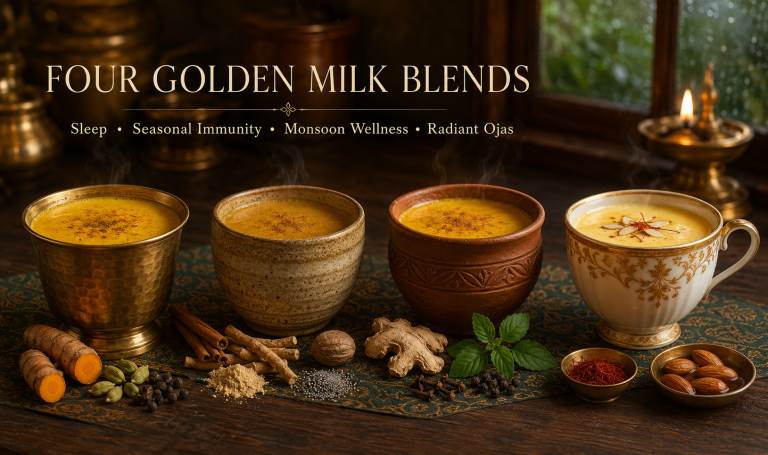
How to transform traditional Haldi Doodh into four purposeful Ayurvedic elixirs
There is no single Golden Milk recipe because there is no single condition of the human body.
The cup that comforts you during a cold monsoon evening may be too heating in summer. The spices that awaken a sluggish morning may be inappropriate when the nervous system is preparing for sleep. A light digestive blend may suit one person, while another needs the deeper nourishment of almonds, saffron, ghee, and warm milk.
This is one of Ayurveda’s most beautiful teachings:
Medicine is not merely a substance. Medicine is the right substance, given to the right person, in the right season, in the right quantity, and at the right time.
My earlier article, Golden Milk: The Ancient Elixir of Light, Healing, and Harmony, explored the history, symbolism, traditional preparation, and sacred relationship between turmeric, milk, Jupiter, and the Moon.
This companion article takes the next step.
Here, we will prepare four distinct Golden Milk blends:
- The Classic Ayurvedic Golden Milk
- The Deep-Rest Golden Milk
- The Monsoon Warming Golden Milk
- The Saffron–Almond Ojas Milk
These are not four fashionable “turmeric lattes.” They are four expressions of the same ancient principle: adapt the medicine to the moment.
Golden Milk Is a Formula, Not Merely an Ingredient
Many people believe Golden Milk means adding turmeric powder to hot milk.
Turmeric is certainly the golden heart of the drink, but the deeper intelligence lies in the formula surrounding it.
Turmeric is traditionally considered heating, drying, clearing, and penetrating. Milk is nourishing, cooling, heavy, building, and lubricating. Ghee carries the qualities of the herbs deeper while softening some of turmeric’s dryness. Black pepper stimulates digestion and complements turmeric, while cardamom makes milk lighter and easier to digest.
The ingredients balance one another.
This is called samyoga—the transformative intelligence of combination. A substance can behave differently depending on what accompanies it, how it is prepared, and who consumes it.
That is why Golden Milk should not be reduced to a list of isolated “benefits.” It is a carefully assembled relationship between nourishment and digestion, warmth and softness, purification and restoration.
The Foundational Ayurvedic Architecture
A well-composed Golden Milk usually contains five elements:
1. The nourishing base
Traditionally, this is cow’s milk, especially when the intention is to nourish ojas, restore depleted tissues, calm Vata, or support convalescence.
If dairy is unsuitable, unsweetened almond or oat milk may be used, although Ayurveda would not consider them identical to cow’s milk in action or subtle quality.
2. The golden herb
Turmeric, or Haridra, provides the formula’s clearing, warming, and circulatory intelligence.
It is traditionally used to support healthy digestion, skin, joints, respiration, and the body’s natural response to inflammation.
3. The digestive companion
Cardamom, ginger, cinnamon, clove, or black pepper prevents the milk from becoming excessively heavy and helps awaken Agni—the intelligence responsible for digestion, assimilation, and transformation.
4. The unctuous carrier
A small amount of ghee or coconut oil helps carry fat-soluble constituents and balances the drying quality of pungent spices.
Curcumin, one of turmeric’s most studied constituents, has naturally low oral bioavailability. Research indicates that piperine from black pepper can increase curcumin exposure, although concentrated extracts used in studies are not equivalent to a culinary pinch of pepper. Fat and warm preparation may also support the practical assimilation of turmeric as food.
5. The intention
Ayurveda never completely separates food from consciousness.
The same milk can be swallowed while scrolling through a phone or received as a nightly ritual of restoration. Chemically, the ingredients may be similar. Experientially and energetically, they are not the same medicine.
Blend One: The Classic Ayurvedic Golden Milk
For everyday nourishment, gentle warmth, and foundational balance
This is the essential blend—the one to learn before adding more elaborate herbs.
It is warming without being aggressively hot, aromatic without becoming overwhelming, and nourishing without being excessively heavy when prepared correctly.
Dry blend
- 3 tablespoons turmeric powder
- 1 teaspoon ground cinnamon
- 1 teaspoon green cardamom powder
- ½ teaspoon freshly ground black pepper
Combine the powders and store them in a clean, dry, airtight glass jar away from direct sunlight.
To prepare one cup
- 1 cup whole milk or suitable unsweetened plant milk
- ½ to ¾ teaspoon Golden Milk blend
- ½ teaspoon ghee or coconut oil
- Jaggery, date paste, or honey, if desired
Preparation
Place the milk, spice blend, and ghee in a small saucepan.
Warm slowly over low heat, whisking until the spices are fully dispersed. Allow the milk to simmer gently for five to seven minutes. Avoid violently boiling it.
Remove it from the heat and let it rest briefly.
If using jaggery or date paste, it may be incorporated according to preference. If using honey, wait until the milk is comfortably warm rather than hot.
Ayurvedic intelligence
This blend is especially appropriate when you want something simple and balancing rather than strongly medicinal.
Turmeric brings movement and clarity. Cardamom lifts the heaviness of milk. Cinnamon adds warmth and sweetness. Black pepper sharpens the formula, while ghee gives it softness and depth.
Best time to drink
- In the evening as a restorative ritual
- After physical practice when the digestive fire is stable
- During cool or damp weather
- During periods of travel, depletion, or irregular routine
Those with high Pitta, acid reflux, active gastritis, or strong heat symptoms should reduce the black pepper and cinnamon.
Blend Two: Deep-Rest Golden Milk
For grounding Vata, quieting evening restlessness, and preparing the body for sleep
Sleep does not begin when the head touches the pillow.
It begins when the body receives enough signals of safety to withdraw from vigilance.
Warm milk has long occupied a place in Indian nighttime ritual because it carries qualities opposite to an overstimulated nervous system. It is warm rather than cold, soft rather than sharp, heavy rather than scattered, and nourishing rather than depleting.
Ashwagandha and nutmeg may deepen this grounding effect, but they should be used with intelligence. More is not better.
Deep-Rest dry blend
- 3 tablespoons turmeric powder
- 1 tablespoon ashwagandha root powder
- 1 teaspoon green cardamom powder
- ½ teaspoon ground cinnamon
- ¼ teaspoon freshly grated nutmeg
Mix thoroughly and store in an airtight glass jar.
Because this formula contains more than ordinary culinary spices, label the jar clearly and keep it away from children.
To prepare one cup
- 1 cup whole milk or unsweetened almond milk
- ½ to ¾ teaspoon Deep-Rest blend
- ½ teaspoon ghee
- A small amount of jaggery or date paste, if desired
Optional:
- ½ teaspoon finely ground culinary poppy seeds, where legal and culturally appropriate
Preparation
Combine the milk, blend, and ghee in a saucepan. Warm gently for five to seven minutes.
If using poppy seeds, grind them freshly and cook them with the milk rather than placing large quantities in the stored powder. Their natural oils can shorten the shelf life of a dry blend.
Drink the milk 45 to 90 minutes before bed, ideally without screens, work, or stimulating conversation.
Why ashwagandha?
In Ayurveda, Ashwagandha is considered a rasayana—a rejuvenative herb used to support resilience, strength, recovery, and the nervous system.
Contemporary research suggests that standardized ashwagandha preparations may produce a modest improvement in sleep quality, particularly among people experiencing stress or insomnia. However, clinical extracts and doses are not identical to a small culinary quantity of root powder in milk. Golden Milk should therefore be understood as a supportive ritual, not a sedative medication or guaranteed treatment for insomnia. (PubMed systematic review)
The role of nutmeg
Nutmeg is traditionally used in extremely small quantities in nighttime milk. Its warmth and heaviness can help settle Vata, but it is powerful.
A pinch may be medicine. A spoonful is not.
Large quantities of nutmeg can produce serious adverse effects, including nausea, agitation, confusion, rapid heartbeat, and hallucinations. The quantity in this batch is deliberately conservative.
Who should avoid the Deep-Rest blend?
Ashwagandha is not appropriate for everyone. Avoid it during pregnancy unless specifically directed by a qualified clinician. People with thyroid disorders, autoimmune conditions, liver disease, upcoming surgery, or those taking sedatives, thyroid medication, immunosuppressants, blood-pressure medication, or diabetes medication should seek individualized guidance. Rare cases of liver injury have also been reported. (NCCIH)
Children should not be given this blend without professional guidance.
Blend Three: Monsoon Warming Golden Milk
For damp weather, sluggish digestion, heavy respiration, and seasonal resilience
The monsoon is not merely a change in weather. From an Ayurvedic perspective, it changes the behavior of the body.
Moisture gathers in the atmosphere. Digestion can become unpredictable. Appetite may weaken. Kapha-like heaviness can accumulate while Vata is disturbed by wind, irregular temperature, and environmental instability.
This is why monsoon formulas tend to be warmer, lighter, more aromatic, and more stimulating than ordinary milk preparations.
Monsoon dry blend
- 2 tablespoons turmeric powder
- 1 tablespoon dry ginger powder, or sonth
- 2 teaspoons tulsi leaf powder
- ½ teaspoon ground black pepper
- ½ teaspoon ground cloves
- 1 teaspoon green cardamom powder
To prepare one cup
- 1 cup milk, or ¾ cup milk with ¼ cup water
- ½ teaspoon Monsoon blend
- ½ teaspoon ghee
- Jaggery, if desired
For a stronger decoction-style preparation, simmer the spices first in the water for three to five minutes, then add the milk and continue warming gently.
Why this blend feels different
Dry ginger is more penetrating and drying than fresh ginger. Black pepper and cloves further increase the heating and stimulating qualities of the formula. Tulsi brings an aromatic clarity traditionally associated with the respiratory system, digestion, and seasonal transitions.
Cardamom prevents the mixture from becoming too dense or harsh.
This formula is intentionally more warming than the classic blend, so the serving quantity is smaller.
The Ayurvedic purpose
This blend may be useful when the weather feels damp, the body feels heavy, the appetite is sluggish, or the throat and respiratory passages feel burdened.
It should not be described as a “flu cure” or a replacement for medical care. Influenza is a viral illness that can become serious. The drink’s purpose is to provide warmth, hydration, digestive support, and comfort during a season in which the body may need greater protection.
Important clarification about Tulsi
Use culinary or medicinal tulsi leaf—not unidentified “tulsi seeds.”
Tulsi seeds are not the same as the commonly sold soaked basil seeds known as sabja. These ingredients are frequently confused online, but they behave very differently. For this warming milk, tulsi leaf is the appropriate ingredient.
Who should reduce or avoid this blend?
Use less or avoid it if you have:
- Strong Pitta symptoms
- Acid reflux or active gastritis
- Mouth ulcers or excessive internal heat
- Sensitivity to pungent spices
- Hot flashes aggravated by warming foods
During high fever, significant breathing difficulty, dehydration, chest pain, or persistent illness, seek appropriate medical care rather than relying on a household beverage.
Blend Four: Saffron–Almond Ojas Milk
For restoration, radiance, reproductive vitality, and sacred nourishment
Some Golden Milk formulas are designed to clear.
This one is designed to build.
Saffron, almonds, cardamom, milk, and ghee belong to a different category of nourishment. They are not primarily included to stimulate or purge the body. They are included to restore what has been spent.
In Ayurveda, ojas is the refined essence of well-nourished tissues. It is associated with immunity, stability, radiance, emotional resilience, fertility, endurance, and the capacity to remain present without becoming easily depleted.
Ojas cannot be forced. It is cultivated through good food, complete digestion, sufficient rest, loving relationships, ethical living, appropriate sensuality, and a regulated nervous system.
This milk becomes one small ritual within that larger architecture.
Saffron–Almond blend
- 3 tablespoons turmeric powder
- 2 teaspoons green cardamom powder
- ½ teaspoon ground cinnamon
- 15 to 20 high-quality saffron strands
Store the saffron threads with the spice blend or in a separate dark container.
It is best to add the almond component freshly rather than storing almond powder at room temperature, where its oils may become rancid.
To prepare one cup
- 1 cup whole milk or unsweetened almond milk
- ½ teaspoon Saffron–Almond blend
- 1 tablespoon finely ground soaked almonds or fresh almond meal
- ½ teaspoon ghee
- 1 teaspoon date paste or a little jaggery, if desired
- An additional 2 or 3 saffron strands for a more luxurious cup
Preparation
If using whole almonds, soak four to six almonds overnight, remove their skins, and grind them into a smooth paste with a little milk.
Place the almond paste, milk, spice blend, saffron, and ghee in a saucepan. Simmer very gently for seven to ten minutes, stirring regularly so the almonds do not settle or scorch.
Allow the drink to rest for a minute before serving.
Why saffron?
Saffron is precious not only because it is expensive, but because its production requires extraordinary care. Each thread is the stigma of the Crocus sativus flower and must be harvested by hand.
In Ayurvedic tradition, saffron is associated with complexion, reproductive vitality, mood, circulation, and the refinement of the tissues. It is often included in nourishing milk preparations when the intention is restoration rather than stimulation.
Modern studies have explored saffron extracts for mood and sleep, but an extract used in a clinical trial is not equivalent to a few culinary strands in milk. The traditional and sensory value of saffron does not require exaggerated medical promises.
When to choose this blend
- After periods of depletion or excessive travel
- During recovery when digestion is reasonably strong
- As a reproductive and preconception nourishment ritual
- When the nervous system needs softness rather than stimulation
- After demanding spiritual practice
- During periods devoted to beauty, refinement, creativity, and Shringar
- On auspicious evenings, full moons, or devotional occasions
When it may be too heavy
This blend may not suit active congestion, very weak digestion, thick tongue coating, nausea, or pronounced Kapha accumulation.
Ojas-building food is helpful only when the body can digest it. Otherwise, what was intended as nourishment may contribute to heaviness and ama.
How Much of the Dry Blend Should You Use?
The quantities above create small household batches. They are not intended to be consumed by the spoonful.
For most adults:
- Begin with ½ teaspoon of blend per cup
- Increase to ¾ teaspoon only if digestion and taste permit
- Use less for the Monsoon blend because it is more pungent
- Drink one cup rather than repeatedly consuming it throughout the day
Ayurveda does not reward excess simply because an ingredient is natural.
A stronger formula is not automatically a more intelligent formula.
Milk, Plant Milk, and Ayurvedic Honesty
Traditional Golden Milk is prepared with milk, not merely because milk makes it creamy, but because milk has its own therapeutic identity within Ayurveda.
Properly sourced and properly digested cow’s milk is traditionally regarded as nourishing, cooling, unctuous, grounding, and supportive of ojas. It is often combined with rejuvenative herbs because it serves as both food and carrier.
However, not everyone digests dairy comfortably or chooses to consume it.
Possible alternatives include:
- Almond milk for a lighter but still nourishing preparation
- Oat milk for sweetness and grounding
- Coconut milk in small amounts for richness, especially when excess heat is present
- Diluted milk when full-strength milk feels too heavy
Plant milks are substitutes in the culinary sense, not exact Ayurvedic equivalents. Choose the medium your body can digest rather than following ideology against direct experience.
The Question of Honey
Classical Ayurveda strongly discourages cooking honey.
If honey is your chosen sweetener, let the Golden Milk cool until it is comfortably warm before adding it. It should not be boiled with the drink.
Jaggery and date paste can be incorporated differently, although sweetness should still be moderate—especially where blood-sugar regulation is a concern.
Golden Milk does not become medicinal simply because it contains turmeric. A heavily sweetened commercial turmeric latte may still function primarily as a dessert.
Which Golden Milk Is Right for You?
| Your present need | Most suitable blend |
|---|---|
| Everyday warmth and balanced nourishment | Classic Ayurvedic Golden Milk |
| Evening restlessness and Vata aggravation | Deep-Rest Golden Milk |
| Damp weather and sluggish seasonal digestion | Monsoon Warming Golden Milk |
| Depletion, restoration and cultivation of ojas | Saffron–Almond Ojas Milk |
| Strong heat, acidity or Pitta aggravation | Use a milder Classic or Saffron blend with reduced pungent spices |
| Congestion and pronounced Kapha heaviness | Use the Monsoon blend lightly, with more water and less milk |
| Very weak digestion or thick ama coating | Pause heavy milk preparations and restore Agni first |
These are general principles, not personalized Ayurvedic prescriptions. Your constitution, present imbalance, season, age, digestion, medications, and health conditions all matter.
A Golden Milk Ritual for Receiving the Medicine
Do not drink it standing over the kitchen counter.
Sit down.
Allow the cup to warm both palms. Notice its fragrance before tasting it. Let the breath lengthen naturally.
You may silently offer the drink to the Divine, to your inner healer, or to the intelligence of the body that has carried you through every season of your life.
Then repeat:
May what is depleted be restored.
May what is disturbed become peaceful.
May what is stagnant begin to move.
May this golden light awaken the wisdom already living within me.
Sip slowly.
The nervous system receives not only ingredients, but context. Warmth, aroma, stillness, safety, gratitude, and attention are also part of digestion.
The Deeper Lesson of the Four Golden Milks
The four recipes teach something larger than how to prepare a beautiful drink.
They remind us that healing is not static.
Sometimes we need purification. Sometimes we need nourishment. Sometimes we need warmth. Sometimes we need cooling. Sometimes the body needs to awaken, and sometimes it needs permission to surrender.
The wisdom lies in recognizing the difference.
The Classic Blend teaches balance.
The Deep-Rest Blend teaches surrender.
The Monsoon Blend teaches adaptation.
The Saffron–Almond Blend teaches replenishment.
All four begin with the same golden root, yet each becomes different through relationship. This is Ayurveda: not the worship of a single ingredient, but the art of creating harmony among substance, season, constitution, preparation, and consciousness.
Turmeric provides the color.
But awareness creates the medicine.
This article is educational and is not a substitute for individualized medical or Ayurvedic care. Herbs and spices can interact with medications and may not be appropriate during pregnancy or for particular health conditions.