Why You Keep Repeating Patterns You Don’t Remember Creating
Have you ever reacted so quickly that you surprised yourself?
Perhaps someone said a single sentence, and suddenly you felt rejected, angry, or anxious before you even had time to think. Maybe you’ve entered a room and instantly felt uncomfortable without knowing why. Or perhaps you keep attracting the same type of relationships, making the same financial decisions, or sabotaging opportunities, despite sincerely wanting something different.
Most people believe these patterns are conscious choices.
In reality, many of them originate from something far deeper:
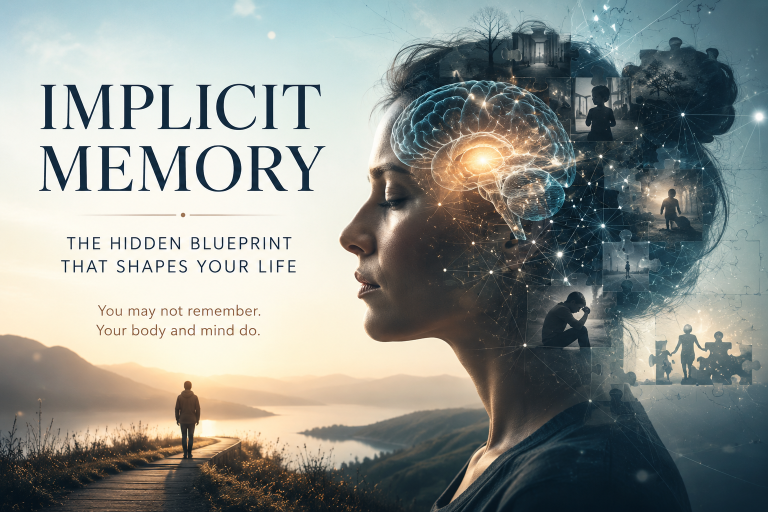
Implicit Memory.
It is one of the most powerful forces shaping human behavior, yet most people have never heard of it.
You may not consciously remember the events that created it, but your nervous system certainly does.
What Is Implicit Memory?
Memory is often imagined as a library.
You remember your first school, your wedding, your graduation, your first car, or the holiday you took last year.
These are explicit memories—memories you can consciously recall.
Implicit memory is different.
It is memory that operates without conscious awareness.
Rather than remembering facts or events, implicit memory stores:
- emotional reactions
- body sensations
- survival responses
- movement patterns
- habits
- conditioned beliefs
- expectations of safety or danger
You don’t remember the experience.
You become the experience.
Your Body Remembers What Your Mind Has Forgotten
One of the most fascinating discoveries in neuroscience is that the brain begins learning long before it develops the ability to create conscious memories.
A baby may never remember their first year of life.
Yet that first year may become the foundation of their entire personality.
Were they consistently soothed?
Were they frequently ignored?
Was the household calm?
Was it unpredictable?
Did caregivers smile with warmth?
Or with tension?
None of these become stories.
They become biology.
The nervous system quietly asks one question over and over:
“Is the world safe?”
The answer becomes embedded in implicit memory.
Before Words, There Is Feeling
Long before language develops, the brain is already recording experience.
The infant cannot think:
“My parents seem emotionally unavailable.”
Instead, the body simply learns:
“I am alone.”
It cannot think:
“I am loved.”
It simply relaxes.
This is why many adults struggle to explain why they feel anxious, abandoned, or unworthy.
Nothing appears “wrong.”
There is no conscious memory.
Only a deeply familiar feeling.
The Architecture of the Brain
Different memory systems rely on different brain structures.
The hippocampus helps create explicit memories—the stories and events you can recall.
But implicit memories depend far more on structures such as:
- the amygdala
- the cerebellum
- the basal ganglia
- brainstem survival circuits
These systems operate far faster than conscious thinking.
By the time you “decide” how to respond…
Your nervous system has often already decided.
This explains why emotional reactions frequently feel automatic.
The Invisible Operating System
Imagine buying a brand-new computer.
The screen is beautiful.
The keyboard works perfectly.
Everything looks modern.
Yet hidden beneath the surface is an operating system controlling every process.
Implicit memory functions in much the same way.
It quietly determines:
- who feels trustworthy
- what feels dangerous
- how much success feels safe
- how close intimacy can become
- how much abundance you allow
- how you handle criticism
- how you respond to uncertainty
Most people spend years trying to change the “apps.”
Few ever update the operating system.
Why Trauma Isn’t Only About Big Events
Many people believe trauma only refers to catastrophic experiences.
Modern psychology paints a much broader picture.
Trauma is not simply what happened.
It is what happened inside the nervous system.
Sometimes implicit memories form through obvious events.
Accidents.
Violence.
Abuse.
Loss.
But just as often they emerge through thousands of tiny experiences.
Repeated criticism.
Emotional inconsistency.
Feeling unseen.
Never being comforted.
Growing up around constant stress.
The nervous system doesn’t measure events by logic.
It measures them by perceived safety.
Predictive Brains
The brain is not designed merely to remember the past.
It is designed to predict the future.
Every implicit memory becomes a prediction.
“If this happened before…”
“It may happen again.”
This allows us to avoid danger.
It also traps us inside familiar patterns.
A person rejected once may begin expecting rejection everywhere.
Someone betrayed repeatedly may interpret kindness as manipulation.
Someone who experienced scarcity may feel anxious even when financially secure.
The past quietly becomes tomorrow’s expectation.
Why Meditation Sometimes Feels Difficult
Many people begin meditation expecting immediate peace.
Instead, they encounter restlessness.
Old emotions.
Random memories.
Unexpected discomfort.
This makes perfect sense.
When external distractions become quieter, implicit memories become easier to notice.
Silence does not create anxiety.
It reveals what was already present beneath constant activity.
Meditation becomes less about creating peace and more about discovering what prevents it.
The Yogic Understanding
Although neuroscience uses the language of implicit memory, yogic philosophy has described similar principles for thousands of years.
Yoga speaks of Samskaras.
These are subtle impressions left upon consciousness through repeated experience, thought, emotion, and action.
Every action leaves an imprint.
Every reaction strengthens a pathway.
Every habit deepens a groove.
Eventually those grooves begin living us instead of us living consciously.
What neuroscience calls implicit memory…
Yoga calls conditioned consciousness.
Different language.
Remarkably similar insight.
Why We Keep Attracting Similar Relationships
One of the greatest misunderstandings about relationships is believing we choose entirely consciously.
In reality, implicit memory often determines what feels familiar.
Unfortunately…
Familiar is not always healthy.
Someone raised around emotional unpredictability may unconsciously associate inconsistency with love.
Someone raised around criticism may feel strangely uncomfortable receiving genuine appreciation.
The nervous system often chooses familiarity before happiness.
Healing therefore requires more than positive thinking.
It requires expanding what the nervous system recognizes as safe.
Implicit Memory Lives in the Body
Notice what happens when someone raises their voice.
Before thinking…
Your shoulders tighten.
Your breathing changes.
Your jaw clenches.
Your stomach contracts.
These reactions occur in milliseconds.
The body remembers before the mind explains.
This is why somatic therapies, breathwork, trauma-informed yoga, and nervous system regulation have become increasingly important.
They speak the language implicit memory understands:
Experience.
Not explanation alone.
Can Implicit Memory Change?
Absolutely.
The brain remains remarkably adaptable throughout life.
This ability is called neuroplasticity.
Every new experience of genuine safety, connection, competence, and regulation helps reshape existing pathways.
Healing does not erase the past.
It gradually teaches the nervous system a larger truth.
“I survived then.”
“But I am safe now.”
This is why transformation requires repetition.
One insight rarely changes a lifetime of conditioning.
Hundreds of regulated experiences do.
Kundalini Yoga and Implicit Memory
Kundalini Yoga offers a unique perspective on transformation.
Many kriyas combine:
- breath
- posture
- movement
- rhythm
- mantra
- focused awareness
Together they influence both the body and the mind.
Rather than working only through intellectual understanding, these practices can help shift habitual patterns by cultivating greater awareness, emotional regulation, and resilience. Many practitioners describe experiencing long-held emotional responses becoming easier to observe without immediately reacting to them.
Whether described as balancing the nervous system, strengthening awareness, or clearing old samskaras, the essential movement is the same:
Creating enough presence that unconscious conditioning no longer runs life automatically.
Awareness Is the First Freedom
Perhaps the greatest gift of understanding implicit memory is compassion.
You begin realizing that much of human behavior is not deliberate.
People often react from programming they never consciously chose.
This understanding does not remove responsibility.
But it changes how responsibility begins.
Instead of asking:
“What’s wrong with me?”
You begin asking:
“What has my nervous system learned?”
That single question transforms shame into curiosity.
Curiosity creates awareness.
Awareness creates choice.
Choice creates freedom.
A Daily Practice to Rewrite the Invisible
Spend a few minutes each evening reflecting on these questions:
- What situation triggered me most today?
- What emotion appeared first?
- Where did I feel it in my body?
- Did this reaction truly belong to today, or did it feel much older?
- What would safety have looked like in that moment?
- How can I offer that safety to myself now?
Do not rush to fix the answers.
Simply observe.
Awareness itself begins loosening unconscious patterns.
The Real Journey
Most people spend their lives trying to change their circumstances.
Few realize they are living through unconscious maps drawn decades earlier.
Implicit memory reminds us that transformation is not only about acquiring new knowledge.
It is about bringing light into the hidden places where old experiences silently became today’s identity.
Every conscious breath.
Every compassionate response.
Every moment you choose presence over automatic reaction.
Every time you remain open instead of defensive.
You are teaching your nervous system something profoundly important:
The past may have written the first chapters of your story, but it does not have to write the ending.
That is where true freedom begins.