
For more than a century, quantum physics has challenged the way humanity understands reality.
Particles behave like waves.
Observation changes outcomes.
Objects exist in probabilities rather than certainties.
And now, another astonishing discovery is reshaping our understanding of the quantum world:
Quantum particles may retain a hidden memory of their entire trajectory history.
Not metaphorically.
Not philosophically.
But physically.
Researchers at the Weizmann Institute of Science have demonstrated that photons moving through a quantum system leave behind subtle informational traces of everywhere they have been — even along paths they appeared not to take in conventional measurements.
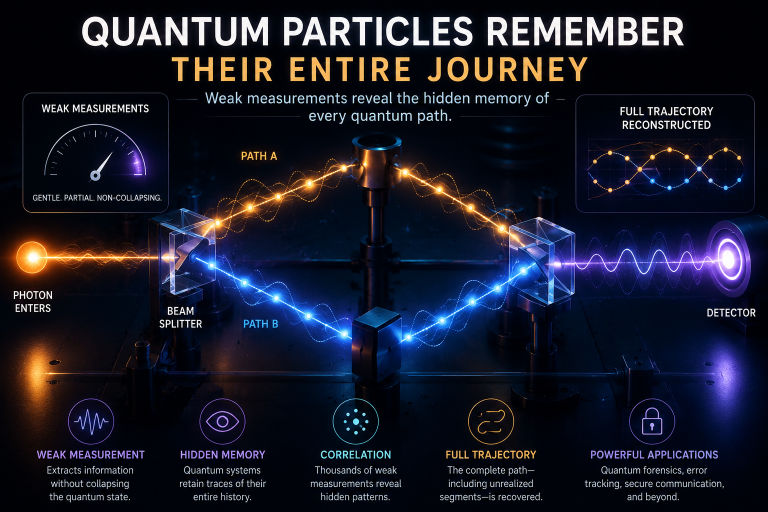
Using weak quantum measurements, physicists reconstructed the full trajectory history of photons traveling through a Mach-Zehnder interferometer without fully collapsing the wave function.
This means the quantum system preserved hidden historical information all along.
The past was still there.
Invisible…
but encoded into reality itself.
The Classical View vs The Quantum View
In classical physics, a particle has a clear trajectory.
A baseball travels from point A to point B through a definable path.
A car drives down a road.
A planet orbits a star.
Its history is continuous and observable.
Quantum particles behave differently.
Before measurement, a quantum particle exists as a wave function — a spread-out field of probabilities rather than a fixed object in one location.
According to traditional interpretations:
- The particle does not have a definite path
- Measurement collapses the wave function
- The unobserved possibilities disappear
For decades, physicists believed that once the wave function collapsed, the unrealized paths vanished completely.
But weak measurement experiments are now revealing something extraordinary:
Those paths may not disappear at all.
Instead, they leave behind faint informational echoes embedded within the quantum field.
What Is a Weak Measurement?
Normally, measuring a quantum particle strongly disturbs it.
This is one of the foundational principles of quantum mechanics.
If you directly observe which path a photon takes, the act of observation collapses the wave function and destroys the interference pattern.
In simple terms:
the measurement changes the system.
But weak measurements operate differently.
Instead of forcefully extracting information, they interact with the particle so gently that the quantum state remains mostly intact.
Each individual weak measurement is extremely noisy and incomplete.
But when scientists correlate thousands of weak measurements together, hidden statistical patterns emerge.
Those patterns reveal information that conventional measurements cannot access.
This is precisely what the researchers achieved.
The Mach-Zehnder Interferometer Experiment
The team used a device called a Mach-Zehnder interferometer — one of the most important experimental tools in quantum physics.
A photon enters the system and encounters a beam splitter, creating two potential paths simultaneously.
The photon behaves like a wave distributed across both paths.
Eventually the paths recombine and create interference patterns.
Under conventional measurement:
you only observe the final outcome.
But with weak measurements:
scientists extracted partial path information throughout the journey without fully collapsing the wave function.
By combining enormous amounts of weak measurement data, they reconstructed the photon’s complete trajectory history.
Even more astonishing:
The reconstruction included path segments the photon seemingly never traversed in standard observations.
The system retained hidden correlations encoding the particle’s entire journey.
The photon “remembered” its history.
Quantum Memory Exists in Correlations
This discovery challenges a simplistic interpretation of wave function collapse.
Wave functions do not merely appear and vanish into nothingness.
Instead, they leave coherent informational traces within:
- The measurement apparatus
- The surrounding environment
- The entangled quantum field itself
This aligns with deeper principles already hinted at in quantum theory:
Information is never truly lost
Quantum mechanics has long suggested that information is fundamentally conserved.
Even black hole physics now revolves around the “information paradox” — the question of whether information can ever disappear from the universe.
This new work suggests that quantum systems preserve historical information in subtle correlations that are usually inaccessible to ordinary observation.
Weak measurements simply reveal what was already there.
The Universe May Record Everything
The philosophical implications are staggering.
If quantum systems preserve traces of prior states, then reality may possess a kind of distributed memory architecture.
Every interaction leaves an imprint.
Every observation modifies the informational fabric of the system.
Every event contributes to an unfolding historical field.
This does not mean particles “remember” consciously.
But it does suggest that the universe stores relational information far more deeply than previously understood.
From a broader perspective, reality may function less like isolated objects and more like an interconnected informational continuum.
Modern physics increasingly points toward this possibility:
- Quantum entanglement links distant particles instantly
- Decoherence spreads information into the environment
- Quantum fields permeate all space
- Weak measurements reveal hidden histories
The universe may not erase the past.
It may encode it.
Quantum Forensics: Reconstructing the Invisible
One of the most exciting applications of this discovery is something researchers call:
Quantum Forensics
If the full trajectory history of a quantum particle can be reconstructed from final-state measurements, scientists may eventually be able to reverse-engineer entire quantum events after they occur.
Potential applications include:
Quantum Computing Error Tracking
Quantum computers are extremely sensitive to decoherence and noise.
Weak measurement techniques may help scientists identify where quantum information deviated or became corrupted during computation.
This could dramatically improve quantum error correction systems.
Quantum Communication Authentication
Quantum communication relies on the integrity of entangled states.
Hidden trajectory reconstruction could help verify whether information channels were intercepted, disturbed, or manipulated.
This has major implications for ultra-secure communications.
Fundamental Physics Research
Weak measurements may allow physicists to probe:
- Hidden quantum variables
- Decoherence pathways
- Entanglement histories
- Quantum gravity behavior
- Time symmetry in quantum systems
Entire new branches of experimental physics may emerge from this capability.
The Bridge Between Physics and Consciousness?
While this experiment does not prove anything about consciousness directly, discoveries like this continue to blur the line between observation, information, and reality itself.
Quantum physics increasingly reveals that:
- Observation matters
- Information persists
- Reality is relational
- Hidden layers exist beneath ordinary perception
This is one reason quantum theory continues to fascinate philosophers, neuroscientists, contemplatives, and consciousness researchers alike.
The deeper we look into matter,
the less reality resembles solid objects —
and the more it resembles dynamic fields of information and probability.
The Future of Quantum History
For decades, scientists assumed that unobserved quantum paths were inaccessible forever.
But weak measurement techniques are opening a doorway into the hidden memory structure of reality.
The implications are profound.
Particles may carry informational histories.
Wave functions may leave persistent traces.
Quantum systems may preserve far more of the past than anyone realized.
And perhaps most importantly:
What appears lost may simply be hidden beneath the threshold of ordinary observation.
Reality may remember far more than we think.
Source:
Weizmann Institute of Science — Department of Physics
Physical Review X (2024)
#QuantumPhysics #WeakMeasurement #QuantumMemory #QuantumTrajectory #Physics #ScienceBreakthrough #QuantumMechanics #Consciousness #QuantumComputing #PhysicsDiscovery