
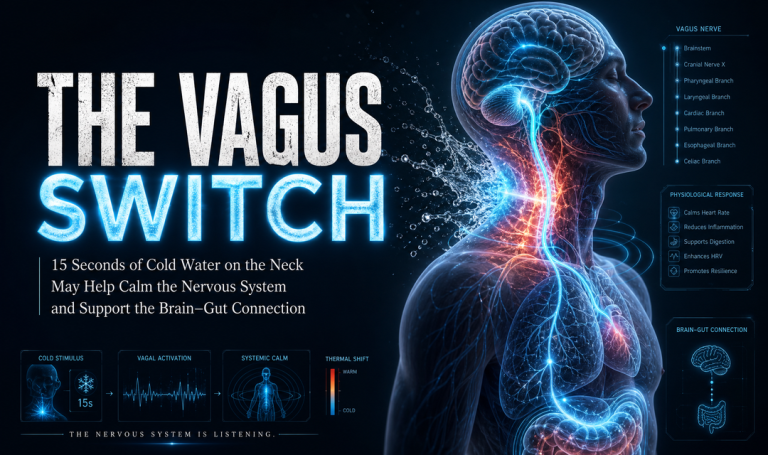
How a Simple Cold-Water Signal May Help Calm Inflammation, Clear Brain Fog, and Restore Nervous System Balance
You reach the end of the day and your body feels impossibly heavy.
Your thoughts are slower than usual. Your digestion feels swollen and uncomfortable after meals. Small things irritate you more than they should. Sleep doesn’t fully restore you. Even after rest, something still feels “on edge” inside your system.
For many people, this is not laziness, weakness, aging, or lack of discipline.
It is often the physiology of chronic low-grade inflammation.
Not the dramatic inflammation of an acute infection or injury, but the quieter, more persistent kind—the type that simmers silently beneath modern life. The kind linked to chronic stress, nervous system overload, emotional suppression, poor sleep, processed food, environmental toxins, hyperstimulation, trauma, and a body that never truly feels safe enough to relax.
Your nervous system becomes trapped in a subtle but continuous survival state.
And one of the most important biological regulators of that survival state is a wandering nerve that ancient yogic systems intuitively understood long before neuroscience gave it a name:
The vagus nerve.
The Great Biological Highway
The vagus nerve—known anatomically as Nervus vagus—is the longest cranial nerve in the human body.
The word vagus comes from the Latin word for “wandering,” because this nerve travels from the brainstem through the face, throat, heart, lungs, diaphragm, digestive organs, liver, pancreas, spleen, and intestines.
It is less like a single wire and more like an entire communication network.
It continuously exchanges information between the brain and the organs, monitoring:
- Heart rate
- Breath rhythm
- Digestion
- Immune activity
- Inflammation
- Emotional stress
- Blood pressure
- Gut microbiome signaling
- Safety perception
Nearly 80% of vagal fibers actually travel from the body to the brain, not the other way around.
This means your body is constantly informing your mind how safe—or unsafe—it feels.
When the vagus nerve functions optimally, the body can transition smoothly out of stress states and return to regulation.
When vagal tone is impaired, the body struggles to shut off survival chemistry.
The Inflammation Loop
Inflammation itself is not bad.
Inflammation is one of the body’s greatest healing tools. Without it, wounds would not close, infections would spread unchecked, and damaged tissues could not repair themselves.
The problem begins when inflammation never fully switches off.
Modern life exposes the nervous system to chronic micro-threats:
- Constant notifications
- Emotional suppression
- Financial stress
- Sleep deprivation
- Social disconnection
- Processed foods
- Sedentary behavior
- Hypervigilance
- Unresolved trauma
- Chronic overstimulation
The immune system begins behaving as though danger is always present.
This creates persistent inflammatory signaling through molecules called cytokines, including:
- Interleukin-6 (IL-6)
- Tumor necrosis factor alpha (TNF-α)
- C-reactive protein (CRP)
Over time, this low-grade inflammatory state contributes to:
- Brain fog
- Anxiety
- Depression
- Chronic fatigue
- Bloating
- Autoimmune dysfunction
- Insulin resistance
- Cardiovascular disease
- Mood instability
- Digestive problems
- Nervous system exhaustion
The body forgets how to fully return to calm.
And this is where the vagus nerve becomes incredibly important.
The Vagus Nerve: The Body’s “Brake Pedal”
The vagus nerve is one of the primary regulators of the parasympathetic nervous system—the branch associated with rest, digestion, healing, repair, and restoration.
It acts like a biological brake pedal.
When activated appropriately, the vagus nerve can:
- Slow heart rate
- Improve digestion
- Reduce stress hormones
- Increase calmness
- Improve emotional regulation
- Support gut function
- Reduce inflammatory signaling
Scientists now refer to part of this mechanism as the:
Cholinergic Anti-Inflammatory Pathway
This pathway allows the nervous system to directly influence immune behavior.
In simple language:
The brain can tell the immune system to calm down.
The vagus nerve communicates with organs like the spleen and digestive tract, helping regulate inflammatory cytokine production.
This means inflammation is not merely biochemical—it is also neurological.
The Cold-Water Reflex
One of the fastest ways to stimulate vagal activity appears to be cold exposure.
When cold water touches specific regions of the body—especially the face, neck, and upper chest—it activates ancient survival reflexes embedded deep within the autonomic nervous system.
This includes:
- The mammalian dive reflex
- Baroreceptor activation
- Parasympathetic rebound
- Vagal stimulation
The side of the neck is especially important because it contains:
- Carotid baroreceptors
- Major blood vessels
- Dense vagal pathways
When cold water is briefly applied to this region, the nervous system interprets it as a signal requiring adaptation and conservation.
Heart rate may slow slightly.
Breathing patterns shift.
The nervous system recalibrates.
And in some individuals, this may rapidly reduce feelings of stress activation.
The “15-Second Vagus Switch”
Recent discussions online have popularized the idea that placing ice-cold water on the side of the neck for 15 seconds can “switch off inflammation.”
This language is obviously simplified.
Human biology is more complex than a single instant cure.
However, there is legitimate scientific interest surrounding vagal stimulation and inflammatory regulation.
Research in neuroimmunology increasingly supports the idea that activating vagal pathways can influence immune signaling and inflammatory processes. Experimental vagus nerve stimulation therapies are already being explored for conditions involving inflammation, depression, epilepsy, autoimmune disorders, and PTSD.
Cold exposure may act as a simpler mechanical trigger for some of these pathways.
The mechanism likely involves:
- Thermal stimulation
- Autonomic nervous system response
- Parasympathetic activation
- Cholinergic anti-inflammatory signaling
While claims like “all inflammation shuts off in 4 minutes” are likely exaggerated, many people genuinely report:
- Clearer thinking
- Reduced stress
- Improved calmness
- Better emotional regulation
- Nervous system reset sensations
- Increased alertness
- Improved resilience
after brief cold exposure practices.
The Gut-Brain Connection
The vagus nerve is also deeply connected to the digestive system.
Your gut and brain are in constant conversation.
The gut microbiome produces neurotransmitters and signaling molecules that affect:
- Mood
- Anxiety
- Focus
- Cravings
- Motivation
- Emotional regulation
Meanwhile, the brain influences:
- Gut motility
- Enzyme secretion
- Intestinal permeability
- Inflammation
- Digestive efficiency
This is why chronic stress often creates digestive symptoms.
The body cannot fully digest while preparing for danger.
When vagal tone improves, digestion often improves too.
People may notice:
- Less bloating
- Easier bowel movements
- Reduced stomach tightness
- Better nutrient absorption
- More stable mood after meals
The nervous system and digestive system are not separate systems.
They are one conversation.
Ancient Yogic Systems Understood This Differently
Long before neuroscience mapped the vagus nerve, yogic traditions observed that certain breathing practices, chanting techniques, cold-water rituals, and meditative states could rapidly alter emotional and physiological states.
In Kundalini Yoga and many traditional systems:
- Cold showers were used to strengthen the nervous system
- Breathwork regulated internal energy and autonomic rhythm
- Chanting stimulated vagal regions in the throat
- Deep diaphragmatic breathing activated parasympathetic states
- Meditation reduced internal stress reactivity
Modern science is increasingly discovering measurable mechanisms behind many of these ancient observations.
Not because spirituality replaces biology—but because consciousness and physiology are profoundly interconnected.
The Cold-Water Neck Practice
The Vagus Switch Protocol
This is not a miracle cure.
It is a nervous system stimulus.
Practice:
- Use cold or ice-cold water
- Apply it to the side of the neck
- Focus below the jawline toward the collarbone
- Continue for approximately 15–30 seconds
- Breathe slowly while doing it
You can try this:
- At the end of a shower
- During high stress
- After emotional overwhelm
- During brain fog
- After overstimulation
- Before meditation or breathwork
Important Perspective
Cold exposure is not appropriate for everyone.
Individuals with:
- cardiovascular disease,
- severe hypertension,
- cold hypersensitivity,
- certain neurological conditions,
- or medical instability
should consult a healthcare professional before intense cold practices.
And no single technique “cures” chronic inflammation.
Real healing usually involves:
- sleep,
- nutrition,
- emotional regulation,
- movement,
- connection,
- nervous system safety,
- sunlight,
- stress reduction,
- and long-term lifestyle coherence.
But small physiological interventions can sometimes create meaningful shifts.
Especially when practiced consistently.
Your Body Is Listening
Perhaps the most profound realization emerging from modern neuroimmunology is this:
Your body is constantly interpreting your internal and external world.
Every thought.
Every breath.
Every stress pattern.
Every relationship.
Every moment of safety or danger.
The nervous system is not merely electrical wiring.
It is an intelligent adaptive field continuously asking:
“Am I safe enough to heal?”
The vagus nerve appears to be one of the great translators of that answer.
And sometimes, something as simple as cold water on the neck is not just about temperature.
It is a signal.
A message to the body that the emergency may finally be over.