How Prolonged Emotional Abuse Reshapes the Brain, Body, and Sense of Self
Emotional abuse does not leave bruises the way physical violence does.
But neuroscience increasingly shows that chronic emotional harm leaves measurable biological fingerprints inside the brain and nervous system.
Words can become weapons.
Silence can become punishment.
Manipulation can become a biochemical environment.
When a human being lives for months or years inside criticism, humiliation, unpredictability, gaslighting, intimidation, emotional withdrawal, or constant psychological tension, the brain adapts for survival — not for peace, creativity, intimacy, or joy.
The nervous system begins reorganizing itself around threat.
What many people call “being too sensitive,” “overreacting,” or “unable to let things go” is often a deeply conditioned survival response built through prolonged exposure to emotional danger.
This is not weakness.
It is neurobiology.
The Brain Was Never Designed for Chronic Emotional Threat
The human nervous system evolved to survive short bursts of danger.
If our ancestors encountered a predator, the body would activate a stress response:
- Cortisol increases
- Adrenaline surges
- Heart rate rises
- Muscles tense
- Attention narrows toward survival
After the danger passed, the nervous system would ideally return to baseline.
But emotional abuse creates a very different kind of environment.
The threat is not a tiger that appears for a few moments.
The threat becomes ongoing.
It becomes:
- daily criticism
- emotional unpredictability
- walking on eggshells
- emotional abandonment
- manipulation
- yelling
- passive aggression
- gaslighting
- shame
- invalidation
- psychological control
The nervous system never fully exits survival mode.
Over time, stress chemistry stops being temporary and becomes chronic.
And chronic stress changes the architecture of the brain itself.
Cortisol: The Chemical of Survival
Cortisol is often called the “stress hormone,” but its role is more complex than that.
It helps mobilize energy during danger.
In short-term situations, cortisol is protective and intelligent.
The problem begins when cortisol remains elevated for long periods.
Under chronic emotional stress, the body behaves as if danger is always nearby.
Research in psychoneuroendocrinology shows prolonged cortisol elevation can contribute to:
- impaired memory
- weakened immune function
- sleep disruption
- digestive problems
- inflammation
- anxiety disorders
- emotional dysregulation
- reduced cognitive flexibility
The body begins prioritizing survival over restoration.
This is why people emerging from emotionally abusive environments often report:
- brain fog
- exhaustion
- forgetfulness
- difficulty concentrating
- emotional numbness
- panic responses
- dissociation
- chronic fatigue
- hypervigilance
Their biology has been living in emergency mode.
The Amygdala: When the Brain Becomes Hyper-Alert
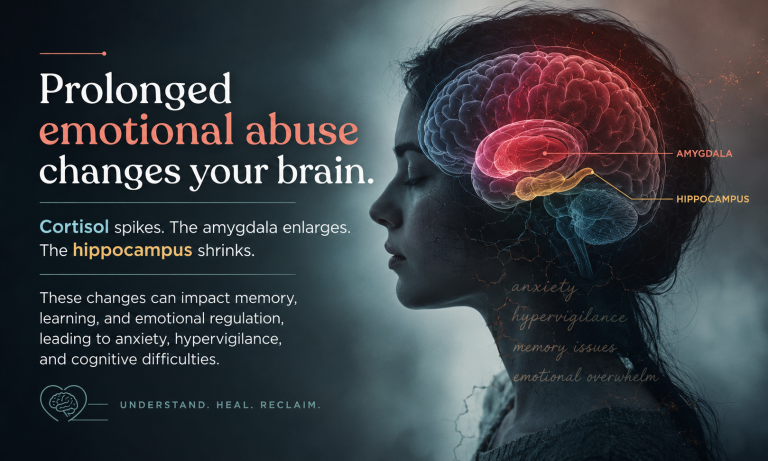
One of the brain regions most affected by prolonged emotional abuse is the amygdala.
The amygdala acts like the brain’s threat-detection center.
It scans for danger continuously.
When a person experiences repeated emotional volatility or psychological harm, the amygdala can become hyperactive and enlarged.
In practical terms, this means the brain becomes more sensitive to perceived threats.
A neutral facial expression may suddenly feel dangerous.
A delayed text may trigger panic.
A change in tone may feel catastrophic.
The nervous system learns:
“Danger can happen at any moment.”
This is why survivors of emotional abuse often struggle with:
- hypervigilance
- exaggerated startle responses
- anxiety
- difficulty relaxing
- fear of conflict
- emotional overactivation
- intrusive thoughts
Their nervous system is not “dramatic.”
It has been trained to scan constantly for emotional danger.
The Hippocampus: Memory, Learning, and Emotional Processing
Another critical brain structure impacted by chronic stress is the hippocampus.
The hippocampus plays a major role in:
- memory formation
- emotional processing
- learning
- contextual awareness
Studies have shown that prolonged exposure to elevated cortisol may contribute to hippocampal shrinkage.
This matters because the hippocampus helps the brain distinguish between:
- past vs present
- real danger vs perceived danger
- memory vs immediate threat
When the hippocampus becomes impaired, a person may struggle with:
- memory lapses
- concentration difficulties
- emotional flooding
- confusion
- feeling mentally “scattered”
- difficulty learning new information
Trauma survivors often say:
“I don’t feel like myself anymore.”
That feeling is not imaginary.
The brain itself has been adapting under pressure.
Gaslighting and Cognitive Fragmentation
One of the most psychologically destabilizing forms of emotional abuse is gaslighting.
Gaslighting occurs when a person repeatedly manipulates another into doubting:
- their perception
- memory
- emotions
- intuition
- reality
Phrases like:
- “That never happened.”
- “You’re too sensitive.”
- “You’re imagining things.”
- “You’re crazy.”
- “You always overreact.”
may seem subtle from the outside.
But over time, they fracture self-trust.
The brain begins overriding its own internal signals in order to maintain attachment or avoid conflict.
This creates profound cognitive dissonance:
- “I feel harmed… but maybe I’m wrong.”
- “I know what happened… but maybe I imagined it.”
- “I feel unsafe… but maybe I’m the problem.”
Eventually the nervous system becomes trapped between intuition and survival.
And survival often wins.
Why Survivors Become Hypervigilant
Hypervigilance is not paranoia.
It is pattern recognition amplified by pain.
When someone has lived inside emotional unpredictability, the nervous system becomes highly skilled at scanning for micro-signals:
- tone shifts
- facial expressions
- silence
- tension
- withdrawal
- changes in energy
The body learns:
“If I detect danger early enough, maybe I can stay safe.”
This can create extraordinary sensitivity.
But it also creates exhaustion.
Because the nervous system never truly rests.
Even in safe environments, the body may still anticipate attack.
This is one reason healing from emotional abuse can take time:
the body must learn safety again.
Emotional Abuse Often Becomes Physiological Illness
The mind and body are not separate systems.
Chronic emotional stress affects:
- the immune system
- hormonal balance
- digestion
- cardiovascular health
- inflammation pathways
- sleep architecture
- mitochondrial energy production
Research in psychoneuroimmunology increasingly links chronic psychological stress to:
- autoimmune dysfunction
- IBS and digestive disorders
- chronic fatigue
- migraines
- fibromyalgia
- anxiety disorders
- depression
- metabolic disruption
The body carries what the mind cannot fully process.
Trauma is not only remembered psychologically.
It is embodied neurologically, hormonally, and physiologically.
Healing the Brain After Emotional Abuse
The hopeful reality is this:
The brain is plastic.
Neuroplasticity means the nervous system can reorganize and heal.
But healing rarely occurs through logic alone.
A dysregulated nervous system does not heal because someone says:
“You’re safe now.”
It heals through repeated lived experiences of safety.
This may include:
- trauma-informed therapy
- nervous system regulation
- somatic practices
- meditation
- breathwork
- safe relationships
- healthy boundaries
- restorative sleep
- proper nutrition
- emotional validation
- community support
Practices like mindfulness and meditation have even been shown in some studies to positively influence amygdala reactivity and hippocampal health over time.
The nervous system slowly relearns:
- safety
- trust
- presence
- emotional regulation
- self-worth
Healing is not about becoming who you were before the trauma.
It is about becoming someone whose nervous system no longer lives in war.
The Deepest Damage of Emotional Abuse
Perhaps the greatest wound emotional abuse creates is not fear.
It is disconnection from self.
People begin abandoning:
- their intuition
- emotions
- needs
- truth
- boundaries
- voice
Survival teaches adaptation.
But healing teaches reconnection.
The goal is not simply to “move on.”
The goal is to rebuild internal safety so thoroughly that the nervous system no longer confuses love with tension, attachment with anxiety, or silence with peace.
Because real safety does not require shrinking yourself to survive someone else’s instability.
And real healing begins the moment the body realizes:
“I do not have to stay at war to stay alive.”