
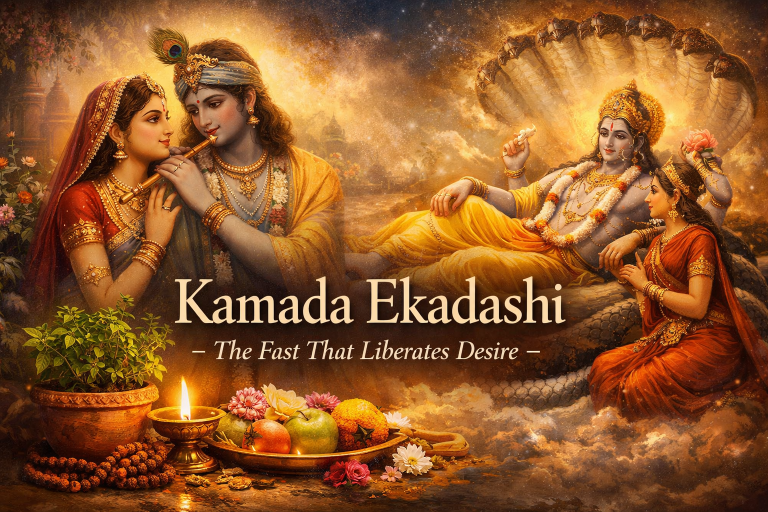

There are moments in the Vedic calendar that are not merely dates—but doorways.
Kamada Ekadashi is one such portal.
Falling in the waxing phase (Shukla Paksha) of the lunar month of Chaitra, Kamada Ekadashi is revered as the Ekadashi that fulfills desires—but not in the superficial way the mind imagines. It does not grant every craving. It refines desire itself.
It transforms Kama (desire) into Prema (divine love).
🔱 What Does “Kamada” Really Mean?
The Sanskrit word Kamada comes from:
- Kama — desire, longing, attraction
- Da — that which gives or fulfills
So Kamada Ekadashi is often translated as:
👉 “The Ekadashi that fulfills desires.”
But in the deeper yogic and dharmic lens, it is:
✨ The Ekadashi that purifies desire so that only aligned desires remain.
Because not all desires are meant to be fulfilled.
Some are meant to be:
- Seen
- Burned
- Transformed
📖 The Sacred Story Behind Kamada Ekadashi
The origin of Kamada Ekadashi is narrated in the Varaha Purana, through a story that beautifully illustrates the power of devotion over karma.
The Story of Lalit and Lalita
Once, in the celestial realm of Gandharvas (heavenly musicians), there lived a couple:
- Lalit — a gifted musician
- Lalita — his devoted wife
During a royal performance in the court of a king, Lalit became distracted—lost in thoughts of his beloved Lalita. His rhythm faltered.
The king, angered by this lapse, cursed Lalit to become a fearsome demon.
In a single moment:
- Beauty turned into distortion
- Harmony into suffering
- Love into separation
Lalita, heartbroken but unwavering, sought guidance from sages. She was instructed to observe Kamada Ekadashi with full devotion and offer the merit (punya) of the fast to her husband.
She did.
And through that sincere vrata (sacred observance):
✨ The curse was lifted
✨ Lalit regained his celestial form
✨ Love was restored
🔥 The Deeper Teaching
This is not just a myth.
It is a map.
What is the “curse”?
- Misalignment
- Distraction
- Forgetfulness of purpose
- Being consumed by unconscious desire
What is the “demon”?
- The distorted self
- The reactive self
- The version of you driven by compulsion instead of clarity
What is the “fast”?
Not just food.
But:
- Fasting from unconscious patterns
- Fasting from distraction
- Fasting from emotional indulgence
And what is the “liberation”?
The return to your original rhythm.
🌙 Why Ekadashi Matters (Beyond Ritual)
Ekadashi is the 11th lunar day, a point where:
- The mind is naturally more sensitive
- The body is more receptive to purification
- The nervous system can shift more easily
In yogic physiology:
👉 This is a powerful day to reset prana (life force)
Because digestion, desire, and perception are deeply linked.
When you reduce food intake:
- Energy moves upward
- Awareness sharpens
- Emotional residue surfaces
🧘♂️ The Spiritual Science of Fasting
Fasting on Ekadashi is not punishment.
It is recalibration.
When you fast consciously:
- The gut rests → freeing energy
- The mind quiets → reducing noise
- The senses withdraw → turning inward
This creates a state where:
✨ Desire can be observed without being acted upon
✨ Patterns can be seen without being justified
✨ Energy can be redirected toward higher centers
🌸 How to Observe Kamada Ekadashi
This is where ritual becomes embodied practice.
🌅 Preparation (Day Before)
- Eat light, sattvic meals
- Reduce stimulation (screens, noise, conflict)
- Set a clear intention (Sankalpa)
👉 What desire am I ready to purify—not just fulfill?
🌞 On Ekadashi Day
1. Fasting Options
- Nirjala (no food or water — advanced practitioners)
- Phalahar (fruits, nuts, milk)
- Simple fasting (light sattvic meals, no grains or beans)
2. Mantra & Devotion
Chanting aligns the emotional body.
You may work with:
- Om Namo Bhagavate Vasudevaya
- Hare Krishna Hare Krishna Krishna Krishna Hare Hare
Hare Rama Hare Rama Rama Rama Hare Hare
These mantras invoke Vishnu—the sustaining intelligence of the universe.
3. Meditation Practice
Sit with your desire.
Not to suppress it.
But to see it clearly.
Ask:
- Is this desire coming from fear or fullness?
- Does this expand me or contract me?
- Is this aligned with my Dharma?
4. Acts of Offering (Seva)
- Feed someone
- Offer prayers
- Support someone in need
This shifts desire from:
👉 “What can I get?”
to
👉 “What can I give?”
🌙 Breaking the Fast (Dwadashi)
The next day, break the fast with:
- Gratitude
- Simplicity
- Awareness
Do not rush back into indulgence.
Carry the refined state forward.
⚡ Kamada Ekadashi in Modern Life
This is where most people miss the point.
They reduce Ekadashi to:
- A dietary restriction
- A ritual checklist
But Kamada Ekadashi is a neuro-emotional reset.
In modern language, it helps you:
- Interrupt dopamine-driven loops
- Reset compulsive behavior patterns
- Increase self-regulation
- Reclaim intentional living
It is not about becoming desireless.
It is about becoming so clear that your desires no longer fragment you.
🧬 The Alchemy of Desire
Desire is not the problem.
Unconscious desire is.
Kamada Ekadashi teaches:
- Desire can bind you
- Or it can liberate you
The difference is:
👉 Awareness
👉 Discipline
👉 Devotion
🌺 A Closing Reflection
On this Kamada Ekadashi, do not just fast.
Refine.
Do not just pray.
Listen.
Do not just ask for your desires to be fulfilled.
Ask:
✨ “Which desires are worthy of my life force?”
Because the highest blessing of Kamada Ekadashi is not that you get what you want.
It is that:
🔱 You no longer want what is not meant for you.