
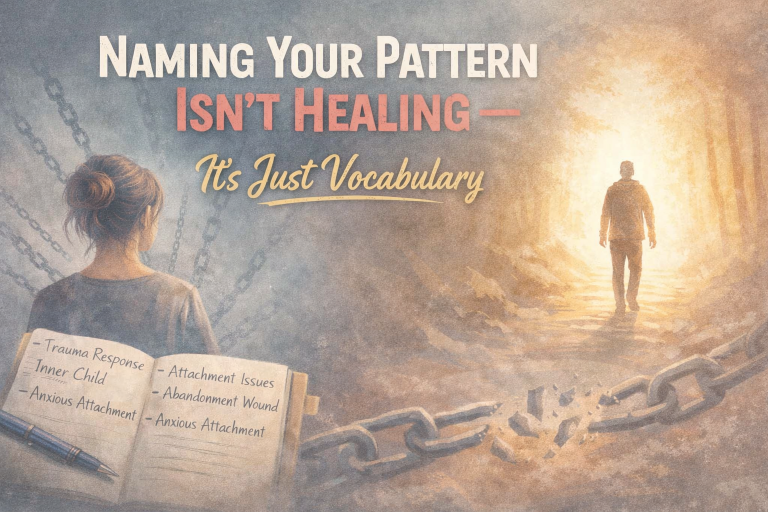
There’s a subtle trap in the modern self-awareness movement.
We have become exceptionally good at naming things.
“I have anxious attachment.”
“This is my abandonment wound.”
“That’s my trauma response.”
“I’m in a freeze state.”
“My inner child is activated.”
The language is sophisticated.
The insight feels powerful.
The awareness feels mature.
But here is the uncomfortable truth:
Naming your pattern without doing the work is not transformation.
It is vocabulary acquisition.
And vocabulary does not change your nervous system.
The Illusion of Progress
There is a dopamine hit that comes from recognition.
When you finally say,
“Oh… this is my pattern.”
It feels like growth.
But awareness is not action.
Insight is not integration.
Explanation is not embodiment.
You can perfectly articulate your shadow and still be ruled by it.
You can intellectually dissect your trauma and still repeat it.
You can analyze your attachment style and still sabotage love.
Because patterns are not removed by labeling them.
They are removed by repatterning behavior.
The Spiritualized Escape Hatch
In spiritual and therapeutic spaces, especially ones that talk about nervous system work, shadow work, or attachment theory, there is a refined version of avoidance:
You describe your pattern beautifully.
You explain why it exists.
You trace it to childhood.
You understand your parents.
You forgive them.
And then…
You do nothing different.
You still avoid the hard conversation.
You still ghost when intimacy increases.
You still flare your nostrils and tighten your jaw instead of speaking truth.
You still choose the unavailable partner.
But now you have language for it.
And language can become anesthesia.
Self-Awareness Without Action Is Self-Soothing
There is a phrase that may sound provocative:
Self-awareness without action becomes psychological self-pleasure.
You feel productive.
You feel evolved.
You feel like you are “doing the work.”
But your life does not change.
Patterns are biological.
They live in muscle tension, breath restriction, posture, tone of voice, hormonal cascade.
You do not think your way out of them.
You act your way out of them.
Ownership Is Not Identification
There is a difference between saying:
“This is my trauma response.”
And saying:
“I am responsible for what I do next.”
Ownership is not shame.
Ownership is power.
When you truly own your pattern, something shifts:
-
You stop waiting for others to accommodate it.
-
You stop announcing it as a disclaimer.
-
You stop using it as justification.
You start interrupting it.
And interruption feels uncomfortable.
The Nervous System Will Resist Growth
Here’s what most people miss:
Your nervous system prefers familiarity over happiness.
If chaos is familiar, you will recreate chaos.
If emotional distance is familiar, you will create distance.
If rejection is familiar, you will unconsciously move toward it.
Naming the pattern does not threaten it.
Changing behavior does.
That is when anxiety spikes.
That is when your body protests.
That is when you want to retreat into explanation instead of expansion.
What Doing the Work Actually Looks Like
It does not look glamorous.
It looks like:
-
Staying in a difficult conversation 5 minutes longer than usual.
-
Not sending the reactive text.
-
Saying “I need space” instead of disappearing.
-
Breathing through the jaw tension instead of exploding.
-
Choosing the secure option instead of the exciting dysfunction.
-
Apologizing without defending yourself.
-
Regulating before responding.
It looks boring.
It looks repetitive.
It looks unsexy.
But it rewires you.
The Gap Between Insight and Integrity
Insight says:
“I understand why I do this.”
Integrity says:
“I will not keep doing this.”
Insight is cognitive.
Integrity is behavioral.
You do not build a new identity by thinking differently.
You build it by acting differently until it feels natural.
The Addiction to Explanation
There is a hidden ego pleasure in being able to articulate your wounds.
It makes you feel complex.
It makes you feel deep.
It makes you feel conscious.
But depth without discipline is indulgence.
And consciousness without correction is decoration.
Your vocabulary should support your evolution — not replace it.
The Courage to Embody
To truly transform a pattern, you must:
-
Notice it in real time.
-
Pause instead of perform it.
-
Choose a different action.
-
Repeat that choice until it becomes default.
This is not glamorous work.
It is micro-decisions, daily.
It is catching yourself mid-pattern.
It is feeling discomfort without collapsing into familiarity.
It is tolerating the anxiety of doing something new.
A Hard Question
If someone removed your psychological vocabulary,
would your life still look transformed?
Or would you just feel less articulate?
Real growth shows up in:
-
Who you choose.
-
How you respond.
-
What you tolerate.
-
What you no longer entertain.
-
The tone of your voice.
-
The steadiness of your breath.
-
The boundaries you hold.
Not in how beautifully you describe your wounds.
Integration Over Identification
Stop identifying with your pattern.
Start interrupting it.
Stop performing self-awareness.
Start practicing self-regulation.
Stop announcing your trauma.
Start healing it.
Because healing is not a language game.
It is behavioral alignment.
The Final Truth
You do not need more vocabulary.
You need more courage.
Courage to:
-
Stay.
-
Leave.
-
Speak.
-
Apologize.
-
Choose differently.
-
Break repetition.
Naming your pattern is the first step.
Owning it is the second.
Taking action is the only step that changes your life.
And until you move —
your pattern is not something you have healed.
It is something you have learned to pronounce.