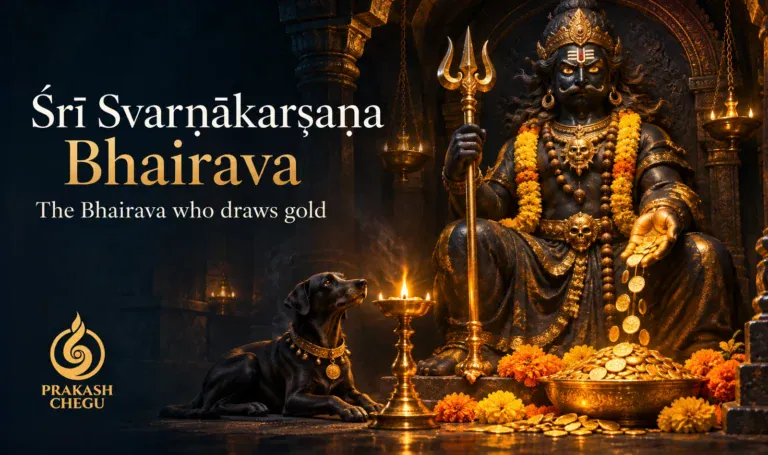
Svarṇākarṣaṇa Bhairava—also written Swarna Akarshana Bhairava, Sornakarshana Bhairavar, or Suvarṇākarṣaṇa Bhairava—is a radiant, prosperity-bestowing manifestation of Lord Bhairava, and therefore of Śiva himself.
His name reveals the essential meaning:
- Svarṇa — gold, radiance, purified value
- Ākarṣaṇa — attraction, drawing toward oneself, magnetization
- Bhairava — the formidable, all-pervading consciousness that removes fear, limitation and ignorance
At the most accessible level, he is worshipped for relief from poverty, debt, financial obstruction and instability. At the deeper Tantric level, however, he does not merely “bring gold.” He destroys the consciousness of deprivation and gives a person the power, intelligence, opportunity and karmic eligibility through which true prosperity can arise.
Who is Svarṇākarṣaṇa Bhairava?
Bhairava is Śiva in his intensely awake, protective and transformative form. While Kālabhairava governs time, death, discipline and the boundaries of sacred space, Svarṇākarṣaṇa Bhairava expresses Bhairava’s power as:
- Dāridrya-nāśaka — destroyer of poverty and deprivation
- Mahā-sampat-prada — giver of great prosperity
- Āpad-uddhāraka — rescuer from danger and adversity
- Dhanādhyakṣa — lord or overseer of wealth
- Sarva-kāma-prada — fulfiller of legitimate desires
- Śrī-rūpa — embodiment of auspicious abundance
- Ratna-rūpa and Svarṇa-rūpa — the essence of jewels and gold
- Saṃsāra-tārin — one who carries the devotee across worldly bondage
These names occur within the transmitted Śrī Svarṇākarṣaṇa Bhairava Stotram, which presents him as possessing the combined principle of Brahmā, Viṣṇu and Śiva—not simply as a minor wealth deity. A Sanskrit recension of the stotra includes its dhyāna, mantra, nyāsa and phalaśruti.
His appearance and iconography
The dhyāna verse describes him seated within a jeweled pavilion beneath a Pārijāta or wish-fulfilling celestial tree, enthroned as the giver of prosperity.
He is visualized as:
- Radiant like molten or newly refined gold
- Three-eyed
- Adorned with golden ornaments
- Seated upon a jeweled or golden throne
- Accompanied by Śrī Bhairavī
- Holding a vessel, ḍamaru and triśūla
- Granting blessings through the vara-mudrā
The principal dhyāna passage reads:
पारिजातद्रुमान्तारे स्थिते माणिक्यमण्डपे ।
सिंहासनगतं वन्दे भैरवं स्वर्णदायकम् ॥गाङ्गेयपात्रं डमरुं त्रिशूलं वरं करैः ।
सन्दधतं त्रिनेत्रं च देव्या युक्तं तप्तसुवर्णवर्णम् ॥
A meaningful translation is:
“I bow to Bhairava, the giver of gold, seated upon a throne in a jeweled pavilion beneath the Pārijāta tree. Golden in radiance and united with the Goddess, the three-eyed Lord holds a sacred vessel, the ḍamaru and the trident, while bestowing blessings.”
Iconography varies across lineages and temples. Some images show two arms, others four, and more elaborate Tantric forms may have several arms. The stotra itself acknowledges both simpler and multiple-limbed manifestations.
Why does Bhairava govern prosperity?
At first, prosperity may seem more naturally associated with Mahālakṣmī or Kubera than with Bhairava. But the principle is profound.
Lakṣmī grants auspiciousness, fertility, beauty, nourishment and abundance. Kubera administers material treasures. Bhairava removes the forces that obstruct, disperse or corrupt prosperity.
These include:
- Fear of receiving or holding wealth
- Chronic indebtedness
- Self-sabotage
- Waste and financial leakage
- Laziness and lack of discipline
- Dishonest or adharmic earning
- Inherited scarcity patterns
- Exploitative relationships
- Karmic obstruction
- Alakṣmī—the principle of disorder, misfortune and depletion
One might say:
Lakṣmī fills the vessel; Svarṇākarṣaṇa Bhairava repairs the cracks in it.
This is why his worship is not merely about attracting money. It concerns the capacity to create, receive, protect, purify and direct resources dharmically.
The deeper meaning of “gold”
Gold is more than a commodity in this sādhana. It symbolizes consciousness that has undergone purification.
Gold:
- Does not rust
- Retains its essential nature
- Survives fire
- Reflects light
- Represents concentrated value
- Has traditionally served as a stable repository of wealth
Svarṇākarṣaṇa Bhairava therefore represents the spiritual alchemy through which the “base metal” of fear, inertia and karmic limitation is transformed into:
- Clarity
- Courage
- Tejas
- Self-command
- Discernment
- Worthiness
- Generosity
- Stable prosperity
Some contemporary Tantric teachers consequently interpret him as the union of the transcendent Bhairava principle and Bhairavī as primordial creative power—the inseparability of consciousness and manifestation. Kanchana Pitham’s theological presentation articulates this inner-alchemical interpretation.
His relationship with Bhairavī and Lakṣmī
The dhyāna explicitly says devyā yutam—he is united with the Goddess. She is generally understood as Svarṇākarṣaṇa Bhairavī, his Śakti.
Without Śakti, Bhairava is unmanifest consciousness. With Bhairavī, his power becomes creative, magnetic and fruitful.
The longer mantra traditions also employ:
- Śrīṃ — the Lakṣmī bīja of prosperity, nourishment and fruition
- Hrīṃ — the great Śakti or Māyā bīja
- Aiṃ — the bīja of knowledge, speech and awakened intelligence
- Bhairava bījas such as Hrāṃ, Hrīṃ, Hrūṃ
This tells us that his abundance is not divorced from intelligence or Śakti. Genuine wealth requires knowledge, energetic capacity and right action—not desire alone.
Is he the same as Kālabhairava?
Not exactly.
Both are manifestations of Bhairava, but their devotional emphasis differs:
| Form | Principal emphasis |
|---|---|
| Kālabhairava | Time, death, discipline, protection, karmic accountability |
| Baṭuka Bhairava | Rapid protection, removal of dangers, accessible guardian form |
| Svarṇākarṣaṇa Bhairava | Prosperity, removal of deprivation, protection of resources |
| Aṣṭabhairavas | Eight directional and cosmic powers of Bhairava |
| Mahābhairava | Vast, transcendent and comprehensive Bhairava principle |
The Svarṇākarṣaṇa stotra also calls the deity Baṭukanātha and Mahābhairava, suggesting that these identities overlap within certain textual and initiatory traditions rather than forming completely isolated compartments.
A safe mantra for everyone
For simple, non-initiatory devotional worship, use:
ॐ श्री स्वर्णाकर्षण भैरवाय नमः ॥
Oṃ Śrī Svarṇākarṣaṇa Bhairavāya Namaḥ
Meaning:
“Salutations to the auspicious Bhairava who draws forth golden prosperity.”
You may chant it 11, 27 or 108 times.
Another widely used short form is:
ॐ ह्रीं श्रीं स्वर्णाकर्षण भैरवाय नमः ॥
Oṃ Hrīṃ Śrīṃ Svarṇākarṣaṇa Bhairavāya Namaḥ
Because this includes bījas, it should be approached with greater purity and consistency, although it is far less complex than the full Tantric mūlamantra.
The full mūlamantra
Several recensions circulate. A commonly transmitted form is:
ॐ ऐं क्लां क्लीं क्लूं ह्रां ह्रीं ह्रूं सः वं
आपदुद्धारणाय अजामलबद्धाय लोकेश्वराय
स्वर्णाकर्षणभैरवाय मम दारिद्र्यविद्वेषणाय
श्रीं महाभैरवाय नमः ॥
There are manuscript and oral variations, particularly around:
- Ajāmala-baddhāya / Ajāmala-vadhāya
- The opening bīja sequence
- The placement of Śrīṃ, Hrīṃ and Aiṃ
- Whether additional sealing bījas appear at the end
This is important: the full mantra is not merely a longer affirmation. Its cluster of bījas, nyāsa, viniyoga, mudrās and āvaraṇa worship indicates a Tantric ritual technology. Serious puraścaraṇa, homa or siddhi-oriented practice should be learned through a competent guru rather than reconstructed from inconsistent internet versions.
A simple home worship
A sattvic household practice can be performed without attempting the initiatory ritual.
You will need
- A clean image or mūrti of Svarṇākarṣaṇa Bhairava
- A yellow or golden cloth
- A sesame-oil or ghee lamp
- Water
- Yellow or red flowers
- Incense
- Fruit or a simple sweet
- A few coins, optionally placed before him and later donated
Procedure
-
Bathe and wear clean clothing.
-
Clean the altar and light the lamp.
-
Invoke Gaṇeśa:
Oṃ Gaṃ Gaṇapataye Namaḥ — 11 times
-
Mentally honour your guru, lineage and Lord Śiva.
-
Offer water, flowers, incense, light and food.
-
Visualize golden light emanating from Bhairava—not raining money upon you, but burning away fear, disorder, debt-consciousness and unconscious financial leakage.
-
Chant:
Oṃ Śrī Svarṇākarṣaṇa Bhairavāya Namaḥ — 108 times
-
Speak a dharmic prayer such as:
“May every obstruction to righteous prosperity be removed. Grant me the clarity, discipline, opportunity and strength to create wealth honestly, preserve it wisely and use it for the welfare of my family, my dharma and all beings.”
-
Sit silently for several minutes.
-
Offer a portion of your income, food or time in service to someone genuinely in need.
The final step matters. Bhairava does not represent fearful hoarding. Circulation, responsibility and generosity are part of becoming a proper vessel for abundance.
Auspicious times for worship
Commonly observed times include:
- Kṛṣṇa Pakṣa Aṣṭamī
- Kālāṣṭamī
- Bhairava Aṣṭamī or Kālabhairava Jayantī
- Tuesday
- Sunday
- Friday when the emphasis is Lakṣmī and prosperity
- Pradosha or evening twilight
- The period after sunset, traditionally associated with Bhairava
For a gentle household practice, morning or early evening is entirely suitable. There is no need to imitate cremation-ground or midnight Tantric observances.
Offerings
Sattvic offerings may include:
- Yellow flowers
- Red flowers
- Bilva leaves
- Turmeric
- Kumkum
- Saffron
- Jaggery
- Bananas or other fruit
- Milk-based sweets
- Sesame-oil lamp
- Ghee lamp
- Coins or gold-coloured objects symbolically offered
- Food or financial charity after worship
Different Bhairava lineages may prescribe alcohol, meat or other vāmācāra substances. Those are lineage-specific ritual sacraments, not universal requirements. They should never be copied casually. Svarṇākarṣaṇa Bhairava can be worshipped in a completely sattvic manner.
A practical 21-day devotional observance
For a safe, disciplined vrata:
- Chant the short mantra 108 times daily.
- Light one ghee or sesame-oil lamp.
- Keep your home, wallet, financial records and workplace orderly.
- Avoid dishonest earning and unnecessary borrowing.
- Pay one neglected obligation each day, even if small.
- Track every expenditure.
- Offer food or money in charity once each week.
- On Day 21, perform a slightly fuller pūjā and feed a person, animal or family in need.
This unites mantra with karma. Without corresponding action, prosperity practice can become magical escapism.
What results should one seek?
Traditional texts promise powerful results: removal of poverty and fear, attainment of prosperity, reputation, beauty, protection, fulfilment and ultimately union with Mahābhairava. The stotra’s phalaśruti uses deliberately expansive devotional language, including immovable prosperity and heaps of gold.
These should be understood on several levels:
- External: income, opportunities, property, resources and relief from debt.
- Psychological: freedom from scarcity, shame, avoidance and financial fear.
- Energetic: greater magnetism, confidence, stability and capacity to act.
- Dharmic: wealth aligned with rightful responsibility.
- Spiritual: discovery of the incorruptible “gold” of consciousness itself.
Worship is not a guaranteed financial transaction. It does not replace skill, planning, ethical work, contracts, debt management or discernment. Rather, sādhana reorganizes the person who must undertake those actions.
The central teaching
Svarṇākarṣaṇa Bhairava asks a deeper question than “How can I acquire more money?”
He asks:
Can you become someone through whom wealth may safely enter, remain, multiply and serve dharma?
His grace is therefore simultaneously attractive and corrective. He may open opportunities, but also reveal waste. He may bring resources, but also remove relationships that drain them. He may grant wealth, but first demand discipline. He may destroy poverty, but also destroy the identity that has become attached to struggle.
That is why he is Bhairava—not merely a golden prosperity god. His abundance comes with purification, responsibility and fearless transformation.
Frequently Asked Questions
Who is Shri Svarnakarshana Bhairava?
The name itself reveals the meaning: Svarna (gold, radiance, purified value), Akarshana (attraction, drawing toward oneself, magnetization), and Bhairava (the formidable, all-pervading consciousness that removes fear, limitation and ignorance). He is a Tantric form of Bhairava associated with drawing gold, abundance in both its outer and inner senses.
Is this deity just worshipped for money?
At the most accessible level, yes, he is invoked for relief from poverty, debt, financial obstruction and instability. But at the deeper Tantric level he does not merely bring gold. He is understood to destroy the inner consciousness of lack, the fear and limitation beneath material poverty. The outer prosperity is the surface of a deeper removal of scarcity within.
How should this teaching be approached?
With both levels held together. It is fine to seek relief from genuine financial hardship; the tradition does not dismiss that. But reducing Svarnakarshana Bhairava to a wealth vending machine misses the point. The real gold being magnetized is a mind freed from the grip of fear and lack, and that inner shift is what the outer abundance is meant to express.