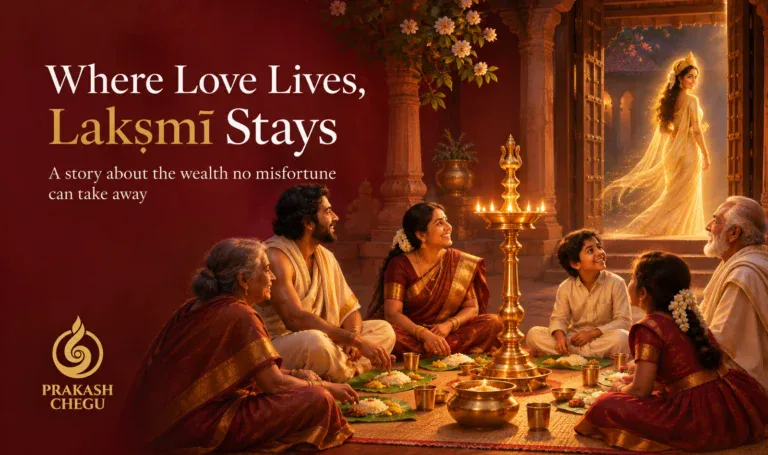
A Story About the Wealth No Misfortune Can Take Away
There was once a prosperous merchant who lived with his wife, his sons, their wives, and their children. His home was abundant. There was food in the kitchen, money in the treasury, movement in the courtyard, and the reassuring rhythm of a large family living beneath one roof.
Then one day, Goddess Lakṣmī appeared before him.
“I am leaving your home,” she told him. “And when I depart, loss will come in my place. Prepare yourself.”
The merchant was shaken.
Lakṣmī was not merely the gold in his vault or the success of his trade. She was the unseen grace that had allowed his household to flourish. Her departure meant that everything he had built might begin to unravel.
Yet before leaving, Lakṣmī offered him one final blessing.
“I am pleased with you,” she said. “Ask me for one boon before I go.”
What would most of us ask for in such a moment?
We might ask that the money remain. We might ask that our property be protected, that our business survive, or that the coming loss be prevented altogether. We might try to negotiate with destiny and preserve as much of our comfort as possible.
But the merchant understood something deeper.
He bowed and said:
“If loss must come, let it come. I ask only this: may love remain among the members of my family.”
Lakṣmī granted his wish.
The Arrival of Loss
A few days later, the youngest daughter-in-law was preparing dal for the family. She added the salt and then stepped away to attend to another task.
Another daughter-in-law entered the kitchen. Not knowing that the dal had already been seasoned, she added salt.
Later, the third daughter-in-law came in and did the same.
Finally, their mother-in-law passed through the kitchen and, assuming no one had yet added it, put in another spoonful.
By lunchtime, the dal was almost inedible.
The merchant sat down first. He lifted a spoonful to his mouth and immediately understood what had happened. The salt was overwhelming.
It would have been easy to shout toward the kitchen:
“Who cooked this? How can anyone be so careless?”
But he remembered his prayer.
He remained silent, ate his meal without complaint, and left.
The eldest son came next. At the first taste, he too was startled. Before reacting, he asked:
“Has Father eaten?”
“Yes,” the family replied.
“Did he say anything?”
“No. He ate quietly and left.”
The son thought, “If Father could remain silent, why should I create a quarrel?”
He finished his food and went on his way.
One after another, each member of the household came to eat. Each tasted the excessively salty dal. Each asked whether those before them had complained.
And each, seeing the restraint of the others, chose not to accuse, insult, or embarrass anyone.
That night, Loss appeared before the merchant.
“I am leaving your home,” Loss announced.
The merchant was surprised.
“Why? You have only just arrived.”
Loss replied:
“Today your entire family ate a meal ruined by salt, yet no one blamed anyone. No one raised their voice. No one humiliated the women in the kitchen. No quarrel began. You protected one another instead of protecting your right to complain. There is no place for me in a house such as this.”
As Loss departed, Lakṣmī appeared once more.
She smiled and said:
“When you asked that love remain in your family, you made it impossible for me to leave. Wherever love, harmony, and mutual respect are protected, I must reside. And where I reside, true prosperity eventually follows.”
Lakṣmī Is More Than Money
We often reduce Lakṣmī to financial wealth. We invoke her for success, income, gold, property, and abundance. These are indeed expressions of her grace—but they are not the whole of Lakṣmī.
Lakṣmī is also nourishment on the table, beauty in the home, dignity in speech, generosity in the heart, fertility in life, auspicious timing, good relationships, and the capacity to enjoy what has been given.
Wealth without harmony is not complete prosperity.
A large house filled with resentment is not truly abundant.
A full bank account accompanied by constant fear is not Śrī.
In the story, Lakṣmī announces that she is leaving, yet the merchant does not cling to the outer forms of wealth. He asks to preserve the inner condition from which sustainable prosperity can arise:
Love.
This was not sentimental love. It was love made visible through restraint.
Every person at that meal had an opportunity to be right. The dal was undeniably bad. A mistake had clearly been made. Complaint would have been understandable. Anger could easily have disguised itself as discipline, honesty, or standards.
But they recognised—perhaps without consciously knowing it—that peace was more valuable than proving who was at fault.
That single choice closed the door through which misfortune hoped to enter.
Loss Rarely Enters Alone
Material loss is painful, but it is often not the original disaster. The deeper damage begins in the reactions that follow it.
A business struggles, and family members begin blaming one another.
Money becomes tight, and respect disappears from the way people speak.
An inheritance arrives, and siblings who once shared a childhood become enemies.
A small household mistake awakens years of accumulated resentment.
Soon, the financial problem is no longer the greatest loss. Trust, tenderness, and belonging have also vanished.
This is how one loss multiplies into many.
The oversalted dal in the story is wonderfully ordinary. There is no great villain, betrayal, or catastrophe. It is a small domestic mistake—the kind that occurs in every home.
Yet homes are not usually broken by a spoonful of salt.
They are broken by what people pour on top of it: accusation, contempt, ridicule, old grievances, and the insistence that someone must be punished.
Loss comes disguised as a minor irritation and waits to see whether we will give it a permanent room.
Restraint Is Not Suppression
The moral of this story is not that families should never speak about mistakes or that one must silently tolerate harmful behaviour.
Love is not the avoidance of truth.
Healthy households require honest communication, boundaries, accountability, and correction.
But there is a profound difference between correcting a mistake and attacking a person.
Restraint creates a sacred pause between experience and reaction. In that pause, we can ask:
-
Does this need to be addressed now?
-
Can I speak without humiliating anyone?
-
Am I solving the problem, or merely releasing my irritation?
-
Is being right in this moment worth damaging the relationship?
-
Can this correction preserve the dignity of everyone involved?
The merchant’s family did not deny that the dal was salty. They simply refused to turn an unpleasant taste into an atmosphere of hostility.
This is emotional wealth: the ability to experience discomfort without making another person pay for it.
The First Person Sets the Frequency
The merchant’s response shaped the behaviour of the entire household.
Had he shouted, the eldest son would likely have considered shouting justified. The next person might have intensified it. Before long, the kitchen mistake could have become a family conflict.
Instead, his composure became contagious.
Each person inherited the restraint of the one before.
Every family has someone who sets its emotional weather. It may be a parent, a grandparent, a spouse, or simply the person with the strongest presence.
When that person reacts impulsively, tension travels quickly through the home.
When that person embodies steadiness, others remember their own capacity for grace.
Leadership in a family is not merely providing money or making decisions. It is the ability to stop unconscious pain from travelling further.
Someone must become the place where the chain of reaction ends.
The Household as a Temple of Śrī
We clean the altar, light a lamp, offer flowers, recite Śrī Sūkta, and invite Lakṣmī into our homes.
These rituals matter. They refine attention, sanctify space, and align the mind with gratitude and abundance.
But the deepest worship begins after the lamp is extinguished.
How do we speak to one another in the kitchen?
What happens when someone makes a mistake?
Do we preserve dignity when money is tight?
Do we offer gratitude for food before criticising its imperfections?
Can elders guide without humiliating?
Can younger members disagree without contempt?
Can wealth be shared without control?
Can success enter the home without creating hierarchy and envy?
The true altar of Lakṣmī is not made only of silver, flowers, and kumkum. It is made of the quality of relationship within the household.
A home becomes Śrīmaya—filled with the presence of Śrī—when beauty is joined with kindness, abundance with generosity, truth with tenderness, and discipline with dignity.
What Are We Really Asking Lakṣmī to Protect?
The merchant’s prayer contains a powerful reordering of priorities:
“If something must be lost, let it not be our love.”
Most people protect possessions and spend relationships.
The wise protect relationships, knowing that possessions can often be rebuilt.
This does not romanticise poverty or pretend that financial security is unimportant. Money feeds families, provides medicine, creates opportunity, supports spiritual work, and allows generosity. Dharma does not require us to reject material well-being.
The story teaches something subtler:
Money is safest in a field of harmony.
When love disappears, even abundance becomes a cause of conflict. When love remains, people can cooperate, rebuild, adapt, and meet adversity together.
The family’s unity was not merely another form of wealth. It was the intelligence that made all other forms of wealth possible again.
A Lakṣmī Practice for Everyday Life
The next time something small goes wrong at home—a delayed meal, a broken object, an unnecessary expense, a forgotten task, or too much salt—pause before responding.
Take one conscious breath and remember:
“This moment is asking me what I value more: the object, the error, or the person before me.”
Then speak in a way that allows truth to remain without driving love away.
You might also establish a simple weekly family practice.
Light a lamp for Lakṣmī, sit together for a few minutes, and let each person name one thing they appreciate about another member of the household. If a practical issue needs attention, discuss it without blame and agree on one clear action.
Such a practice may appear small.
So did the spoonful of salt.
Homes are shaped by small acts repeated until they become culture.
Where Love Is Protected, Prosperity Has Roots
There will always be seasons when fortune seems to recede. Businesses change. Savings rise and fall. Health demands attention. Families encounter uncertainty.
No spiritual teaching can honestly promise a life untouched by loss.
But this story reminds us that loss does not have to become the ruler of the house.
When difficulty comes, it looks for division. It looks for blame, impatience, pride, and the need to wound someone because we ourselves are uncomfortable. If it finds these, it settles in and multiplies.
But when it encounters patience, shared responsibility, reverence, and love, it cannot establish itself so easily.
Lakṣmī is not held by locked vaults.
She is not compelled by display.
She is invited by cleanliness, beauty, right action, gratitude, generosity, and harmony.
Most of all, she is welcomed wherever people refuse to sacrifice one another at the altar of a temporary problem.
The merchant thought he had asked for love instead of Lakṣmī.
In truth, he had asked for the one treasure that ensured she could never leave.
Where love is protected, Lakṣmī is already present.
The reusable version is here: .
Inspired by the traditional story retold in the original YouTube Short.
Frequently Asked Questions
What is the story of Where Love Lives, Lakshmi Stays about?
A prosperous merchant is visited by Goddess Lakshmi, who announces she is leaving his home, and that loss will come in her place. What shakes him is the realization that Lakshmi was never merely the gold in his vault or the success of his trade. She was the unseen grace that allowed his whole household to flourish. The story asks what wealth really is.
What does Lakshmi actually represent here?
Not just money, but the living grace of a home, the warmth, love and harmony beneath the visible prosperity. In this telling, Lakshmi stays where love lives. Where a household holds genuine care for one another, that deeper wealth remains even through material ups and downs; where love leaves, no amount of gold can keep her.
What is the takeaway for everyday life?
That the wealth worth protecting most is the one no misfortune can take: the love within your home. Fortunes rise and fall, but the grace that makes a household flourish is cultivated through how people treat one another. Tend the love, and you are tending the deepest form of prosperity there is.