Sat Nam Rasayan, Emotional Sovereignty, and the Sacred Art of Remaining Neutral
There is a sentence that every healer, teacher, therapist, caregiver and deeply sensitive human being eventually needs to understand:
True empathy does not require you to become another person’s pain.
We are often taught that empathy means feeling what another person feels. If someone is grieving, we enter their grief. If they are afraid, we feel their fear. If they are overwhelmed, their agitation begins moving through our own body. We call this sensitivity. We may even call it compassion.
But if their fear becomes our fear, who remains present enough to meet it? If their grief becomes our grief, who holds the space in which grief can move? If the healer is pulled into every restriction perceived in the person before them, there are no longer two people in the healing space. There are simply two nervous systems caught in the same storm.
The deepest healing traditions ask something subtler of us. They ask us to become intimate without becoming entangled, receptive without becoming overwhelmed, and profoundly sensitive without surrendering our center.
This is emotional sovereignty. And it is one of the central premises of Sat Nam Rasayan.
Empathy Is Not the Same as Absorption
What we ordinarily call empathy contains several very different experiences.
There is emotional contagion: your fear activates fear in me.
There is affective empathy: I can feel something of what you are feeling.
There is cognitive empathy: I can understand your perspective and recognize what your experience may mean to you.
There is compassion: I care about your suffering and remain available to respond wisely.
And then there is identification: I can no longer distinguish between what is arising in you and what belongs to my own history, interpretation and identity.
These experiences are often bundled together, yet they do not lead to the same place. Emotional contagion may create distress. Understanding may create clarity. Compassion may create helpful action. Identification may leave both people more burdened than before.
Modern research increasingly distinguishes empathic care—feeling for another person—from empathic distress, in which another’s suffering produces overwhelming distress in oneself. The first can move us toward compassionate action. The second may lead to exhaustion, avoidance or helplessness.
Sat Nam Rasayan enters this territory through direct meditative experience. It does not teach the practitioner to feel less. It teaches the practitioner to feel without becoming possessed by what is felt.
The Difference Between “I Am Afraid” and “Fear Is Present”
Imagine sitting with someone who carries great anxiety. As you enter the meditative space, you notice tightness in your chest, pressure in the throat, an impulse to move away, or a rapid stream of thought.
The ordinary mind immediately constructs a story:
I am anxious.
Their energy has entered me.
I have absorbed something.
I must remove it.
I need to protect myself.
Sat Nam Rasayan invites another relationship with the same experience:
Tightness is present.
Pressure is being perceived.
An impulse to withdraw is arising.
Thought is moving quickly.
The sensation has not been denied. Nothing has been suppressed. The practitioner may actually perceive more than before. But the experience is no longer organized around the personal “I.”
This is a profound shift: from I am experiencing this to this is appearing within experience.
The sensation becomes information rather than identity.
The Practitioner Does Not Stand Outside the Field
Emotional boundaries are often described through the language of separation:
“This is mine. That is yours.”
“Do not let their energy enter you.”
“Close your field.”
“Protect yourself.”
Such practices can be helpful when a person has little internal stability. But Sat Nam Rasayan reveals a more radical possibility. The practitioner does not necessarily create a harder boundary. The practitioner becomes spacious enough that a defensive boundary is no longer required.
This does not mean losing oneself inside another person. Nor does it mean allowing abuse, manipulation or intrusion in ordinary life. Relational boundaries remain necessary. The deeper point is that consciousness itself does not need to contract in order to remain whole.
Within the healing space, the practitioner may become extraordinarily receptive. The distinction between “my sensation” and “your restriction” can become less important, while identification still does not arise.
The boundary may become transparent, but the center does not disappear.
Shuniya: Where the Personal Healer Becomes Quiet
The power of Sat Nam Rasayan does not arise from emotional intensity. It arises through Shuniya—the state of inner silence, zero-point awareness or profound neutrality.
Shuniya is not blankness. It is not dissociation, indifference or absence. It is an awake and deeply receptive silence in which sensations, thoughts, emotions and impulses can arise without immediately becoming judgment, interpretation or reaction.
In this state, the practitioner may become aware of:
- pressure, temperature, density or movement;
- an emotion appearing without an obvious personal cause;
- an image, memory or thought;
- a physical contraction;
- an impulse to change position or create distance;
- a disturbance in the relationship between the person and the surrounding space;
- the practitioner’s own desire to fix, rescue, explain or withdraw.
None of these perceptions must instantly become a diagnosis. They are events within awareness. The discipline is to perceive them without turning them into a personal story.
The healer becomes less of a personality doing healing and more of a sacred space in which reorganization becomes possible.
Resistance Creates the Second Wound
The original sensation may be simple: pressure in the chest, heat in the face, sorrow, restlessness or heaviness.
Then the mind adds resistance:
I should not feel this.
This is bad energy.
I must get rid of it.
I am failing to remain neutral.
I have to heal this person.
The resistance creates another contraction around the first one. The practitioner is no longer simply perceiving the restriction. The practitioner is struggling against having perceived it.
Sat Nam Rasayan asks us to include even this reaction. If the desire to fix appears, it too is allowed within awareness. If fear appears, fear is included. If confusion appears, confusion is not treated as a failure.
Neutrality cannot be created by fighting non-neutrality. It emerges when even our resistance is permitted to reveal itself and relax.
This is why Sat Nam Rasayan is not passive. Remaining present without interference requires immense sensitivity, stability and discipline.
The Desire to Heal Can Become a Restriction
One of the most subtle obstacles in healing is the healer’s need for the person to change.
“I must remove this pain” sounds compassionate. But hidden within it may be a judgment that the present experience should not exist. There may also be a personal identity at work: I am the one who will fix this. Their improvement will prove my ability.
Even benevolent intention can create pressure inside the field.
In deep neutrality, compassion does not disappear. It becomes cleaner. The practitioner does not abandon the person, but neither does the practitioner impose an imagined outcome upon them. Healing is no longer an act of conquest against a symptom. It is a relationship with the totality of the person, including the restriction, within a field larger than the restriction.
The practitioner does not demand that life reorganize according to personal preference. The practitioner creates the conditions in which another possibility may reveal itself.
Carrying Is Not the Same as Containing
To carry another person’s suffering means that it becomes weight inside your personal identity. You continue thinking about it after the session. You feel responsible for resolving it. Their pain enters your relationships, your sleep and your body. You may begin to believe that exhaustion proves how much you care.
To contain suffering means that your awareness is spacious enough to let it be present without being reduced to it.
Yet even the word contain is incomplete. It can imply that the practitioner is a vessel holding something dangerous. In the deepest state, awareness is not laboring to hold anything. Sensations arise, change and dissolve within it.
The ocean does not carry the wave as a burden. The wave is a movement within the ocean.
This is the difference between a healer who repeatedly absorbs and purges and a healer who remains established in the meditative mind. The first works through personal effort and energetic drama. The second allows the field to move without turning every movement into a possession.
Sensitivity Without Neutrality Becomes Fragility
Many people proudly identify themselves as empaths. They sense moods, tensions, unspoken feelings and subtle changes in a room. But greater sensitivity is not automatically greater consciousness.
Without neutrality, sensitivity may become overwhelm. Without discernment, intuition may become projection. Without humility, sensing another person may become a claim to know them better than they know themselves.
True sensitivity must include the possibility that we are mistaken.
We may feel something real but misinterpret its origin. A sensation may arise from the other person, from our own memories, from the relationship between us, or from the larger environment. Perception becomes wisdom only when it is not immediately colonized by certainty.
This is why genuine empathy retains curiosity. It does not declare, “I know exactly what you feel.” It says, “This is what I am perceiving, and I remain open to what is true.”
With neutrality, sensitivity becomes precision.
The Sacred Space Between Indifference and Enmeshment
There are two common ways of losing the healing space.
The first is indifference: “Your suffering belongs to you. It does not affect me.”
The second is enmeshment: “Your suffering has become mine, and I must carry it with you.”
Sat Nam Rasayan reveals a third possibility:
Your experience may appear completely within my awareness, yet I do not abandon myself, appropriate your journey or turn your suffering into my identity.
This is intimacy without possession.
It is compassion without agenda.
It is closeness without collapse.
It is the ability to be touched without being taken over.
From Empathy to Sacred Space
The movement can be understood as a progression:
- Emotional contagion: I unconsciously take on what you feel.
- Empathy: I feel with you and recognize your experience.
- Discernment: I perceive the feeling without making it my identity.
- Neutrality: I allow the experience without resistance or interpretation.
- Shuniya: The personal healer recedes into meditative silence.
- Sacred Space: The restriction is included within a field larger than itself.
Sat Nam Rasayan is therefore not merely an advanced form of empathy. It is the transformation of empathy into meditative presence.
The Healer Who Feels Everything
The mature healer is not someone who has become numb. Nor is the mature healer someone who avoids difficult people and protects a fragile peace by refusing to feel.
The mature healer may feel the tremor beneath another person’s words, the grief hidden behind anger, the fear beneath control, or the exhaustion concealed by competence. The healer may perceive these experiences intimately—sometimes even physically—without claiming them.
This capacity does not make the healer less human. It makes human feeling available to a consciousness larger than personal reaction.
The healer who feels nothing cannot truly meet the person.
The healer who becomes everything they feel cannot truly serve the person.
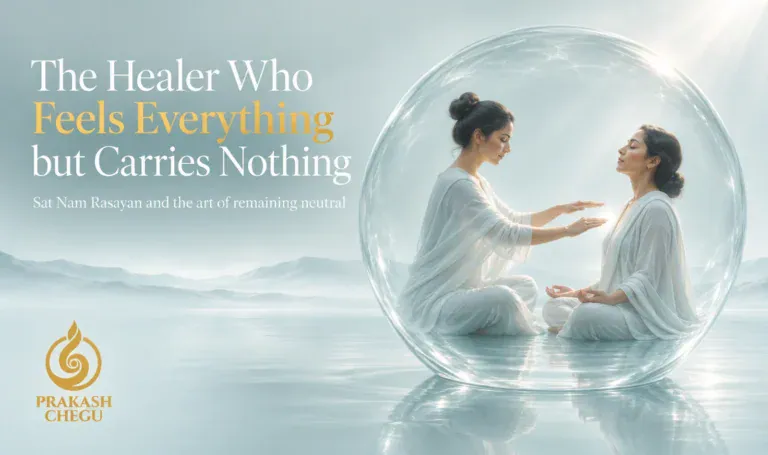
The healer who feels everything and carries nothing becomes a doorway through which healing may occur.
The Essential Teaching
Sat Nam Rasayan does not teach us to protect ourselves from experience. It teaches us not to turn experience into identity.
It does not ask us to become distant from another person’s pain. It asks us to become so profoundly present that neither avoidance nor absorption is necessary.
It does not say, “I suffer because you suffer.”
It does not say, “Your suffering is yours, and I remain untouched.”
It says:
I can meet your suffering without turning away. I can allow it within my awareness without making it mine. I do not need to fight it, carry it, explain it or use it to become important. I remain present in Shuniya, and within that sacred neutrality, another possibility may emerge.
This is emotional sovereignty—not the sovereignty of separation, but the sovereignty of consciousness.
And this may be the heart of the entire practice:
Sat Nam Rasayan is not the art of feeling less. It is the art of feeling everything without losing Shuniya.
Further reading
- Empathic care and empathic distress: predictive brain markers and their relationship to helping behavior
- How we empathize with others: a neurobiological perspective
- Self–other distinction and the right supramarginal gyrus
Frequently Asked Questions
Does not real empathy mean feeling what another person feels?
That is what we are usually taught: if someone grieves, we enter their grief; if they are afraid, we feel their fear. We call it sensitivity, even compassion. But there is a problem: if their fear becomes my fear, who is left present to help? Empathy, in the sense I work with, does not require you to become another person’s pain.
What does it mean to feel everything but carry nothing?
It means remaining fully present and sensitive to another’s state without absorbing it as your own. You sense the grief or fear clearly, you do not numb yourself, but you do not take it on and carry it away with you. This is central to Sat Nam Rasayan: the art of remaining neutral, so your presence can be genuinely helpful rather than just another nervous system caught in the same storm.
How do you stay sensitive without burning out?
By learning that presence and absorption are different things. Burnout in caregivers and healers often comes from merging with others’ pain rather than staying beside it. Cultivating a steady, neutral awareness lets you feel deeply and still return to yourself intact. Paradoxically, the one who carries nothing can often help the most, because they have not been pulled under.