On divine longing, the surrender of the separate self, and the quiet responsibility that follows ecstasy
There are moments when the mind grows quiet because we have disciplined it. And there are moments when the mind grows quiet because the heart has become so completely occupied by love that there is no room left for anything else.
The first movement is familiar to many meditators: we return to the breath, gather our attention, and gently withdraw from distraction. The second is harder to explain. A name of the Divine is spoken, and suddenly the name is no longer merely a word. A song opens a tenderness we did not know we were carrying. The distance between the one who calls and the One being called seems to narrow.
The devotional traditions of India have spent centuries attending to such experiences with great care. Among their most luminous expressions are bhāva, mahābhāva, and samādhi. Together, they invite a profound question: What happens when love becomes so complete that the usual sense of “I am the one loving” falls away?
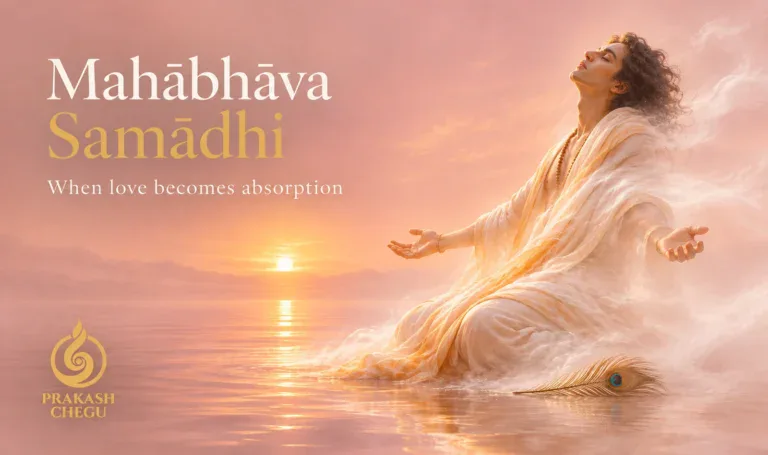
We may call that question mahābhāva samādhi. Yet we should approach the words with reverence. They do not refer to a mood we can manufacture on demand, nor to a certificate that someone has reached a superior spiritual level. They point toward an interior landscape in which devotion, absorption, and grace meet.
First, what do the words mean?
Bhāva can mean feeling, disposition, inner mood, or a lived relationship. In devotion, it is more than a passing emotion. It is the way the heart stands before the Divine: as a child before the Mother, a friend before a friend, a servant before the Beloved, or a lover yearning for union.
Mahā means great. Mahābhāva, however, should not be flattened into “a very big emotion.” In Gauḍīya Vaiṣṇava theology, it has a precise and exalted meaning: the utmost intensification of prema, divine love. The Caitanya-caritāmṛta presents Rādhā as its embodiment and describes an unfolding of devotion through increasingly refined states of love. Within that tradition, mahābhāva is especially associated with Rādhā and the divine experience of Śrī Caitanya; it is not a routine milestone in an ordinary practitioner’s meditation. vedabase.io+2
Samādhi names profound absorption. It is not simply relaxation, an unusual sensation, or the temporary absence of thought. Different schools describe its forms and meanings differently. In the devotional setting, bhāva samādhi refers to absorption suffused with a living relationship to the Divine. Swami Sivananda explicitly uses the expression “Maha Bhava Samadhi” while describing the devotee’s path, alongside other accounts of samādhi found in rāja yoga and Vedānta. His language is broader than the more specialized Gauḍīya account of mahābhāva. Both usages deserve to be heard in their own setting. gurudevsivananda.org
There is another phrase that sounds similar but means something else: mahāsamādhi commonly refers to a realized teacher’s passing from the body. Mahābhāva samādhi and mahāsamādhi are not interchangeable.
The heart does not become infinite by becoming louder
It is tempting to imagine that the highest devotion must be the most dramatic. We look for tears, trembling, visions, or an inability to speak. Accounts of saints do describe outward signs of ecstasy. But a visible sign cannot, by itself, tell us what has occurred within a person.
Someone may weep because they are grieving. Someone may tremble because they are overwhelmed. Someone else may remain perfectly still while their prayer deepens beyond words. None of these appearances authorizes us to announce a spiritual attainment.
The tradition asks a more searching question: What is this experience doing to the heart?
Is the person becoming more truthful? More humble? More capable of meeting another person’s pain without turning away? Can they receive an ordinary day without needing to recreate yesterday’s extraordinary one?
The Bhagavad Gītā describes a beloved devotee in terms of friendliness, compassion, freedom from possessiveness, steadiness, and a mind offered to the Divine. These are less spectacular than an ecstatic display, but they are more revealing in daily life. vedabase.io
Divine love does not have to make us perform intensity. Sometimes it makes us dependable. Sometimes it teaches us to listen. Sometimes its most visible sign is that another person feels safer in our presence.
Rādhā and the mystery of love that remains love
In the Rādhā–Kṛṣṇa tradition, mahābhāva is not a generic synonym for mystical bliss. It belongs to a particular vision of relationship. Rādhā’s love is presented as the fullness of devotion: love so refined that self-interest cannot claim its center. The Caitanya-caritāmṛta calls her the embodiment of mahābhāva. vedabase.io+1
This matters because devotion does not always seek to erase relationship. A lover may long to become one with the Beloved; a lover may also wish to remain close enough to adore, serve, call, and be answered. Swami Sivananda describes a devotional mode in which the bhakta relishes divine love without wishing to lose the sweetness of relationship in complete merging. gurudevsivananda.org
That is one of bhakti’s beautiful paradoxes: the separate self softens, yet love may preserve an intimate “you and I.” The boundary is no longer a fortress. It becomes a place of offering.
To contemplate Rādhā’s mahābhāva is therefore not to imagine ourselves casually occupying her place. It is to allow her devotion to question the quality of our own: Do I love only when I feel rewarded? Can I remain present when the Beloved seems absent? Can longing refine me without hardening into demand?
Caitanya and the sacred ache of separation
Śrī Caitanya’s life, as narrated in the Caitanya-caritāmṛta, gives powerful expression to love in separation. His singing, remembrance, and longing for Kṛṣṇa were not treated as mere episodes of heightened mood. Within the tradition, they belong to a sacred theology of divine love, with outward expressions described as exceptional. vedabase.io
Why would separation be part of a path toward union?
Because longing reveals what we truly love. When what nourishes us is absent, we learn whether our devotion was simply a preference for pleasant experience or a deeper movement of the being. Separation can burn away possession. It can teach the heart to seek the Beloved for the Beloved’s sake.
This does not mean we should romanticize suffering or deliberately create deprivation. Human grief needs tenderness, and ordinary losses deserve to be met honestly. The spiritual insight is subtler: when longing arises in prayer, we can bring it into relationship instead of suppressing it or making it a spectacle. “I miss You” can itself become an offering.
Ramakrishna: love, absorption, and the return to others
Śrī Ramakrishna offers another illuminating window. His life at Dakshineswar was marked by intense devotion to the Divine Mother and repeated states of absorption. The Ramakrishna Order also recounts his later practice under Totapuri and his experience of nirvikalpa samādhi. His life moves across devotional and nondual ways of speaking about realization; we should not force them into one identical definition. Ramakrishna Math and Ramakrishna Mission
What strikes me most is that the story does not end at absorption. Ramakrishna taught, received visitors, guided householders and monks, and insisted on sincere longing and service. The same account of his life connects realization with seeing the Divine in living beings. Ramakrishna Math and Ramakrishna Mission
The question after an expansive spiritual experience is therefore not only, “How do I return to that state?” It is also, “How will I return to the people in front of me?”
If the heart has truly opened, it must eventually become available in the kitchen, in the classroom, at the bedside, and in the conversation we would rather avoid. The moment of absorption may be rare. The work of love waits every day.
Where does Kundalini Yoga meet this teaching?
Kundalini Yoga gives us powerful ways to work with attention, breath, mantra, sound, and the capacity to remain present. As a teacher, I know how profoundly nāad can change the felt quality of a room. A mantra repeated with sincerity can soften the edges of a defended heart. Silence after chanting can feel alive rather than empty.
Yet a strong energetic experience should not automatically be named mahābhāva. Heat, vibration, tears, stillness, and expansiveness may be meaningful experiences in practice; none of them establishes the theological state described in the Gauḍīya texts.
Kundalini practice can prepare the ground for devotion. It can help us notice what prevents surrender: the urge to control, the hunger to be seen, the fear of intimacy with the Divine. But the blossoming of love cannot be reduced to a technique. A kriya is something we do. Grace is something we receive.
Perhaps the most honest meeting of these paths is simple: let practice make you more available, and let devotion keep practice from becoming another project of the ego.
What about the body and the nervous system?
Spiritual experience is lived through a human body. Breath may change. The voice may catch. Tears may come unexpectedly. After an intense practice, one person may feel tender and clear while another needs rest, nourishment, and time to settle.
We can speak carefully about these observations without pretending that physiology alone proves or disproves a sacred experience. No instrument can tell us, simply by measuring an outward response, that someone has entered mahābhāva. Nor should we pressure people to breathe, chant, or emote until they resemble a story from a saint’s life.
Good practice allows the body to remain a companion. We pause when needed. We respect each person’s pace. We make space for quiet integration. An experience that cannot be questioned or gently brought back into ordinary life is not something a teacher should hurry to glorify.
A devotional practice for the ordinary day
We cannot schedule mahābhāva samādhi. We can, however, make our days hospitable to sincerity.
Choose a name of the Divine that truly belongs to your prayer, or sit with a form of reverence that is authentic to your path. Begin with a few natural breaths. Let the shoulders soften without trying to produce a special sensation.
Speak or sing the name gently for several minutes. Listen to the sound as carefully as you make it. Then fall silent and notice what remains. If longing comes, let it be longing. If tenderness comes, let it be tenderness. If nothing remarkable happens, stay honest; you have not failed.
At the end, offer something small and real: a glass of water, a flower, a moment of gratitude, a helpful action. The Bhagavad Gītā places emphasis on the devotion with which a simple offering is made. vedabase.io
Then ask yourself: Who will receive a little more care from me today because I prayed?
That final question protects the practice from becoming private spiritual consumption. It lets what opened inwardly travel outward.
The humility to leave the highest words high
There is a quiet dignity in admitting that we do not need to claim the rarest state in order to live a sacred life.
We can honor mahābhāva as the tradition honors it. We can learn from the devotional language of samādhi without declaring every moving meditation its equivalent. We can appreciate the saints while refusing to imitate their outer symptoms. And we can allow the highest expressions of love to illuminate the next humble action available to us.
Maybe today that action is to chant one name with your whole attention.
Maybe it is to apologize without defending yourself.
Maybe it is to sit beside someone without trying to fix their sorrow.
When love becomes deeper than self-display, it begins to transform the ordinary. And if grace ever carries the heart beyond words, perhaps the most meaningful evidence will appear afterward: in the way we return, in the way we serve, and in the way our presence makes room for life.
Sat Nam.
Frequently Asked Questions
What is Mahabhava Samadhi?
It is a state in which a person becomes so completely occupied by love, devotional love for the Divine, that there is no room left for anything else. Samadhi is deep absorption; Mahabhava points to the highest reach of devotional feeling. It is love that has stopped being one experience among many and become the whole field of awareness.
How is this different from ordinary meditation?
The first movement is familiar to any meditator: returning to the breath, gathering attention, gently withdrawing from distraction. The second is harder to describe. A name of the Divine is spoken and suddenly it is no longer merely a word; a song opens a tenderness you did not know was there. Where ordinary meditation often quiets feeling, this path lets overwhelming love itself become the doorway to absorption.
Is this a state you can aim for or practice toward?
You can prepare the ground, through devotion, music, the names of the Divine, and sincere longing, but absorption of this depth is not something you manufacture on command. Like the opening of the crown, it tends to be received more than achieved. The practice is to keep showing up with an open heart; the absorption, when it comes, arrives as grace rather than as the result of effort.