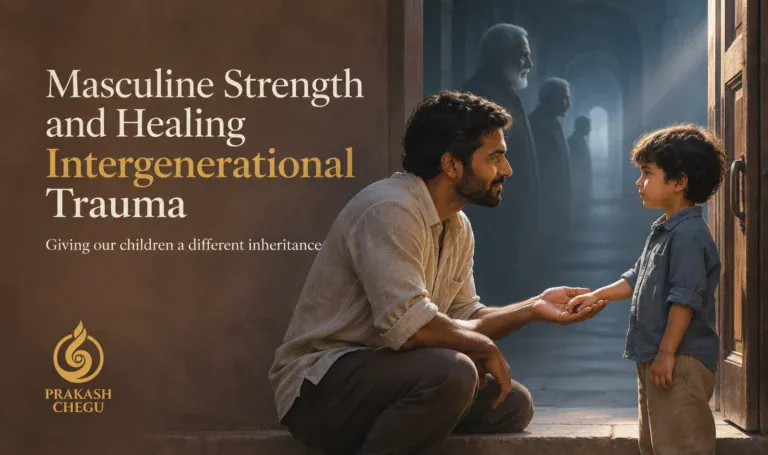
Giving our children a different inheritance
A man can spend years building a strong body and still find it difficult to face the pain he carries. He may lift heavy weights, manage a business, provide for a family, and remain unable to hear that his anger frightens the people he loves.
Physical strength deserves respect. The discipline of training can be a valuable part of a man’s life. Yet there is another kind of strength that deserves just as much attention: the willingness to examine what happened to us, take responsibility for how it lives in our behavior, and change what we pass on.
For a man who wants to become a father, or who is already raising children, this work has consequences beyond his own peace of mind. His children will experience his understanding of love through the way he treats them. They will learn something about power from how he responds when they are vulnerable. They will discover whether honesty is welcome by watching what happens when someone tells him a difficult truth.
One of the deepest expressions of masculine responsibility is to face the pain that has moved through a family and make it less likely that another generation will have to live inside the same patterns.
This responsibility belongs to people of every gender. Speaking directly to men gives us an opportunity to examine the particular lessons many boys receive about strength, emotion, authority, and asking for help.
The inheritance we rarely name
Families pass down more than names, property, recipes, and traditions. They also pass down ways of responding to distress.
In one family, conflict is followed by days of silence. In another, a child’s mistake becomes an occasion for humiliation. Somewhere else, everyone learns to organize themselves around one person’s temper. Affection may be abundant until someone disagrees, at which point love becomes something to earn back.
A boy growing up in such an environment may learn that crying invites ridicule, that needing comfort is dangerous, or that the safest response to tension is to disappear. These lessons can become familiar enough to feel like personality.
Later, he may say, “I am just not an emotional person,” without considering whether emotional distance once helped him survive. He may call himself a disciplinarian without examining why ordinary childhood behavior feels like a challenge to his authority.
A parent’s trauma history can affect parenting. The National Child Traumatic Stress Network identifies this relationship as an important reason to support parents in understanding their own experiences. That does not mean every trauma survivor becomes a harmful parent. It means the past deserves attention when it continues to shape the present. The National Child Traumatic Stress Network
We should also use the word trauma carefully. Every disagreement, disappointment, or imperfect parenting decision is not trauma. A family pattern can deserve attention without requiring a clinical label.
Intergenerational healing begins with a practical question:
What happened in my family, and what am I still repeating?
The boy beneath the armor
Some boys receive a narrow education in masculinity. They are encouraged to be useful, competitive, and independent, while tenderness is treated as embarrassing. Anger may be tolerated where sadness is mocked.
An adult man shaped by those lessons may have little practice naming grief or asking for reassurance. When he feels hurt, he may argue. When he fears losing someone, he may become controlling. When he feels inadequate, he may work until there is no space left for intimacy.
These are possible patterns, not a diagnosis of every reserved, ambitious, or angry man. The invitation is to become curious about our own responses rather than assume we already understand them.
Consider a father whose child says, “I don’t want to talk right now.” He may hear disrespect and insist on immediate obedience. Yet beneath that reaction could be an old fear of being dismissed or powerless. The child’s need for a little space and the father’s history have become tangled together.
Recognizing that possibility creates room for a different response. He can maintain a reasonable boundary while allowing the child a voice. He can ask what is happening before deciding what it means.
Facing the boy beneath the armor requires compassion. He may have adapted to circumstances he could not change. The adult, however, now has a responsibility to examine whether those adaptations are harming the people around him.
Responsibility without self hatred
Understanding our wounds should make accountability more possible.
A man can acknowledge that he was shouted at, neglected, frightened, or repeatedly shamed. He can grieve what he did not receive. He can also recognize that his partner and children are not responsible for repairing that history by tolerating harmful behavior.
“This is how I grew up” explains a context. It does not settle the question of how he will behave today.
The useful next sentence is, “I need to learn another way.”
That might involve professional support, learning to communicate before frustration becomes an explosion, or changing the conditions that repeatedly leave him exhausted and reactive. It may require admitting that an apology has become a familiar ritual while the behavior remains unchanged.
Self-hatred rarely offers a workable plan. If every mistake becomes proof that a man is worthless, he may become defensive or collapse into shame. In either case, attention moves away from the person he hurt.
Accountability asks more specific questions. What did I do? What was its impact? What needs to stop? What support or structure will help me respond differently next time?
These questions turn regret into work that other people can eventually observe.
What children experience as strength
A child experiences a parent’s strength in everyday moments.
Can I tell him I made a mistake? Can I disagree without becoming afraid? Will he help me understand a boundary, or make me feel small for crossing it? When he is upset, am I expected to comfort him?
Children need limits and guidance. A father can be firm about bedtime, safety, honesty, or respectful behavior while remaining attentive to a child’s dignity. Firmness does not require threats, humiliation, or affection that disappears whenever the child struggles.
Harvard’s Center on the Developing Child describes how responsive exchanges between children and caregivers support developing brain architecture. This gives us a grounded reason to value ordinary attention: noticing a child’s attempt to connect and responding with interest. developingchild.harvard.edu
In a home, that attention can be simple. A father puts down his phone when his child wants to show him something. He listens long enough to understand why a teenager is upset. He notices that a small child needs help settling before expecting a complicated explanation.
Providing financially matters. Emotional availability matters too. Children benefit when the person who works hard for their future is also someone they can approach in the present.
A meaningful form of protection is to make the home a place where a child can speak truthfully without fearing the parent’s response.
Honoring our fathers while changing the pattern
Examining family pain can feel disloyal, especially when we know how much our parents sacrificed.
A father may have worked through illness, lived with scarcity, or carried responsibilities from a young age. A grandfather may have endured displacement or loss without anyone asking how he was coping. Their endurance deserves recognition.
Their suffering may also have affected the people closest to them.
We can hold both realities. Gratitude for what someone provided can coexist with grief about what was missing. Respect for a parent’s hardship does not require us to reproduce every way they handled it.
For some men, healing includes an honest conversation with a parent. For others, that conversation is unavailable, unwelcome, or unsafe. Change can still begin without an admission, apology, or reconciliation from the previous generation.
Ancestral work also involves recognizing what we want to keep. A family may have passed down generosity, devotion, humor, hospitality, or a willingness to serve. Healing allows us to preserve those gifts while becoming more discerning about the habits that accompany them.
To honor a lineage is to care about what continues through it.
A yogic approach to masculine responsibility
Yoga offers a useful language for this examination, provided we bring it into our relationships.
Samskaras are often described as impressions or habitual tendencies. As a spiritual lens, this concept invites us to notice how repetition shapes our lives. It is distinct from a clinical account of trauma, and we do not need to treat the two as interchangeable to learn from both.
The yogic principles of svadhyaya, ahimsa, tapas, and satya offer a framework of self-study, non-harming, discipline, and truthfulness. The following is a practical application of those principles to family life. yoga.org
Svadhyaya can begin with the moment we feel certain that everyone else is the problem. We pause and ask what we are bringing into the interaction. Are we responding to the situation in front of us, or reacting to an expectation formed long ago? What feeling are we unwilling to acknowledge?
Ahimsa gives this inquiry an ethical direction. It asks us to consider the effects of our words and actions, including the harm caused by intimidation, contempt, or withholding affection as punishment.
Tapas brings the discipline to keep practicing when change is inconvenient. For a father, that discipline may involve returning to a difficult conversation, attending the appointment he wants to cancel, or accepting feedback without immediately defending his intentions.
Satya asks for honesty about what is actually happening. A man may have a devoted meditation practice and still struggle to listen at home. Naming that gap is part of his practice.
Kundalini Yoga, mantra, or contemplative silence can be part of a man’s spiritual life. Their meaning becomes more tangible when the attention cultivated in practice accompanies him into conflict, parenting, and partnership.
Spiritual interpretation should never make a child responsible for a parent’s wounds. Calling a painful relationship karmic does not remove the adult’s duty to behave safely and respectfully.
Repair makes change visible
Even a committed parent will have moments of impatience, misunderstanding, and poor judgment. What happens afterward matters.
Imagine a father who raises his voice over a spilled drink. Once he can speak calmly, he returns to his child and says:
“I shouted. That was frightening, and I am sorry. Cleaning up the spill was something we could have handled together. Managing my anger is my responsibility.”
He leaves space for the child’s response. He does not demand a hug, insist that the child forgive him, or add, “But you made me angry.”
Then he examines what must change. If he regularly loses control during the evening rush, he may need a more workable routine, help with responsibilities, and support for the anger itself. The apology belongs alongside those changes.
Repair is more than explaining our intentions. It includes listening to impact and accepting that trust may take time to return.
An adult child may be unwilling to reconnect immediately. A partner may want evidence of change before believing another promise. Respecting those boundaries is part of taking responsibility.
Children should also be spared the details of adult processing. A parent can say, “I am working on how I handle anger,” without asking a child to absorb his history, reassure him that he is a good man, or become his emotional caretaker.
Healing requires support and changed behavior
The image of a man lifting generations of pain can be powerful. It can also leave him imagining that he must do the work alone.
Support makes this responsibility more sustainable. It may come through a qualified therapist, a trusted mentor, a thoughtful community, or practical help that reduces pressure on the family. A partner can care deeply without becoming responsible for managing the entire process.
When PTSD is present, there are treatments with substantial research support. The US National Center for PTSD identifies trauma-focused psychotherapies, including Cognitive Processing Therapy, EMDR, and Prolonged Exposure, among the best-supported options. Choosing appropriate care belongs with a qualified clinician. PTSD: National Center for PTSD
Yoga and spiritual practice can accompany care; seeking treatment does not undermine devotion or masculine dignity.
Healing also needs a clear distinction between ordinary relationship difficulties and abuse. If there is violence, coercion, or intimidation, protecting the people affected takes priority. They are not obliged to remain exposed while someone works on himself.
Progress will look different for different men. Tears may matter, but they are not the only measure. A more useful sign is whether the people around him experience greater honesty, consistency, and respect over time.
A practical place to begin
Start with one recurring situation rather than trying to understand an entire family history at once.
Perhaps you become sarcastic when corrected. Perhaps you withdraw whenever your partner wants to discuss the relationship. Perhaps you interpret your child’s frustration as ingratitude.
Write down what happened, what you felt, and what you did. Then ask where you learned that response and what it costs the people you love. Keep the exercise specific enough that it can guide a change.
Before the next similar interaction, decide on one action you can practice. You might ask a clarifying question before replying, lower your voice, or say that you need a short pause and agree on when you will return. A pause should have a clear return, so it does not become another form of prolonged silence.
If the pattern feels overwhelming or keeps returning despite your efforts, bring it to someone qualified to help. Understanding a pattern intellectually does not always make it easy to change.
Afterward, review what happened without turning the exercise into a trial of your character. Did you notice the reaction sooner? Did you follow through? Is there something you need to repair? What would make the next attempt more workable?
A daily sadhana can include this review. Alongside prayer or meditation, ask how you treated someone who had less power than you. Let the answer influence tomorrow’s behavior.
Giving the next generation more freedom
No parent can promise children a life without pain. They will encounter disappointment, loss, and challenges of their own. A man’s healing cannot control every experience they will have.
It can change the conditions in which they grow.
He can make it less necessary for them to monitor his mood, hide mistakes, or silence their needs to keep the household steady. He can show them that asking for help is acceptable and that taking responsibility does not require surrendering dignity.
For men who already have grown children, this work still matters. There may be conversations to approach differently, boundaries to respect, and behavior to change without expecting immediate recognition. For men who do not become fathers, the same responsibility can shape their influence as partners, uncles, mentors, teachers, and community members.
Healing a family pattern is rarely one grand act. More often, it is a series of choices made in familiar circumstances: hearing the criticism, staying respectful, seeking help, and returning to make things right.
A man gives his children a different inheritance when his strength helps them feel safe enough to become themselves.
The weight he chooses to face today may be one they no longer have to organize their lives around tomorrow.
Frequently Asked Questions
What kind of strength is this article really about?
A kind that often gets overlooked. Physical strength deserves respect, and the discipline of training can be valuable in a man’s life. But there is another strength that deserves just as much attention: the willingness to examine what happened to you, take honest responsibility for how it lives in your behavior, and change what you pass on. The strongest thing a man can do is make sure his strength never frightens the people he loves.
What does healing intergenerational trauma mean for a father?
It means recognizing that patterns, how anger is handled, how love is shown or withheld, travel down through families unless someone consciously interrupts them. For a man raising children, or preparing to, the work is to look clearly at the inheritance he received and decide what he will and will not pass forward. Giving your children a different inheritance is an act of strength, not weakness.
Is not focusing on what happened to us just dwelling on the past?
There is a difference between dwelling and taking responsibility. The aim is not to stay in the wound or to blame; it is to understand how the past lives in your present behavior so you can change what you hand to the next generation. That is forward-looking work. If any of this stirs up more than self-reflection can hold, it is worth talking it through with someone you trust or a professional.