Winter is not a mistake in the rhythm of life.
It is not a delay, a slowdown, or something to “push through.”
Winter is a biological and energetic invitation—one that modern culture has largely forgotten how to listen to.
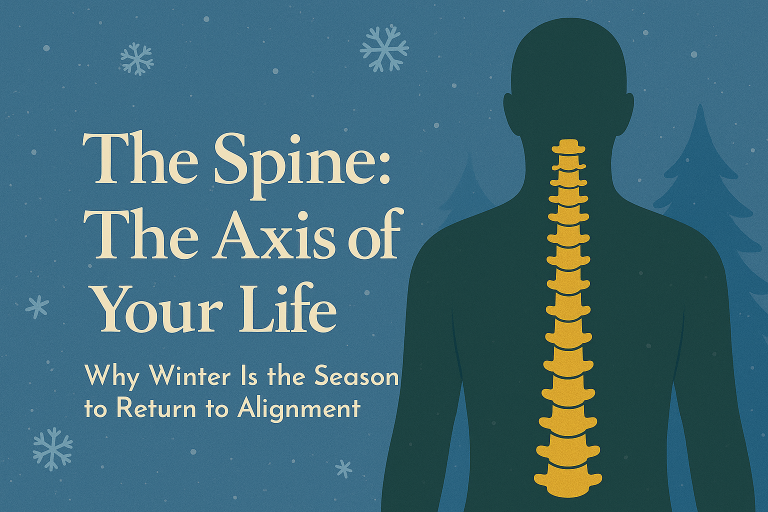
In yogic science, winter is the season where life turns inward to strengthen its axis before the next cycle of growth begins. And that axis—both physically and energetically—is the spine.
Winter Is a Nervous System Season
Every season speaks directly to the nervous system.
Spring activates.
Summer expands.
Autumn releases.
Winter stabilizes.
In winter, the body naturally seeks:
Stillness
Warmth
Containment
Rhythm
This is not laziness.
This is regulation.
When winter is ignored—when we maintain summer-level output in a winter body—the nervous system pays the price. Fatigue, anxiety, scattered thinking, shallow breath, and emotional reactivity are often signs of seasonal misalignment, not personal failure.
Winter asks us to come home to the spine.
The Spine Is More Than Structure
In modern anatomy, the spine is described as a column of bones, discs, nerves, and muscles.
In Yoga, it is something far more profound.
The spine is called Merudanda—the sacred staff, the central pillar, the axis that connects Earth and Heaven.
This axis:
Holds your posture
Organizes your breath
Regulates your nervous system
Shapes your emotional tone
Determines how awareness moves within you
The spine is not passive.
It is communicative.
How you hold your spine directly affects how you experience life.
Alignment Is Not Aesthetic — It Is Functional
Posture is often reduced to appearance: standing tall, sitting straight, looking confident.
But posture is not about how you look.
It is about how energy flows.
When the spine is aligned:
Breath naturally deepens
Muscular effort reduces
The nervous system shifts toward regulation
Thoughts slow and organize themselves
Awareness gathers instead of scattering
When the spine collapses:
Breath shortens
The chest caves
The nervous system moves toward stress
Thoughts fragment
Emotional reactivity increases
This is why posture is not cosmetic—it is neurological and energetic.
Your Posture Is Your Pranic Signature
In yogic language, prana is life force—but it is not abstract.
Prana moves through:
Breath
Nervous system signaling
Subtle channels of awareness
Your posture determines how prana moves.
A collapsed posture restricts flow.
An aligned posture invites circulation.
This is why two people can perform the same practice and have completely different results. It is not about the technique alone—it is about the quality of alignment through which the technique is received.
Your posture is your pranic signature.
Your prana is the quality of your life.
Sushumna Nadi: The Central Channel of Awareness
Within the spine flows Sushumna Nadi, the central channel described in yogic anatomy.
This channel is not symbolic—it is experiential.
When Sushumna is accessible:
Awareness feels centered
Emotions become easier to regulate
Breath becomes smooth and rhythmic
Vitality increases without force
When Sushumna is obstructed:
Energy leaks into tension
The mind oscillates between extremes
The body feels restless or dull
Winter practices are designed to support Sushumna gently, not aggressively.
Slow movements, steady postures, rhythmic breathing, and spinal awareness invite the nervous system to soften so awareness can naturally return to center.
Why Winter Is the Season of the Spine
Winter strips away excess.
There is less stimulation outside, which means more sensitivity inside. This makes winter the most powerful season for spinal recalibration.
In winter:
The body is more receptive to subtle alignment
The nervous system responds more quickly to regulation
The spine can be strengthened without strain
Awareness deepens without effort
This is why traditional yogic systems emphasize:
Fewer practices, done with precision
Emphasis on posture and breath
Gentle strengthening rather than forceful exertion
Repetition over intensity
Winter is not about doing more.
It is about doing less, correctly.
The Golden Spine: Strength Without Rigidity
Alignment does not mean rigidity.
A healthy spine is:
Upright but supple
Stable but responsive
Strong but fluid
This is the paradox of winter practice.
You strengthen the axis not by tightening it, but by listening to it.
When the spine becomes stable, the nervous system relaxes.
When the nervous system relaxes, life reorganizes itself naturally.
This is not philosophy.
This is embodied physiology.
Winter as a Doorway, Not a Pause
Winter is often treated as an interruption to life.
In truth, it is a threshold.
What you stabilize in winter determines how you expand in spring.
A spine that is cared for in winter:
Carries less tension into the next cycle
Supports clearer decision-making
Holds emotional steadiness
Sustains vitality longer
Growth without alignment leads to burnout.
Alignment before growth leads to resilience.
The Deeper Invitation
Your spine is the axis of your life.
How you hold it determines:
How you breathe
How you feel
How you think
How you respond to stress
How you move through change
Winter simply reveals what has always been true.
When you return to the spine, you return to yourself.