A scientific guide to hyphal invasion, mycotoxins, and the real “keep vs toss” line in modern kitchens
Most people approach moldy food with a simple question: Can I cut this off, or should I throw it away?
But this everyday decision hides a far more complex biological reality. Mold is not a surface blemish—it is a living, penetrating organism whose most dangerous effects are often invisible.
This article dismantles the common myths around moldy food and replaces them with a clear, science-based framework grounded in mycology, food physics, and toxicology. The goal is not to increase fear or food waste, but to define the precise boundary between acceptable salvage and unacceptable health risk.
1. The Iceberg Principle of Mold
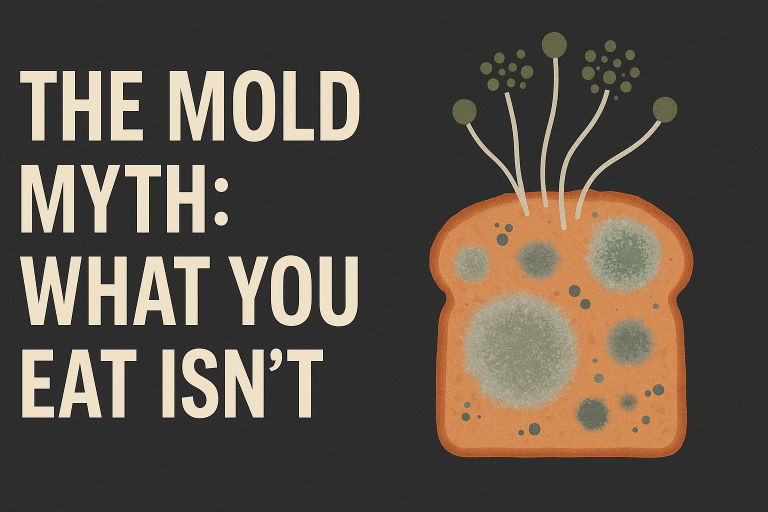
What we call “mold” is usually the reproductive tip of a much larger organism.
The fuzzy green, white, or black patch you see on food consists mainly of aerial hyphae and spores—structures designed to release reproductive particles into the air. These spores are light, hydrophobic, and easily spread across kitchens, refrigerators, and storage containers.
Beneath that visible layer lies the real concern: the vegetative mycelium. This is a dense, microscopic network of threadlike filaments (hyphae) that penetrates the food itself, digesting it from the inside by releasing enzymes that break down starches, proteins, and fats.
In many foods, this network extends far beyond what the eye can see, meaning that removing visible mold often removes only the symptom—not the contamination.
2. Why Structure Matters More Than Appearance
Whether mold stays localized or spreads systemically depends less on the mold species and more on the physical structure of the food.
Porous, high-moisture foods
Bread, cakes, berries, soft fruits, cooked grains, shredded cheese, and leftovers are structurally vulnerable. Air pockets, softened cell walls, and high water activity allow hyphae to move rapidly and allow dissolved toxins to diffuse throughout the food.
In these foods, visible mold is a late-stage signal. By the time it appears, the internal matrix is often already colonized.
Scientific conclusion: these foods cannot be safely “trimmed.” They must be discarded.
Dense, low-moisture foods
Hard cheeses and certain firm vegetables resist penetration. Their compact protein or fiber structure physically slows hyphal growth and limits toxin diffusion.
This density creates the only scientifically defensible exception to the “discard” rule—but only with strict trimming protocols.
3. The Real Danger: Mycotoxins, Not Mold Itself
The most serious health risk from moldy food is not infection, but mycotoxicosis—toxicity caused by fungal secondary metabolites.
Why mycotoxins are uniquely dangerous
They are invisible. You cannot smell or taste them reliably.
They are chemically stable. Cooking, baking, or boiling may kill mold organisms but often leaves toxins intact.
They diffuse. Many mycotoxins migrate through moisture within the food, contaminating areas that appear normal.
Key mycotoxins of concern
Aflatoxins (nuts, peanuts, corn): potent liver toxins and carcinogens.
Patulin (apples, apple juice): gastrointestinal toxicity and genotoxic effects.
Ochratoxin A (grains, coffee, dried fruits): kidney toxicity and cancer risk.
Fusarium toxins (wheat, corn): hormonal disruption, GI illness, cancer associations.
This is why food safety agencies treat visible mold as a proxy warning, not as the problem itself.
4. The Foods That Must Always Be Discarded
Based on microbiological behavior and toxicological risk, the following categories are never safe to salvage once mold appears:
Bread and baked goods
Soft cheese, yogurt, sour cream
Berries and soft fruits (tomatoes, peaches, strawberries)
Cooked leftovers and casseroles
Jams, jellies, and preserves
Nuts, nut butters, peanuts
Leafy greens
In these foods, structure and moisture guarantee invisible spread. Cutting away visible mold offers no meaningful protection.
5. The Narrow Salvage Zone (and How to Do It Correctly)
Only a small class of foods can be safely rescued—and only if handled precisely.
Hard cheeses
Parmesan, Pecorino, aged Cheddar, Asiago.
Why they qualify: dense protein matrix + low water activity.
How to salvage safely:
Cut at least 1 inch (2.5 cm) around and below the mold.
Keep the knife out of the mold area.
Discard the contaminated portion.
Rewrap the remaining cheese in clean packaging.
Firm vegetables
Carrots, cabbage, bell peppers, turnips.
Conditions:
The vegetable must remain firm.
Trim generously (same 1-inch rule).
If soft, slimy, or collapsing → discard.
6. The Nuanced Cases People Get Wrong
Apples: the patulin paradox
Apples are firm, but patulin—produced by Penicillium expansum—is water-soluble and can diffuse beyond visible rot.
Small, superficial spot on a very firm apple → possible to trim generously.
Any softness, bruising, or internal core mold → discard.
Apples for juice or applesauce → never use compromised fruit.
Honey: crystallization vs fermentation
Honey’s low water activity prevents mold growth under normal conditions.
Crystallization (grainy, cloudy appearance) = safe and natural.
Fermentation (foam, bubbles, sour smell) = discard.
True surface mold indicates moisture contamination → discard.
Potatoes: mold vs solanine
Potatoes carry two separate risks:
Solanine (green color, bitterness): a plant neurotoxin.
Fungal rot (soft, moldy, foul-smelling).
Firm potatoes with small surface defects may be trimmed.
Green, bitter, mushy, or moldy potatoes should be discarded.
7. Why “When in Doubt, Throw It Out” Is Scientifically Sound
The economic loss of discarding questionable food is small.
The biological cost of repeated low-dose mycotoxin exposure is not.
Chronic intake—even at low levels—has been linked to:
Liver and kidney damage
Increased cancer risk
Immune suppression
Gastrointestinal illness
Mold is not a cosmetic flaw. It is a biochemical signal that the food’s internal ecology has shifted in ways you cannot see or reliably neutralize at home.
Final Takeaway
Visible mold is never the full story.
In porous, wet foods, it signals systemic contamination.
In dense foods, it marks a local breach—sometimes containable.
And in high-risk commodities like nuts and grains, it is a non-negotiable discard signal.
Understanding the mycology of consumption allows you to reduce waste without gambling with health. The true rule is not emotional or cultural—it is structural, chemical, and biological.
And once you understand that, the “keep vs toss” line becomes very clear.