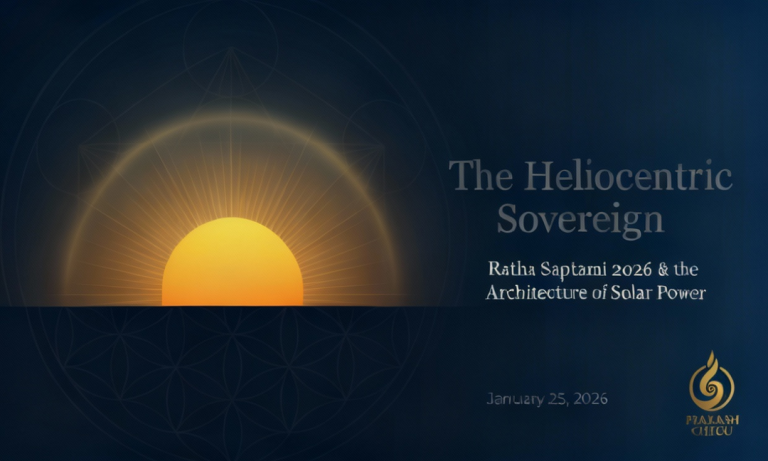
A Comprehensive Treatise on Ratha Saptami 2026 (Magha Saptami • Surya Jayanti • Arogya Saptami)
There are days in the Vedic calendar that feel less like “festivals” and more like cosmic pivot points—moments when sky-rhythm and life-rhythm click into alignment. Ratha Saptami is one of those days.
Celebrated on Magha Shukla Saptami (the 7th lunar day of the bright fortnight of Magha), Ratha Saptami honors Surya Narayana—the Sun not merely as a celestial body, but as the visible deity of prāṇa, the regulator of seasons, immunity, mood, agriculture, and the biological clock. Traditionally, it is understood as the day Surya’s chariot “turns” with tangible momentum toward the Northern Hemisphere—an energetic confirmation that winter’s dormancy is releasing and spring’s vitality is awakening.
Ratha Saptami 2026: why this year is extra potent
In 2026, Ratha Saptami falls on Sunday, January 25, 2026, creating the auspicious convergence known as Bhanu Saptami (Saptami on Ravivaar—Sunday). Many panchangas and tradition lines treat this as an amplification of Surya worship and health-related merits.
Note on dates: Some temple announcements may reference adjacent civil dates due to local sunrise/tithi boundaries and temple schedules. Always defer to your local panchang and your temple’s posted timing for processions/darshan.
1) The Chronological Framework for 2026 (IST)
Ratha Saptami is unusually timing-sensitive because the core rituals are tied to Arunodaya (pre-dawn) and sunrise.
Key timings (New Delhi reference; adjust slightly by location):
Saptami Tithi begins: 12:39 AM — Jan 25, 2026
Snan Muhurat: 5:26 AM – 7:13 AM
Sunrise: ~ 7:13 AM
Saptami Tithi ends: 11:10 PM — Jan 25, 2026
The inner logic is elegant: you meet Surya at the threshold of day, when dawn is still a veil and light is just beginning to architect the world.
2) The Architecture of the Sun’s Chariot: Symbol, Cosmos, Time
Ratha Saptami’s central image—Surya riding the Ratha—is not decorative mythology. It is a metaphysical blueprint of how Vedic thought understands time (kāla), order (ṛta/dharma), and life-force (prāṇa).
The one wheel, twelve spokes, seven horses
Classical descriptions encode a cosmology of cycles:
One wheel: the singular continuity of Time—one motion expressing many seasons.
Twelve spokes: the twelve solar months / zodiacal divisions—the Sun as the keeper of the yearly measure.
Seven horses: layered meaning converges here:
the seven colors of visible light (a poetic mirror of spectrum knowledge)
the seven days of the week (Sun as the “lord of the week” in many traditional framings)
the vibratory dimension: sound, meter, rhythm—life carried by resonance.
This is why Ratha Saptami never feels like a “belief system.” It feels like a living calendar of energy.
3) Aruna: The Dawn-Intelligence That Makes Light Livable
Surya’s charioteer, Aruna, is central to Ratha Saptami theology: dawn is not a random aesthetic; it is a protective intelligence.
Aruna is described as shielding Earth from the Sun’s overwhelming intensity—filtering the raw blaze into a form life can metabolize. Symbolically:
Aruna = discipline before illumination
Dawn = preparation before revelation
Practice = the nervous system learning how to hold power without burning out
Ratha Saptami is performed in Aruna’s time (pre-sunrise) because the tradition understands a subtle truth: what you do at threshold moments programs the day.
4) Why “Arogya Saptami”? The Healing Narratives
Ratha Saptami is also known as Arogya Saptami—the health-giving Saptami. One of the best-known healing narratives is that of Samba, whose solar penance is tied to the Konark/Chandrabhaga region in Odisha and has inspired the great Magha Saptami congregations there.
Across India, the shared belief is consistent: the Sun’s rays on this day carry a particular restorative charge—for vitality, skin health, digestion, mood, and resilience.
5) The Ritual Ecosystem: How Ratha Saptami Is Actually Done
This festival is not passive. It is an engineered interface with water, light, plant-medicine, geometry, and food.
5.1 Arunodaya Snan with Arka Leaves (Calotropis)
The signature rite is the pre-dawn bath during the Snan Muhurat.
Many South Indian traditions use Arka/Erukku/Jilledu leaves (Calotropis)—often seven leaves, placed on key points of the body (head, shoulders, knees, feet). The symbolism is precise: you are “seating” Surya’s healing pattern on the body’s vital junctions and asking the new solar momentum to re-code your system.
If you can’t access Arka leaves: a sincere Arunodaya bath, clean clothing, and sunrise arghya still retain the core intent—purification + solar alignment.
5.2 Arghya Pradāna at Sunrise
At sunrise, stand facing East and offer water (traditionally in copper) while chanting Surya mantras (even a simple “Om Suryaya Namah” is sufficient). Drik Panchang lists sunrise around 7:13 AM for the reference location.
This is the festival’s heart: gratitude made visible.
5.3 Ratha Kolam / Rangoli as Sacred Geometry
In parts of Tamil Nadu, Karnataka, Andhra, and beyond, thresholds are drawn with chariot motifs and seven horses—inviting Surya’s order into the domestic field. Using rice flour also becomes a subtle act of bhoota-yajna (feeding smaller life).
5.4 Naivedya: Solar Food, Earthen Pot, and “Pongal Overflow”
Sweet offerings like Paramannam/Sweet Pongal are common, with a beautiful symbolic detail in many lineages: earthen pot, courtyard, sunlight—as though Surya “receives” the offering directly.
In some regional customs, specific seasonal foods appear because the body is transitioning from winter physiology to spring physiology—warming digestion, stabilizing mood, restoring prāṇa.
6) Regional Living Traditions in 2026
Andhra Pradesh: Arasavalli Surya Narayana Swamy Temple (Srikakulam)
Arasavalli is one of the great Surya centers. Reports in 2026 note large pilgrim inflow and special arrangements (including darshan logistics and online booking guidance in some coverage).
What draws people here is not only devotion—but the living confidence that Surya worship can rebuild health, clarity, and life-direction.
Tirumala (TTD): “Ardha Brahmotsavam” Scale Celebrations
At Tirumala, Ratha Saptami is observed with major processions and a full day rhythm of vahanams and ritual sequence. TTD’s official news channel has published Ratha Saptami directives and schedules for 2026.
Even if you never visit Tirumala, the symbolism is worth receiving: the Divine moves through multiple “vehicles”—meaning, consciousness meets you through many forms across one day, just as Surya moves through many qualities across one year.
Odisha: Chandrabhaga / Konark Magha Saptami
Odisha’s Chandrabhaga gathering near Konark is one of the most iconic Magha Saptami observances—devotees entering the water before sunrise to meet Surya rising over the Bay of Bengal. In 2026, local authorities have even announced event-day crowd/traffic arrangements—evidence of how alive and large this tradition remains.
7) The “Hidden Science” Inside the Rituals
It’s tempting to call this “science,” but it’s more accurate to say: ritual is behavior designed to preserve wisdom across generations.
Vitamin D, circadian rhythm, and winter recovery
Late January is often the period when many people’s light exposure has been lowest for months. Ratha Saptami mandates: wake early, bathe, face sunrise, be outdoors, cook in open air—all behaviors that support circadian entrainment and seasonal mood stabilization. (The tradition doesn’t need modern labels to know what it’s doing.)
Ethnobotany of Arka (Calotropis)
Arka has a long presence in folk and classical medicinal streams (handled carefully, especially given its latex). External/ritual use on this day reflects a lineage memory of seasonal skin/joint vulnerability and the need to reset the body at the winter→spring hinge.
Food as seasonal pharmacology
Traditional sweet offerings, warming ingredients, and region-specific legumes/vegetables often match the same principle: rekindle agni, stabilize nerves, and support the body’s seasonal transition.
8) Modern Practice: Surya Namaskar as a Global Ratha Saptami Sadhana
Many modern yoga communities observe Ratha Saptami as a sunrise Surya Namaskar day—sometimes in 108 rounds, sometimes 12 (matching solar months), sometimes 27 (nakshatra resonance).
If you try 108: treat it like tapasyā, not performance—warm up, pace breath, protect wrists/shoulders, and end with stillness facing the Sun.
9) A Simple Home Protocol (Works Anywhere in the World)
If you’re not near rivers, temples, or traditional supplies, you can still do a powerful Ratha Saptami.
Ratha Saptami 2026 (Sunday, Jan 25) – Minimal yet potent sadhana
Wake before sunrise (even 30–60 minutes is enough).
Bath / shower with the intention: “May this day reset my vitality and clarity.”
Face East at sunrise and offer water (a simple cup is enough).
Chant any one:
“Om Suryaya Namah”
“Om Ghrini Suryaya Namah”
(Optional) Aditya Hridayam if you already know it.
12 Surya Namaskars (or a gentle mobility sequence if you’re not doing asanas).
Eat simply, warmly, and with gratitude.
One act of dāna (charity): food, warmth, or support to someone who needs it.
This is the essence: align the body-clock with the light-source.
Closing: The Sun as Sovereignty
Ratha Saptami is ultimately about sovereignty—not ego, but inner governance.
When you meet the Sun at dawn, you are training the psyche and the nervous system to remember something simple and immense:
life is cyclic, but not random
light returns, and so does strength
devotion is a biological technology
discipline at threshold moments changes destiny
Whether you are at Chandrabhaga’s waters, Arasavalli’s crowds, Tirumala’s vahanams, or a quiet balcony in a western city—the teaching is the same:
Honor the Source—then live like your life is lit from within.