One of the most frequently repeated—and most misunderstood—claims about Hinduism is that it has “33 crore gods”, often translated as 330 million deities. This idea is not rooted in the Vedas or the Upanishads. Instead, it arises from a linguistic misunderstanding of a single Sanskrit word: Koti (कोटि).
When read correctly, Vedic wisdom reveals something far more elegant, precise, and philosophically profound.
1. The True Meaning of the Word Koti
In Sanskrit, koti carries two distinct meanings:
Numerical meaning: Ten million (1 crore)
Qualitative meaning: Category, class, type, rank, or excellence
In Vedic and Upanishadic usage, koti is used qualitatively, not numerically.
Thus, 33 Koti Devas does not mean 330 million gods.
It means:
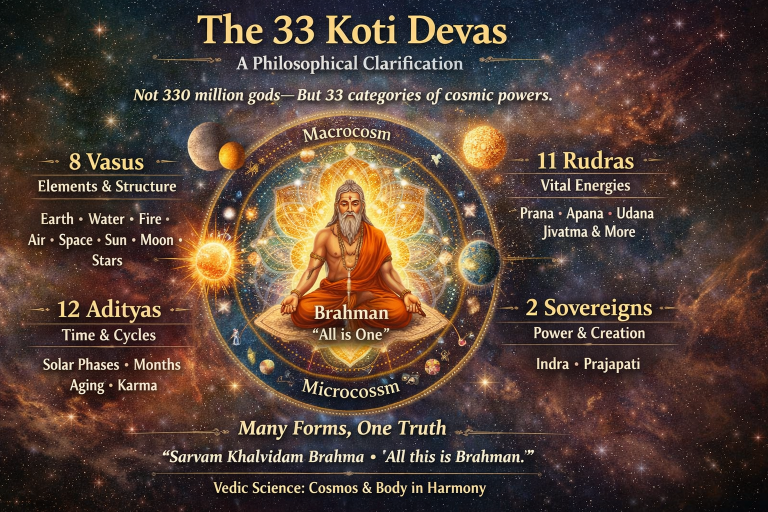
33 categories of cosmic intelligences or energy principles governing the universe.
2. Scriptural Foundation: Brihadaranyaka Upanishad (3.9.1–2)
The clearest clarification comes from a dialogue between Sage Yājñavalkya and King Janaka.
When asked how many gods exist, Yājñavalkya enumerates exactly 33—no more, no less.
The 33 Devas Explained
🔹 Eight Vasus (Aṣṭa Vasus) — Structural Principles
The Vasus are the elemental foundations of manifestation:
Earth
Water
Fire
Air
Space
Sun
Moon
Stars
They are called Vasus because they “dwell”—they form the habitat of existence.
🔹 Eleven Rudras (Ekādaśa Rudras) — Vital Kinetic Forces
The Rudras represent the 10 Prāṇas (vital airs) plus the Jīvātma (individual soul).
They are called Rudras because when they depart the body, grief (rudan) arises.
🔹 Twelve Ādityas (Dvādaśa Ādityas) — Time & Solar Law
The Ādityas are the 12 solar phases, governing:
Months
Time cycles
Aging
Karmic maturation
They gradually draw away lifespan, month by month.
🔹 Two Sovereigns
Indra — Cosmic power, command, and vital energy
Prajāpati — Creation through sacrifice (yajña) and continuity
✅ Total: 33 Devas
This exact enumeration is also affirmed in the Śatapatha Brāhmaṇa of the Śukla Yajur Veda.
3. Confirmation from Other Vedic Sources
🔹 Atharva Veda (10.7.13)
“With the 33 gods, with the six limbs of Brahman, may he prosper.”
Here, the number 33 is presented as a philosophical framework, not mythology.
🔹 Chandogya Upanishad (3.16.1–3)
This text clarifies that:
The 33 Devas do not act independently.
They are supported, unified, and sustained by Brahman.
4. Many Forms, One Reality — The Non-Dual Vision
Although Hindu tradition speaks of many gods, its final conclusion is Ekam—One.
An Administrative Analogy
Brahman → Chairman / Absolute Intelligence
33 Devas → Departmental heads managing cosmic functions
These are Adhikāra Devatās—functional authorities maintaining Ṛta, the cosmic order.
Key Philosophical Declarations
Brihadaranyaka Upanishad (3.9.9)
“All these gods are but the limbs of the One.”
Bhagavad Gita (10.2)
Aham ādir hi devānām — “I am the source of the Devas.”
Bhagavad Gita (7.20–23)
Worship of many forms ultimately reaches the One—but through partial understanding.
Philosophical Summary
The aim of this teaching is not to deny deity worship, but to reveal the scientific unity beneath it.
The confusion arose when koti (category) was mistaken for koti (crore) over centuries.
The 33 Devas are not personalities alone—they are laws of nature, functioning:
In the cosmos
In time
In the human body
All converge into the great Advaitic truth:
“Sarvam Khalvidam Brahma” — All this is Brahman.
Macrocosm = Microcosm
Vedic philosophy declares:
“Yat pinde tad brahmāṇḍe”
What exists in the universe exists in the body.
The same 33 energies governing the cosmos operate within us.
Detailed Mapping of the 33 Devas in the Human Body
1. Eight Vasus — The Body’s Architecture
| Vasu | Bodily Correspondence |
|---|---|
| Prithvi (Earth) | Bones, teeth, nails |
| Apas (Water) | Blood, lymph, fluids |
| Agni (Fire) | Digestion, metabolism |
| Vayu (Air) | Breath, nerve signaling |
| Akasha (Space) | Bodily cavities, cellular space |
| Chandra (Moon) | Mind, hormones |
| Surya (Sun) | Vision, inner radiance |
| Nakshatra (Stars) | Memory, time-sense |
2. Eleven Rudras — The Energetics of Life
Prana — heartbeat, inhalation
Apana — elimination
Samana — digestion
Udana — speech, upward movement
Vyana — circulation
Naga — belching, alertness
Kurma — blinking, sleep
Krikara — hunger, sneezing
Devadatta — yawning
Dhananjaya — post-death decomposition
Jīvātma — the governing sense of Self
3. Twelve Adityas — Time, Aging & Karma
The twelve solar names—Anśumān, Aryamān, Bhaga, Dhātṛ, Mitra, Varuṇa, Savitṛ, Vivasvān, Tvaṣṭṛ, Pūṣan, Indra, Viṣṇu—represent:
Monthly solar phases
Circadian rhythm
Progressive aging
Gradual prāṇa depletion
4. Two Sovereigns — Energy & Continuity
Indra: Electrical energy, nerve impulses
Prajāpati: Reproduction, regeneration, cellular multiplication
Unified Gnosis: The Body as a Living Temple
Vasus build the body
Rudras operate the body
Adityas determine the body’s time
Indra & Prajapati sustain energy and continuity
The single substance binding all 33 is Brahman.
To harmonize these 33 forces within oneself
is the supreme discipline called Yoga.
Not mythology.
Not polytheism.
But a precise map of consciousness, energy, and life itself.