
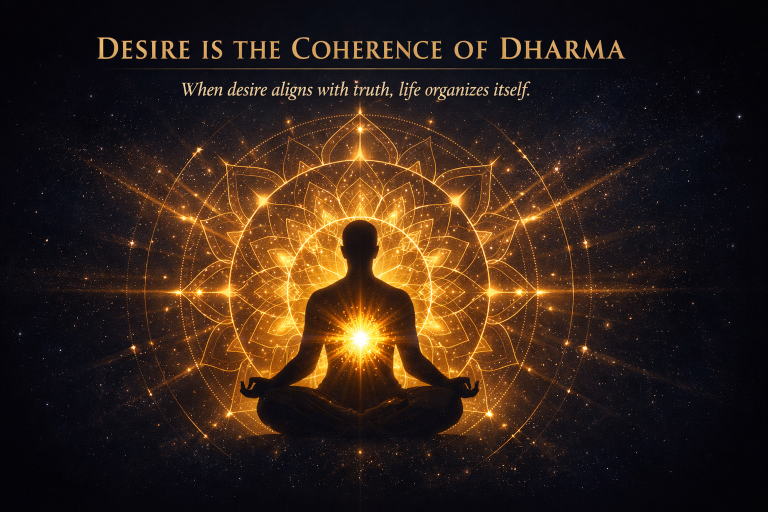
For centuries, spiritual teachings have warned humanity about desire.
Desire is blamed for suffering.
Desire is blamed for attachment.
Desire is blamed for the endless cycle of craving and disappointment.
But this interpretation is incomplete.
Desire is not the enemy of Dharma.
In fact, desire is the coherence of Dharma—when it is aligned with truth.
The problem is not desire itself.
The problem is misaligned desire.
To understand this, we must look deeper into how Dharma and desire interact within human consciousness.
What Is Dharma?
Dharma is often translated as duty, cosmic order, or life purpose.
But Dharma is more subtle than a simple role or responsibility.
Dharma is the intrinsic intelligence that guides your life toward coherence with the universe.
It is the natural expression of your design.
Just as:
-
The sun shines
-
The river flows
-
The seed becomes a tree
Your Dharma is the natural movement of your being toward its fullest expression.
When you are aligned with Dharma, life begins to feel:
-
Effortless yet purposeful
-
Challenging yet meaningful
-
Dynamic yet deeply stable
But how do you know when you are aligned with Dharma?
This is where desire becomes important.
Desire: The Inner Compass
True desire is not random.
It is the signal of your Dharma attempting to express itself.
When Dharma begins to move within you, it manifests as:
-
Curiosity
-
Passion
-
Attraction toward certain paths
-
The urge to create, build, teach, or serve
This is not superficial craving.
This is Dharma whispering through the language of desire.
In Sanskrit philosophy, the four pillars of life are:
-
Dharma – alignment with truth
-
Artha – material stability and resources
-
Kama – desire and fulfillment
-
Moksha – liberation
Notice something important.
Kama (desire) is not outside Dharma.
It is part of the structure of life.
When Kama flows within Dharma, it creates harmony.
When Kama detaches from Dharma, it creates suffering.
Misaligned Desire
Most people are not suffering because they desire too much.
They are suffering because they desire without alignment.
Misaligned desire often manifests as:
-
Seeking validation instead of contribution
-
Seeking status instead of mastery
-
Seeking stimulation instead of meaning
-
Seeking comfort instead of growth
This type of desire is unstable.
It constantly changes direction.
It produces temporary pleasure but long-term emptiness.
The nervous system feels restless because the soul knows something is off.
You may achieve things—but they don’t feel fulfilling.
Why?
Because the desire was not coherent with Dharma.
Aligned Desire
Aligned desire feels different.
It carries a sense of inevitability.
It feels like something inside you must be expressed.
It may be:
-
Teaching wisdom
-
Creating art
-
Building communities
-
Healing people
-
Exploring knowledge
-
Raising children consciously
-
Protecting the environment
-
Building systems that uplift society
Aligned desire often requires effort.
But it does not feel draining.
It feels energizing.
Because the energy fueling it is life itself.
This is Dharma expressing itself through desire.
The Physics of Inner Coherence
Think of Dharma as the organizing principle of your life.
Think of desire as the force that moves you toward that organization.
When these two are coherent, something powerful happens.
Your life begins to stabilize.
Decisions become clearer.
Energy becomes focused.
Opportunities appear more frequently.
This happens because inner coherence produces outer coherence.
Just as a laser becomes powerful when light waves align in phase, a human life becomes powerful when desire aligns with Dharma.
Scattered desire produces chaos.
Aligned desire produces impact.
The Manipura Chakra and the Fire of Desire
In yogic physiology, desire and willpower are deeply connected to the Manipura Chakra, the energy center located at the navel.
Manipura governs:
-
Willpower
-
Identity
-
Direction
-
Transformation
-
Personal power
The ancient texts describe this chakra as having ten petals, each representing emotional forces that influence human behavior.
Among them are:
-
Fear
-
Jealousy
-
Anxiety
-
Greed
-
Shame
-
Anger
-
Desire
These emotions are not enemies.
They are raw energy waiting to be refined.
When the fire of Manipura is unconscious, desire becomes:
-
Greed
-
Control
-
Compulsion
But when the fire is purified through awareness and discipline, desire transforms into:
-
Vision
-
Courage
-
Leadership
-
Purpose
This transformation is the journey from Tṛṣṇā (craving) to Icchā Shakti (sacred will).
The Difference Between Craving and Dharma-Driven Desire
Craving is restless.
Dharma-driven desire is calm and focused.
Craving asks:
“What can I take?”
Dharma asks:
“What am I here to build?”
Craving depends on comparison.
Dharma emerges from authenticity.
Craving seeks approval.
Dharma seeks alignment.
One drains life.
The other expands it.
Why Many Spiritual Paths Misunderstand Desire
Some spiritual traditions attempt to eliminate desire completely.
This often leads to confusion.
If desire disappears entirely, so does:
-
Creativity
-
Innovation
-
Exploration
-
Love
-
Expansion
Even enlightenment itself begins as a desire.
A desire to know truth.
A desire to transcend illusion.
What the sages actually taught was not the destruction of desire—but the purification of desire.
When desire becomes coherent with Dharma, it becomes sacred.
Desire as a Signal From the Future
One of the most fascinating aspects of desire is that it often points toward a future version of yourself.
You feel drawn toward things you are not yet fully capable of.
You feel called to roles you have not yet grown into.
This is not arrogance.
This is evolution.
Your Dharma often appears first as a vision that feels bigger than your current identity.
Desire becomes the bridge between who you are and who you are becoming.
Without desire, evolution would stop.
The Courage to Trust Your Desire
One of the greatest challenges in life is learning to trust the desires that arise from your deepest truth.
Society often pressures people to follow safe paths.
But Dharma rarely feels safe.
It feels meaningful.
It feels challenging.
It feels alive.
To follow Dharma, you must learn to distinguish between:
-
The desires that distract you
-
The desires that define you
One is noise.
The other is destiny.
When Desire and Dharma Become One
When desire becomes coherent with Dharma, life enters a new phase.
Your work becomes service.
Your growth becomes contribution.
Your ambition becomes responsibility.
You are no longer chasing success.
You are expressing truth.
At this point, something beautiful happens.
Desire stops feeling like a struggle.
It becomes a current carrying you forward.
And the life you build begins to feel less like something you are forcing—
and more like something you were always meant to become.
Desire is not the enemy of the spiritual path.
Unconscious desire is.
When purified by awareness, discipline, and Dharma, desire becomes the force that organizes a life of meaning, impact, and truth.
Desire is not chaos.
Desire is the coherence of Dharma.