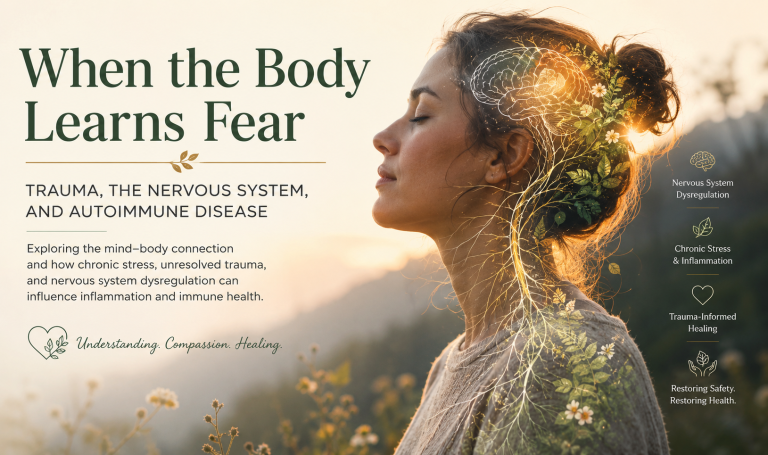
For many years, autoimmune disease was viewed almost entirely through the lens of genetics, pathogens, or isolated immune dysfunction. The immune system was believed to malfunction randomly, mistakenly attacking healthy tissue as though it were foreign.
But modern research is revealing something far more complex, intimate, and deeply human.
An autoimmune condition is not always simply “the body attacking itself.”
In many cases, it may reflect a nervous system that has lived in survival mode for so long that the body no longer remembers what true safety feels like.
The immune system does not operate independently. It constantly communicates with the brain, endocrine system, emotions, memories, environment, and autonomic nervous system. The body is not a collection of separate systems—it is a living conversation.
And when the nervous system becomes chronically conditioned toward danger, the immune system can begin responding to life itself as though it were a threat.
The Biology of Survival
Human beings evolved to survive acute danger.
When a threat appears, the nervous system activates a survival response:
- Heart rate increases
- Stress hormones rise
- Inflammation temporarily increases
- Digestion slows
- Muscles tense
- Attention narrows
- The immune system shifts into defensive mode
In short bursts, this response is intelligent and lifesaving.
The problem begins when the body never fully exits survival mode.
Many people spend years—sometimes decades—living in environments where they do not feel emotionally safe enough to fully relax, express themselves honestly, establish boundaries, or rest deeply.
This may come from:
- Childhood emotional neglect
- Chronic criticism
- Unpredictable parenting
- Trauma
- Relational instability
- Suppressed grief
- Toxic workplaces
- Long-term caregiving stress
- Emotional invalidation
- Hyper-responsibility
- Chronic fear or uncertainty
Over time, the nervous system adapts to this environment.
The body becomes vigilant.
The brain begins scanning constantly for danger.
The stress response becomes baseline physiology.
What was once temporary becomes chronic.
Psychoneuroimmunology: The Conversation Between Mind, Brain, and Immunity
The field of Psychoneuroimmunology explores how psychological experiences influence immune function through the nervous and endocrine systems.
This field has demonstrated that emotional stress is not merely “mental.”
It creates measurable biological changes throughout the body.
Chronic stress can influence:
- Cytokine production
- Inflammatory signaling
- Cortisol rhythms
- Gut permeability
- Immune cell behavior
- Vagal tone
- Sleep quality
- Hormonal regulation
- Mitochondrial function
The nervous system and immune system are in constant communication.
Immune cells possess receptors for stress hormones.
The brain monitors inflammatory signals from the body.
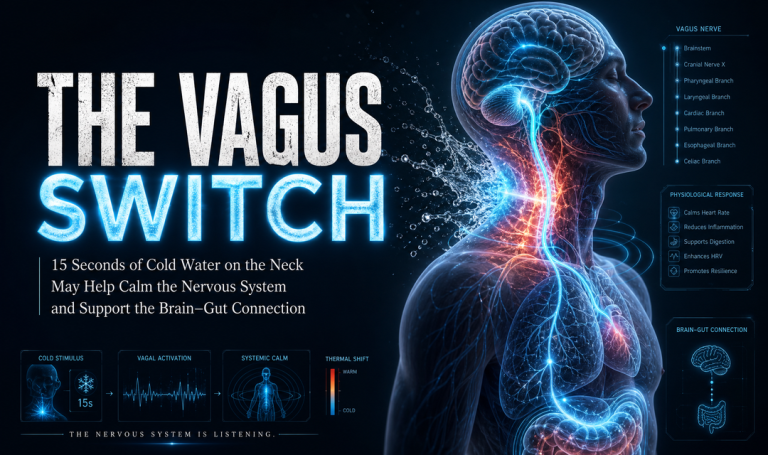
The vagus nerve acts like a bidirectional communication highway between emotional states and physiological regulation.
The body listens to experience.
And it remembers.
When Hypervigilance Becomes Biology
A traumatized nervous system often remains prepared for danger even when no immediate threat exists.
This state is called hypervigilance.
Hypervigilance is not simply “anxiety.”
It is a biological adaptation.
The body begins expecting:
- Rejection
- Criticism
- Conflict
- Abandonment
- Instability
- Emotional unpredictability
This expectation shapes physiology.
The autonomic nervous system may become locked into sympathetic dominance:
- Elevated stress hormones
- Increased inflammation
- Shallow breathing
- Muscle tension
- Reduced digestion and repair
- Altered immune signaling
Eventually, the stress-response system itself may become dysregulated.
Cortisol, one of the body’s primary stress hormones, can become chronically elevated—or paradoxically depleted after long-term stress exhaustion.
When cortisol signaling becomes dysfunctional, inflammatory processes may lose proper regulation.
The immune system becomes confused.
Protection begins to lose precision.
The Immune System and the Experience of Threat
The immune system is fundamentally a threat-detection system.
Its job is to distinguish:
- Self from non-self
- Safe from dangerous
- Harmful from harmless
But chronic nervous system activation changes the body’s internal environment.
Persistent stress chemistry can create:
- Ongoing inflammatory signaling
- Increased cytokine activity
- Altered T-cell behavior
- Gut microbiome disruption
- Heightened immune sensitivity
In trauma-informed medicine, researchers increasingly recognize that unresolved emotional stress may contribute to chronic inflammatory states that influence autoimmune vulnerability.
This does not mean autoimmune disease is “imaginary,” “all in the mind,” or caused by weakness.
Far from it.
Autoimmune conditions are profoundly real physiological illnesses involving genetics, environmental triggers, infections, immune regulation, metabolism, and complex biological pathways.
But emotional experience and nervous system regulation are also biological realities.
The body does not separate emotional pain from physical physiology as neatly as modern culture often does.
The Role of Suppression
Many individuals with chronic autoimmune conditions describe a lifelong pattern of suppression:
- Suppressing anger
- Suppressing grief
- Suppressing needs
- Suppressing exhaustion
- Suppressing authenticity
- Suppressing emotional truth
The body may comply externally while internally remaining under tension.
The nervous system learns:
“It is not safe to fully feel.”
“It is not safe to fully express.”
“It is not safe to fully relax.”
Over years, this internal contraction can become embodied physiology.
Muscles remain tight.
Breathing remains shallow.
Inflammation remains elevated.
Recovery becomes incomplete.
The body continues preparing for a danger that may no longer exist externally—but still exists neurologically.
Trauma Lives in Physiology
Trauma is not defined only by what happened.
Trauma is also what the nervous system was unable to process, complete, or safely integrate.
Two people may experience the same event very differently depending on:
- Emotional support
- Safety
- Attachment
- Resilience
- Nervous system capacity
- Environment afterward
When stress responses cannot fully resolve, survival energy can remain trapped in the body.
The autonomic nervous system may continue cycling through:
- Fight
- Flight
- Freeze
- Collapse
- Fawn responses
This affects:
- Immune signaling
- Hormonal rhythms
- Sleep
- Digestion
- Pain sensitivity
- Inflammation
- Tissue repair
The body begins organizing itself around protection rather than restoration.
The Gut, Inflammation, and Emotional Safety
One of the clearest intersections between trauma and immunity exists within the gut.
The gut and brain communicate continuously through:
- The vagus nerve
- Neurotransmitters
- Immune signaling
- The microbiome
Chronic stress can alter gut permeability (“leaky gut”), microbiome diversity, and inflammatory pathways.
Interestingly, many autoimmune diseases also involve gut dysfunction.
This is not accidental.
The digestive system is deeply connected to the parasympathetic nervous system—the branch associated with rest, repair, digestion, and healing.
A body that never feels safe enough to rest may struggle to heal efficiently.
Safety is physiological medicine.
Healing Is Not Just About Suppressing Symptoms
Modern medicine provides lifesaving interventions for autoimmune conditions, including:
- Immunomodulators
- Anti-inflammatory therapies
- Biologic medications
- Nutritional interventions
- Hormonal support
- Functional medicine approaches
These treatments are often essential.
But many people discover that true healing also requires addressing the nervous system itself.
Not because illness is psychological.
But because physiology and psychology are inseparable.
Trauma-informed healing approaches increasingly include:
- Nervous system regulation
- Breathwork
- Somatic therapies
- Meditation
- Trauma therapy
- Safe relationships
- Emotional processing
- Sleep restoration
- Mind-body practices
- Vagal nerve support
- Gentle movement practices
- Community and connection
Healing often begins when the body experiences something unfamiliar:
Safety.
The Biology of Being Seen
Human beings regulate through connection.
Research in attachment science and interpersonal neurobiology shows that emotional safety changes physiology.
A regulated nervous system can help regulate another nervous system.
Being deeply heard, emotionally safe, accepted, and supported influences:
- Heart rate variability
- Cortisol levels
- Inflammatory markers
- Oxytocin production
- Parasympathetic activation
Love is not merely poetic.
Connection is biochemical.
The body heals differently when it no longer feels alone in survival.
The Future of Medicine
The future of health care will likely become increasingly integrative.
Not merely asking:
“What disease does this person have?”
But also:
“What has this nervous system lived through?”
“What adaptations kept this person alive?”
“What patterns became embodied?”
“What does this body still believe it must protect against?”
This does not replace immunology, genetics, or medicine.
It deepens them.
Because the human body is not a machine disconnected from experience.
It is a living archive of memory, stress, emotion, adaptation, biology, and consciousness woven together.
Returning the Body to Safety
Perhaps one of the deepest forms of healing is teaching the body that survival is no longer the only option.
That it can:
- Rest without fear
- Feel without collapse
- Express without punishment
- Receive without vigilance
- Connect without danger
For many people, this process takes time.
Years of survival conditioning cannot always unwind quickly.
But the nervous system is plastic.
The body can relearn safety.
Inflammation can change.
Stress physiology can soften.
Immune balance can improve.
Healing is rarely linear.
Yet every moment of genuine safety, regulation, presence, breath, and connection sends a new signal through the body:
“You are no longer at war.”
And sometimes, that is where healing truly begins.